Adoptees Are Not Gifts and Possessions – An Adoptee’s Perspective

“All children are a gift from God,” – Says the world. 

I believe this is part of the reason our adoptive parents refer to us as gifts; however, to refer to each adopted individual as a gift would insinuate that children are owned by someone who then bestows the gift upon a receiver and that this person is now the owner of the property being gifted. 

I think people likely mean well; however, sometimes, they don’t understand the layers and depths of their words when explaining and exploring the different dynamics of the adoption and adoptee experience. Sometimes people can say things that are well intended, but the reality is that they can be hurtful to adoptees. On the other hand, sometimes, a little enlightenment on a topic can go a long way.

Let me get straight to the point. Children are free individuals, and no one possesses them in a way that they would be in a position to “give one” to someone else as a gift. Being your parent’s responsibility is entirely different from being their property. 

Having my own experience with adoption and hearing the experiences of my fellow adoptees for over a decade, many of us feel as if we are referred to as a monetary possession when hearing from our adoptive parents and others. This comes off as a reflection of “ownership” to many of us. 

However, when most of us are paid for with a cash price, is when the reality of our feelings gets magnified even more considerably. Not to mention the lifelong reminders we get from those around us and the families we grow up in. 

The feelings of being referred to as a gift imply ownership, entitlement, and possession are many ways adopted people feel in our experiences with our adoptive parents and others. I now consider this line of thinking linked to adoptive parent parental narcissism.

Nevertheless, as if feeling this was not enough, many adoptees are expected to celebrate “Gotcha Day” or “Adoption Day” and referred to as a “Gift” as if the loss we experience before we are adopted does not count for anything. I will be writing about this soon. 

We are expected to feel thankful and grateful that our adoptive parents took us in when our biological families did not want us. Assuming that an adopted child or adult should be more grateful and thankful than a biological child can be an epic failure in acknowledging and recognizing what that person had to experience to be adopted, to begin with. Expecting us to be more thankful or grateful than another person on earth is an unrealistic expectation placed on us. 

Our biological connections matter to us and presuming that their loss doesn’t exist causes tremendous grief and pain for the adopted person, on top of the loss we already experience, and it’s not helpful. 

Unfortunately, society at large and most of our adoptive parents have not left room for us to share our feelings because they assume we should be thankful and grateful. While many adoptees have not come to a place of sharing their true feelings, many of us are blazing the trailways and sharing how adoption has impacted us and made us feel. 

I remember as a teen, I would have new friends or a new boyfriend, and my adoptive mom would suddenly act as if she had new friends and a new boyfriend. She would ask questions and want me to tell her everything about them and my life. She rarely had friends of her own, and she never had a boyfriend as she and my adoptive dad divorced when I was one year old. She did not have her own life and lived through me and mine. 

I would constantly tell my adoptive mom to “Stay out of my business” when it seemed like she was constantly overstepping. Being a teenager, I thought she was just a nosey parent; however, when this carried over into my adult life is when I knew something was not right. 

One of the phrases I heard throughout my childhood and adult life from my adoptive mom was, “Your life is my life, and everything that has to do with you is my business!” Anytime she would say this to me, it would strike a chord profoundly. Unfortunately, I had no healthy examples in my life of what a mother and daughter were supposed to be like, so I grew up thinking this was normal. 

As I grew into my teen and adult years, I would still hear, “Your life is my life, and everything that has to do with you is my business.” 

In my childhood, I also remember hearing “you were my greatest gift,” like a broken record about my biological mother giving me up for adoption and my adoptive mom sharing her elated feelings about this decision. Ultimately, my birth mother chose not to parent, which allowed my adoptive mom’s dreams to come true to be a mother. 

But, while she celebrated, I suffered in silence as many adoptees do. As soon as her feelings of happiness came into the conversation, there was no room for my sadness about this woman who was gone, to whom I was very much connected. So while I believe she had no idea how damaging this would be, I am here to share that it was indeed damaging.

An adopted person is usually paid for with a cash price, so our sentiments being referred to as a gift will likely be different than a biological child or a child that wasn’t paid for with monetary value. It makes us feel like a monetary possession. Yet, too often than not, we’re expected to be glad that someone on this earth cared enough about us that they created GoFundMe and received loans from family and friends to purchase us as if that wouldn’t impact us at some point in life. 

I completed a poll on the How Does it Feel to Be Adopted? Page in 2015 asking adoptees if they were okay with being referred to as a gift. I had 378 adopted people respond, with 88% saying that “NO” they aren’t okay with being referred to as a gift. Can we consider this when we speak about adopted children and adults moving forward? 

I would like to think that it counts for something significant that 88% of adoptees are not okay with being referred to as a gift, which implies ownership of a whole human being. Can we at least be sensitive that this is a problem and have the willingness to consider changing our language in adoption?

When I think of the children I brought into the world, they are my children, but they are also their own individual people. While I didn’t pay for them with a $45,000.00 cash price, I still do not refer to them as a gift because of the weight of ownership this implies. 

One of the most amazing things I have received was from a friend, Frank Ligtvoet. He shared the song “On Children” by Sweet Honey In The Rock, and I wanted to share it. I think this song is powerful in so many ways. I would like to think it could be applied to the lives of those who wish to accept, acknowledge and appreciate that none of us own our kids. They are sons and daughters of the universe and the world itself. Adopted or not, this is a powerful reminder that no one has ownership over another, and no human being is a GIFT of monetary possession. Can we acknowledge that things ring differently for adopted people? Even with well-intended circumstances, adopted people are not okay with feeling like they are possessions and gifts. 

It’s time our language and thoughts match up with this reality. 

Take a listen below!

For my fellow adoptees, have you been referred to as a gift or felt as if you were a possession? If so, how did that make you feel?

Thanks for reading and listening!

Pamela A. Karanova

Facebook: Pamela A. Karanova

Don’t forget that I’m streaming my articles on several audio platforms for your listening convenience! 👇🏼

📱 iTunes – https://apple.co/3tKzT5f

🌎 Google – https://bit.ly/3JP6NY0

🎧 Spotify – https://spoti.fi/3Ny6h35

📦 Amazon – https://amzn.to/3JScoga

☕️– Buy Me A Coffee https://bit.ly/3uBD8eI
*The views and opinions expressed in this article and podcast are that of the author, Pamela A. Karanova. Reproduction of the material contained in this publication may be made only with the written permission of Pamela A. Karanova

Adoptees, Why Did Your Adoptive Parents Adopt You?  

I write about the difficult dynamics in adoption, the ones no one wants to talk about. As I have emerged from the fog of adoption, I’ve learned that not all adoptees are adopted for the reasons most people think they are. So what was the reason your adoptive parents adopted you? What were you told, and did it align with the truth?

Society paints a picture that adoptees are taken in when their biological families don’t want them. Their adoptive parents have taken on this responsibility to parent another person’s child to provide a safe and loving home for the child. The adoptive parents are then seen as heroes and often take on the superior attitude of saving an unwanted child from a life of despair. White savior complex sits front and center on many occasions regarding adoptions today. There is an underbelly to these false realities.

However, this is the opposite contrast of what many adoptees feel while we navigate life on the other side of the coin. For many of us, over years of our lives, we learn the truth about why we were adopted, and it opens up a level of understanding for each of us. We’re told we were chosen, and most of the time, we believe it. It’s a cushion to soften the blow of the realities about adoption. The chosen baby theory makes people feel better, even when it’s not true.

I am here to share the truth that most of the time, when a baby is adopted, the reasons they were separated from their biological mothers isn’t usually a pretty story. We must share this reality to stop setting adoptees up for the life-altering disappointment when they discover the truth. The separation trauma is traumatic enough, and we don’t have to add more lies and secrecy to it by using the chosen baby theory. I will be writing more about the chosen baby theory soon.

It’s rare for someone to choose to take on the responsibility of parenting another person’s child, with it being the first option. People generally want to have their own biological children FIRST, before adoption is ever spoken of. This means adoption is likely the LAST option vs. the chosen one. If you think your adoptive parent’s hand-picked you out of a line of babies, I can guarantee you this is a false narrative spun by the adoption industry. It’s part of the propaganda they sell to dress adoption up and hide what it truthfully is. The truth is, they took the next baby in line.

My adoptive mom was infertile. She couldn’t have kids of her own. So instead of healing from this significant loss and accepting those were the cards she was dealt, she adopted! I carried the load of her struggles with infertility my entire life. Somehow I remember saying “I’m sorry, I’m sorry” more than anything. She never healed from the divorce or her infertility struggles. I was the prime target of her emotional and mental outbursts and my adopted sister. Our adoptive father divorced her, left us, and moved away even when he knew she couldn’t take care of us. It was no secret that she was mentally ill. From an early age, I was her caretaker. I rubbed her back, put lotion all over her body, cleaned her room, changed her bedding. I ran her bath water, brushed her hair, cut coupons for her, cleaned the whole house, and the list could go on.

I started to learn in my early teens that my adoptive mother had a fear of going to a nursing home in her older age. She talked about this in my childhood many times, and by my teen years, it was very apparent to me that she had significant issues with going to a nursing home. As I started to connect the dots on this, and I experienced a life of hell in this home, it is evident that she adopted 1. Because she couldn’t have offspring of her own. 2. She didn’t want to go to a nursing home in her old days. These reasons are far-fetched from wanting to provide a loving and caring home to a child in need.

Another highlight about this reality is that our relationship was very strained my whole life, especially as I grew into my adulthood. She tried to convince me to be her power of attorney when I was 38 years old. When I was 38 years old, I was the single parent of a new 18-year-old high school graduate. I also had twins that were in 9th grade. I had my hands full to take on this responsibility, and I declined. If we had a healthy relationship and if she wasn’t abusive my whole life, I might have considered it. However, she went straight for my fresh out of high school 18-year-old daughter when I declined.

My daughter was barely out of high school, yet when she asked her and pursued her to be her POA. She was applying to colleges and ready to start her life as an adult. So why would she want to dig her claws in my daughter in this way? Because her plan with me backfired. I cared for her and catered to her my entire life until I finally broke free in 2005. I packed up a UHaul, all my belongings, my kids and moved across the country to escape her. It was the hardest thing I ever did because when you are adopted, you then step into a space of having no family and, in this case, no mother. I didn’t have one anyway, but we started our life over. I had no place to live, no job, no money, no car, and no keys TO ANYTHING.

I did this not only for my kids to have a better life but also for myself. So I could start the healing process from all my adoption experience has caused. I have come to life little by little, and today I’m thriving. However, this doesn’t mean that I haven’t been hurt by the reality of why my adoptive mom adopted me, to begin with. I see right through her intentions. It would be easier to believe the fairytale narrative; however, my life’s experiences won’t allow me to believe this.

I am not saying that some adoptees aren’t adopted for pure reasons, but I know I am not the only one who has figured out I was adopted to fill the void a biological child would have brought to my adoptive mom and her adopting for her wants and needs. It’s almost like I feel like a pawn in a game I never agreed to play. Unfortunately, because of this and all the abuse and lies she inflicted on me my entire life, we were estranged for several years before she passed away.

I’m curious about the experiences of my fellow adoptees? Do you feel like your adoptive parents adopted for “the right reasons?” whatever that looks like to you? Or do you feel there was another reason or even several? How has this made you feel?

Don’t forget this article along with all my other articles are available in audio for your convenience, just look up Pamela A. Karanova Podcast on Google PodcastsiTunes , Spotify. and Amazon Music.

Interested in treating me with a coffee, to add fuel to my fire? Click here. 

Many thanks in advance to my supporters!

Thanks for reading and listening,

Love, Love.

*The views and opinions expressed in this article and podcast are that of the author, Pamela A. Karanova. Reproduction of the material contained in this publication may be made only with the written permission of Pamela A. Karanova.

The Raw Resentment I Have Carried for Most Adoptive Parents and What Changed – An Adoptees Perspective

Yep, I’m going there. I write about the difficult dynamics in adoption, the ones no one wants to talk about.

But before I do, I’m not here to throw my adoptive parents under the bus for what they did or didn’t do wrong. At this point, that’s water under the bridge for me.

I’ve said for many years that Adoptive Parents aren’t my gift. They aren’t in my arena of life, and I have purposely set things up to keep most of them out of my space for mental health and self-care reasons.

I seem to clash with them, and I have carried great fury toward them over the years. Adoptive parents have been the hardest for me to manage out of all the people in the adoption constellation.

Why?

My experiences with most adoptive parents have been primarily online, and they haven’t been positive experiences. 99.9% of the time, they don’t have the willingness to want to learn or listen to what adoption feels like from an adult adoptee’s perspective. Online I’ve found them to be damaging, dismissive and emotionally abusive.

Anytime I have tried to share, they end up making it about them and why they adopted, to begin with, their infertility issues, and all they have sacrificed to adopt the child they have. So it’s always about them, and this saddens me.

If I’m being transparent, it MADDENS ME.

They don’t have to listen to me for me, but I think of all their adopted kids who could experience the pain I once did and that so many adoptees experience growing up. Unfortunately, the adoption agencies, adoption attorneys, and adoption officials aren’t telling them the truth. So if there were any way I could help the adoptive parents understand the adoptee’s experience more profoundly, I would be happy to do that when time permits.

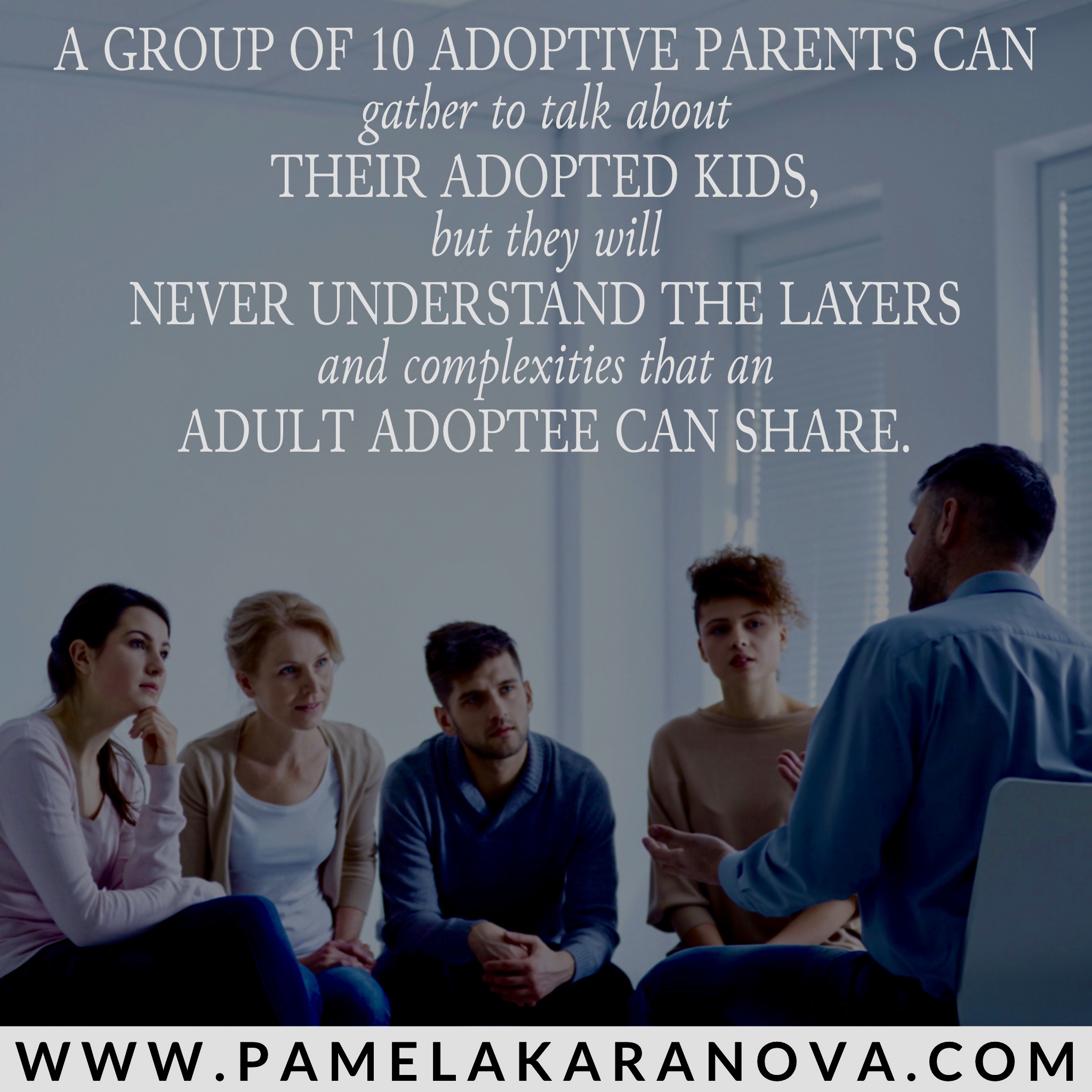
I believe adopted adults hold the keys to understanding all the heartache and heartbreak adoptees experience after separation from their biological mother. We also understand life as the adoptee experience. A group of 10 adoptive parents can gather to talk about their adopted kids, but they will never understand the layers and complexities that an adult adoptee can share. We understand the grief, loss, and trauma because we’ve sat in it. We live it each day.

I need to be transparent. My motivation is more for the adoptee because they are the community I pour my heart and soul into. So with that, if networking with the adoptive parents will bring some healing and clarity, I will try, but only if they are willing to listen and learn.

I learned a hard lesson in 2015, about five years after coming out of the fog. When adoptive parents didn’t want to receive the message, I would insert my views, experiences, and words into conversations with adoptive parents online. Then, they would shut me down and silence me, and I would become worked up. I can’t even begin to describe the anguish and emotional triggering I put myself through because interactions online like this happened repeatedly. It seems easy, but it was excruciating when I put myself in these situations!

Until one day, I woke up. Then, I realized I had the power to excuse these frustrating interactions from my life altogether. I learned that the only way my message would be received was if the person was willing to receive the message I wanted to share! Wow, this was a game-changer for me. But, to be completely honest, this isn’t only in the adoption arena.

This is with every area of life.

Once I learned that a small number of adoptive parents wanted to hear from the adult adoptee’s perspective to understand their adoptive child better, things started to shift for me. The small number of adoptive parents I have had significant positive interactions with have given me the hope that some adoptive parents out there have the willingness in them to listen and learn. They genuinely want to try. Thank you for your willingness. I’m sure there are plenty of adoptive parents who want to listen and learn, I just haven’t met them. I actually wrote an article about this one time in 2014 called, Just Listen, That is All.

I realized I was selling myself short when communicating and speaking to adoptive parents. However, the small number of interactions I have had, mostly in real life, have been positive, meaningful, and life-changing. In addition, I have had 1 to 2 positive experiences online with adoptive parents who have reached out to me about advice that have been positive interactions.

While the positive experiences are far and few between, I have chosen to put my mental health first and no longer insert my opinion or experience to adoptive parents online unless they seek me out first. When they come with open hearts and minds, I will consider engaging. I wrote an article about this one time.

When Adoptive Parents Have the Willingness to Listen,

With this, I have been able to shift little by little regarding my feelings towards adoptive parents, and because of these positive experiences, I hope things are changing for the better, but we still have a long way to go. So today, I set boundaries and refuse to allow much of my time dedicated to APs because it takes time away from my commitment to adoptees. Wasting time with anyone who doesn’t have the willingness to listen and learn is something I will no longer do. So, I took my power back. If this article resonates with you, I encourage you to do the same.

If you are an adoptive parent, do you have the willingness to have hard, yet truthful conversations with adult adoptees? Do you feel they hold a special value to the adoptee experience? If you have had conversations with adult adoptees, what has that experience been like for you?

If you are an adoptee reading this, what has your experience been like with communicating with adoptive parents? Have you had mainly positive experiences, or have they been similar to mine?

Why do you think adoptive parents are so triggering to many adoptees? If they have been triggering to you, as they have me, is there been anything that helps you navigate these experiences?

Don’t forget this article along with all my other articles are available in audio for your convenience, just look up Pamela A. Karanova Podcast on Google Podcasts, iTunes , Spotify. and Amazon Music. Interested in treating me with a coffee, to add fuel to my fire? Click here. Many thanks in advance to my supporters!

Thanks for reading,

Love, Love.

*The views and opinions expressed in this article are that of the author, Pamela A. Karanova. Reproduction of the material contained in this publication may be made only with the written permission of Pamela A. Karanova

My Birthmother was an Alcoholic but I didn’t Love her any Less…

Knowing she was suffering from alcoholism had absolutely no impact on me wanting to meet and know and love my birthmother.

Never for the life of me will I understand why an adoptive parent would share negative things with their adoptive child about their birth families? Why do they do this? From my experience in my journey and hearing other adoptees share their stories it’s almost as if the adoptive parents get some self-satisfaction about sharing some dark points about the biological families in hopes to create a wedge or a negative feelings from the adoptee about their birth families. I find this appalling.
Our birth families are who we are. They are a big part of us and no one can say or do anything to change that. I hear over and over, “But she was addicted to drugs, and she was a prostitute, or she was an alcoholic.” Those things don’t make her our mother any less. I know some adoptees may feel different but for me, I never had a chance to know the woman that gave me life. But after finding her and being reunited with her one time I learned a lot about her. I wish I was given more time to get to know her. I learned from those around and of course my adoptive mom loved to throw it in my face that she was an alcoholic. She would mention this because I was a drinker for 25 years of my life. I drank to escape the pain and heartbreak of my birth mother giving me away. My adopted mom said “You act like she would have given you a better life”.
You know, I really resent that statement to a major degree. Let’s see. Would I have rather had my REAL mother who was an alcoholic OR a FAKE mother that was addicted to prescription pain pills and depressed who battled mental illness my whole life. For me the answer to that is simple. I WOULD HAVE RATHER HAD MY REAL MOTHER! At least she would have been my REAL mother, not some stranger that wanted me for her own selfish reasons. Families have dysfunctions, and families have issues. I fully understand this. But when my adopted mother started speaking negatively about my birth mother it only drew me further away from her. It felt like I had to choose a side. And in the end I was left with nothing. Because it just so happened my birth mother didn’t want me in her life. I struggle with this adoptee battle daily!
I’ve learned to accept these things but it hasn’t been easy. I would like to share that any time an adoptive parent speaks negatively about a birth family member of the child they are raising they are speaking negatively about the child. This has a reflection of the adoptee thinking badly about oneself and starting to feel as if something is wrong with them. Why would any parent want that for their child? If there are traumatic events that happened and they are the reason why the child was separated from their original family there is no reason the child needs to hear that in a demeaning way. They can hear the truth at age appropriate times, but what about speaking love about the first family? Telling that child it’s okay to cry, and grieve because of those reasons. Instead of speaking badly about their very own roots.
It’s not what you say it’s how you say it. Let me make this clear, it was only my adoptive mother that spoke negatively. My adoptive father never said a negative word about anyone. He never talked about it ever.
I will just say I commend all the adoptive parents who have nothing but love for their adoptive child’s first family and don’t speak badly about them or talk down on them. I know there are many out there that don’t do this. For those that do, or for those that are raising adoptive children. I plead with you to please not speak negatively about your child’s first family. This can and will have lasting long term side effects that will damage the child’s inner being and make them feel terrible about themselves. It will not make them feel more grateful they were adopted if those are your intentions. It will only confuse them more.  Take it from an adoptee that’s experience this.


Thanks for reading.