. For over a decade now, I’ve witnessed some very significant walls that are in place between individuals in the adoption constellation that have blocked the truth from coming to light.
My new column is dedicated to breaking these walls (barriers) down so everyone in the adoption constellation has a more well-rounded perspective on how it feels to be adopted from the adult adoptee’s perspective.
After spending over a decade in adoptee spaces, I’ve been able to gain valuable insight from healing in my own personal journey but also walking with my fellow adoptees out of the darkness into the light when it comes to our experiences being adopted.
My new Substack Newsletter “The Real Adoptea Moxie” recently launched. I’m opening my “Ask Me Anything” Column to answer questions from anyone who would like more insight into the adoptee experience. Maybe you are married to an adoptee or an adoptive parent seeking clarity or suggestions? Maybe you are an adoptee dealing with a significant struggle? Maybe your best friend is an adoptee?
I genuinely feel adult adoptees hold the keys to wisdom, knowledge, and understanding that are essential for understanding when it comes to adoption. Because of this, I’m incredibly excited to launch “ASK ME ANYTHING” on my platform for all subscribers.
My “Ask Me Anything” newsletter — will answer adoptee-related questions from subscribers.
Think: What adoptee healing tools have been the most valuable to you? How have you navigated the grief and loss process? What made you want to search for your biological family? How was your reunion once you searched? Do you regret searching? How do I talk to my adoptive parents? Why is my adopted daughter so angry with me?
If you are reading this, I invite you to be a part. You can ask anonymously or use your first name.
To submit a “Ask Me Anything” question, please email it to: pamelakaranova@gmail.com
The Real Adoptea Moxie is a reader-supported publication. To receive new posts and support my work, consider subscribing by clicking the link below! Thanks for your support!
Together, we’re bringing the truth to light one article at a time.
The Essence of My Biological Parents and My Adoptive Parents Being Deceased – An Adoptees Perspective by Pamela A. Karanova
For years now, I have had strained or missing relationships with all of my adoptive parents and my biological parents. But, in the last twelve years, they have all passed away one by one—four people with whom I had four unusual or missing relationships.
Two of them passed away in the last six months.
As a result, my obsession with trolling for obituaries on Google has concluded. I won’t miss it because, like closed adoption, it’s torture and agonizing.
How would you feel if the only way you might learn of your parent’s or family members passing was by conducting Google searches weekly or sometimes daily looking for obituaries? What if this went on for years or even a lifetime?
How many of my fellow adoptees have found themselves doing this?
How does it make you feel?
I always knew this day would come when my biological parents and adoptive parents, aka my parents on paper, would all be gone. Thankfully, I did gain notification of each of the deaths by way of social media or direct contact but that doesn’t change the reality that Google has been my #1 search engine in hopes of learning about the deaths of all of my parents.
But unfortunately, I recently learned my adoptive dad passed away on 1/3/23, and I struggle to find the emotions I should have about his passing. We hadn’t communicated in several years. The sadness I feel doesn’t feel new, I have felt this loss every day. Yet, I haven’t shared his passing with anyone but very few people. So let me also share that my biological father also passed away a little less than six months ago on 6/21/22. I still have yet to scratch the surface on processing his passing away. I have enormous feelings about the obituaries for each of these people, but I will save them for another article.
One of these men took a small part in raising me, and the other took every part in creating me. Equally, from the world’s description, they should have been my fathers, but the description of strangers is more true-to-life.
So how do I have a chance at two fathers yet feel like they are essential strangers? Welcome to the torture of adoption, the one that splits family trees apart and separates and divides. The one that creates lifelong consequential emotional and mental torment for the adopted child that grows up.
I have the same experience with both of my mothers. One took part in raising and traumatizing me; the other took part in creating me and her choice for my life and being separated from her traumatized me at the very beginning of my life.
I describe my adoptive parents as my parents on paper or my paper parents. Here’s why. They signed the adoption paperwork, and I did not. My life was estranged from both of them before they passed away for many reasons I will not discuss in this article but what I will say is that I feel like I was forced to make a choice.
With that choice, I picked myself. Unfortunately, I have been put in a situation because of the split adoption creates where I had to make this conclusion, and I regret it enormously. Most non-adoptees don’t comprehend what I even mean.
Well, let me be frank – when I was born in the adoption paradox at no choice of my own, I have always felt this internal tug-of-war being tugged in a million different directions. It’s felt like a split in the core of my being, and then from those two splits, there are more splits and more and more, and the splits go on forever, yet I can’t fully claim any side as mine.
Some may see it as a larger-than-life, full-of-love family tree. But I see it as a tree with no growing roots, replaced by severed roots that are chopped up all over the ground and left for dead.
I am the dead roots, trying to come alive, all alone. Still, because of all the emotions and deep-rooted feelings that resurface over and over, it’s almost impossible to feel planted or to grow with all these different people and families from all over the place.
Two sets, maternal and paternal, represent a DNA connection, and the other two, my adoptive parents, represent shared history. They are equally part of me, but I am forced to keep them separate. I fucking hate it because it always feels like I’m hiding half of myself to protect the other side. I have to watch what I say, and I have to watch what I do. And I damn sure can never share MY STORY because of the fear of pissing both sides off.
I have always felt like tremendous missing links have created a wedge between all my parents and me, and I genuinely believe ADOPTION is the root cause. I have no shared history with my biological parents and no shared DNA with my adoptive aka paper parents. I have always felt ripped into a million pieces between these two worlds. I have never felt like I belong in either of them.
Because of 45+ years of trying to shake this reality off, the sooner I acknowledged my adoptee pain was here to stay, the sooner things got more manageable for me. But in this self-reflection process, I also acknowledged I had to walk away from everyone to save myself.
This is something only a very minimal number of adoptees can do. Taking the first step towards freedom took strength and courage, but it didn’t come without a cost.
It was the hardest thing I ever did.
It cost me everything to choose myself.
EVERYTHING.
But at least now I have myself, even if I feel like I am in shambles half the time.
When others lose a parent, I see people grieving, crying on social media about the loss, and having loved ones surround them with care and concern. I see meal trains and flowers delivered. I see people take off work to grieve the life-changing loss and to take suitable time to grieve the loss. I see the world have compassion for someone when they lose a parent, not to mention losing two parents in a short period.
I don’t see the same thing for adopted people, especially when we mention we had no relationship or estranged relationships with our adopters or biological parents. It’s almost as if the world shrugs its shoulders and says to itself, “Well, you didn’t know them, so what’s the big deal?” or better yet, “You chose not to have a relationship with them,” so it’s your fault. It’s a miracle if we are contacted at all.
No matter how hard we try or what we do, we’re always outsiders looking in – especially to the immediate adoptive or biological relatives because, let’s never forget, blood is always thicker than water. In my case, and many other adoptees, blood will also toss you to the wolves in the name of “Brave Love.” Even more so if you have no shared history.
In reality, the loss of these individuals hurts and hurts profoundly. However, as an adoptee, I can share that my grief for each person is not due to what was but rather what wasn’t. Every day of my life, I have cried inside at the loss of my biological mother and the loss of the woman I wished my adoptive mom was.
I have also cried inside at losing the connection with my biological father and the relationship I always wished I had with my adoptive dad. But unfortunately, these deep relationships never existed, so I have cried every day as if each of these people died daily because, essentially, I felt like they did.
But, instead of shedding external tears of sadness for what was lost with each of them, I have shed internal tears that ebb and flow as life passes me by every day of my life.
This isn’t new; it’s been a lifelong journey.
The two biological parents I sincerely spent a lifetime desiring to find, meet and get to know slammed the door in my face once located. I have yet to experience any more tremendous pain in this lifetime than the pain of this disappointment followed by grief, loss, abandonment, and rejection that will never entirely go away.
Unfortunately, the two who paid a cash price in exchange for being parents, who signed the dotted line, weren’t capable of being parents. My adoptive dad knew my adoptive mother was mentally unstable, yet he adopted two daughters and abandoned us a year later, divorced her, and left. He moved over an hour away, remarried, and raised her three sons as his own.
I get it.
He chose to save himself as I did.
I can’t tell you one lesson my adoptive dad taught me over my lifetime. He was always far away, and it impacted any relationship we might have had. I remember him saying, “If you’re happy, I’m happy,” which has been the extent of anything I have retained that could be a “lesson” he taught me. I don’t know anything about him other than he worked at John Deere, where he retired. While I am waiting patiently on his obituary to be published, I am confident I will find out more about him in his obituary than what I knew in my 48 years of him being my parent on paper.
I almost got up enough nerve about 8-9 years ago to reach out to him and ask him if he could come to Kentucky for a weekend, so I could get to know him while we planned a father/daughter visit. I was hoping that one time in my life, I could spend even one hour with him alone to get to know him one-on-one. This is something I have never experienced nor do I have any father/daughter memories to hang onto. But then, one day, I woke up and reevaluated all my relationships and acknowledged the reality that I have visited Iowa dozens of times over the years. As a result, I accepted that my adoptive dad had visited Kentucky 3 times in over 30 years.
I have never spent one hour with my adoptive dad, just him and me ever, in my whole life. So it’s hard for me to look at him like a father. I can see why the other people in his life have that experience with him; however, I don’t. Because of his choice to leave me with my adoptive mom, my childhood was robbed and stolen. Here’s an article on what it was like growing up with her. – The Narcissistic Adoptive Mom.
Not long after I turned 17, my adoptive mom moved me across the country, away from everyone. I never got along with my adoptive mom. We were like oil and vinegar. Because of this, I have felt entirely alone in the family area my whole life until I had my kids, who are all adults now.
So many memories with my biological family have been robbed because of adoption, and so much time has been lost, never to return. Reminiscing upon my life story, one of the most valuable things to me is time and what I can do with it. I hold high importance on making memories with those I love with the time I have left on this earth.
Adoption is a coverup for the most tremendous loss of someone’s life. It glosses over the loss before an adoption takes place with a shiny, sparkly coat that shines for all to see. But the reality is adoption is the ring leader of counterfeit and forged connections and not every adoptee benefits from it or bonds with their adopters.
I thank adoption because it’s the gift that keeps on giving; to me, it feels like death all by itself. It’s the queen of separation and the king of the division of families. It’s the ruler of grief, loss, anger, rage, abandonment, and rejection. It’s the monarch of a lifetime of pain that never goes away, rooted in secrecy, lies, and half-truths.
While I have stepped into a space of acknowledging that all my parents are gone because of the separation and division that adoption causes, I have never felt like they were here to begin with. This isn’t new because they have all left the earth; it’s been this way since the beginning.
I think my grief is heightened because this is it. Any small glimmer of hope something will change or be different is dead and gone with all the people with whom I should have the closest relationships.
“You chose to walk away from everyone,” says the world.
Yes, yes, I did.
But I should have never felt like I had to make that decision, to begin with. Unless you are adopted and forced to walk this tightrope, you have no idea how it feels. The split is too painful for me, and I give up on it.
But make no mistake, giving up still comes with a lifetime of anguish about what should have been, could have been, and what was robbed because of adoption and relinquishment.
My adoptive and biological parents are all deceased; however, adoption’s revolting and heartbreaking consequences are still felt for generations. I have no idea where to start processing my pain, but writing this article is a first step for me.
For my fellow adoptees, does this article resonate with you at all?
How do you think adoption has impacted your relationships with your adoptive parents and biological parents?
If they have passed away, how have you processed the loss?
I’ve created a comprehensive list of recommended resources for adult adoptees and adoption advocates!
Thank you for reading,
Love, Love
Pamela A. Karanova
Don’t forget this article, along with all my other articles, are available in audio for your convenience; look up Pamela A. Karanova Podcast on Google Podcasts, iTunes, and Spotify. And Amazon Music. Interested in treating me to a coffee to add fuel to my fire? Click here. Many thanks in advance to my supporters!
Disclaimer: The views and opinions expressed in this article and podcast are that of the author, Pamela A. Karanova. Reproduction of the material contained in this publication may be made only with the written permission of Pamela A. Karanova. While it is Pamela’s hope that you find the information in her website useful and informative please note- the information contained in this website is for general information purposes only. The information is provided by Pamela A. Karanova with the goal of having the information up-to-date and correct; she makes no representations or warranties of any kind, express or implied, about the completeness, accuracy, reliability, suitability or availability with respect to the resources list on the website or the information, products, services, or related graphics contained on the resources listed on her website. Any reliance you place on such information is therefore strictly at your own risk. Through this website you are able to link to other websites which are not under the control of Pamela A. Karanova. She has no control over the nature, content and availability of those sites. The inclusion of any links does not necessarily imply a recommendation or endorse the views expressed within them.
I genuinely believe the topic of newborn bonding isn’t brought to light enough in the adoption arena, so I decided to share my adoptee feelings about it based on my lived experience.
Just because someone adopts a child doesn’t mean the adoptee will bond or attach to the adoptive mother or father. It’s also essential to note that not all adoptive parents can form an attachment or bond with their adopted child. This is not guaranteed, yet it’s almost always dismissed as if it isn’t a real possibility.
When we assume the newborn infant will bond with the adopters, it has damaging impacts that can affect the adoptee for a lifetime. Unfortunately, this is real and has issues that will cause severe anguish throughout the adoptee’s life, at no fault of their own. The difference between adoptees, birth parents, and adoptive parents are that adoptees didn’t make this choice; it was made for us. Expectations to bond with a foreigner were placed upon us at no agreement of our own.
Let’s also put on the table that we know that anytime a biological mother and a child are separated for whatever reason, a trauma occurs. We know that the separation from our biological mothers can leave a broken bond that sets the tone for all the future relationships we will have. We know that our relationship to maternal attachment impacts how we parent our children and practically every area of our lives.
If we research bonding and attachment theory, we know that the maternal bond with our biological mothers is the most critical bond we will ever have. Attachment to our biological mothers is the cornerstone of infant development and is the sounding board on how we bond and connect with the world around us.
When we know this, we have to assume that when the maternal bond is disrupted for whatever reason, it can harm the child. If you do the research, you will find that neurology, psychiatry, biology, genetics, and psychology hold valuable scientific findings to infant prenatal and perinatal development.
“Human babies are born very dependent on their parents. They undergo huge brain development, growth, and neuron pruning in the first two years of life. The brain development of infants (as well as their social, emotional, and cognitive development) depends on a loving bond or attachment relationship with a primary caregiver, usually a parent. Infancy is a crucial time for brain development. It is vital that babies and their parents are supported during this time to promote attachment. Without a good initial bond, children are less likely to grow up to become happy, independent, and resilient adults.” – Robert Winston & Rebecca Chicot.
Let’s also recognize that contrary to popular opinion, mothers aren’t interchangeable. Not one woman on this planet could replicate the connection and bond I should have had with my biological mother, but they can try, but it will never be the same.
But, often, substitute maternal figures can benefit an individual, provide love, and sometimes form a long-lasting bond and connection with a child. However, we can’t assume that all adopted people form a bond with their adopters, particularly their maternal figure, the adoptive mother. Sadly, the ability to not bond with our adopters is valid for many adoptees.
Let’s focus on the adoptees who don’t bond with their maternal figure since it’s presumed that most adoptees automatically bond with their primary caregiver, whether it’s their biological mother or not. No one is talking about the side of the coin on what it might feel like from an adoptee’s lens to be forced to bond with foreigners you are incapable of bonding with. DNA matters, and our maternal bond with our biological mother matters.
“Not everyone bonds with their biological parents, adopted or not!” – says the non-adoptee community.
You are correct; however, here in this article, we are talking about adoptees! Of course, bonding isn’t guaranteed, and I am entirely aware that not all individuals form everlasting and substantial bonds with their biological mothers or parents.
Nevertheless, let’s spotlight that being born to and raised with your biological mother compared to an essential stranger carries a tremendous difference. One is a foreigner, and one we share DNA with.
I am an adoptee who didn’t form a bond with my adoptive mother.
I am also an adoptee who was forced to TRY.
It felt like I was put in a room with a stranger, and she started hugging me, touching me, and being obsessed with me, but she never left. She was always around, dominating and controlling every aspect of my life. It was traumatic, and it made my skin crawl. I still feel fragments of it when I think about it.
To add to this complexity, I was coerced to live an illusion, a fantasy, to appease my adoptive parents’ wants, needs, and desires. Adoption is rooted in a delusion that was agreed upon by my adoptive parents and my biological mother as co-conspirators in a legalized plan to hijack my true identity, better known as Adoption.
I was coerced to accept my new identity as truth, while my Authentic identity was kept captive, secretly hidden away, never to be discovered. I was lied to, told I should be grateful, and love is the reason my biological passed me over to genetically foreign strangers.
I was stalled from finding my biological father by being told he was dead, which was an absolute untruth. I said, “I want to stand over his grave then, and until I do that, I will never believe he’s dead!” And guess what? My tenacity persisted, and I found, met, and laid eyes on my birth father. He was very much alive, and they lied.
While everyone in the transaction gets what they want, I am the one left to sift through the rubble once the entire orchestration blows up and the pieces are shattered all over the ground. One by one, I have fought the world to find my truth year after year. They got what they wanted in some regard, but I have never been the compliant and grateful adoptee they signed up for.
Instead, I’ve conducted my life as quite the opposite. I was pissing people off the minute I entered the world, and I have no plans on stopping now.
How do you think this assumed UNNATURAL bonding has negatively impacted my life? Or the lifetime of lies my entire existence was built on? I don’t like it when people fucking touch me or look at me. I don’t trust people and struggle significantly with allowing them to get close to me. The forced pretending has carried over to my adult life. I constantly have to correct myself and work on operating from a place of TRUTH AND TRANSPARENCY, even when everyone in the adoption industry (even my adopters) pushed secrecy, lies, and half-truths.
Being pushed or coerced to bond with a foreigner is a special kind of mental mind f*ck. So let’s bring the real deal to the table. It’s brutal, and it isn’t pleasant. It gives me the creeps. It’s caused me C-PTSD, extreme grief, sadness, and a loss that can not be measured. A counterfeit mother figure couldn’t substitute my real biological mother, but because of Adoption, she tried and failed miserably. Kudos to her for trying at my expense!
I remember from a very young age being repulsed by her. From around four to five years old, I remember her forcing me to do things I didn’t want to, like massaging her entire body with lotion. She made me put on makeup on her and brush her hair. I had to run her bathwater, keep her room clean and take care of her when she was manic, depressive, sick, and suicidal. I was forced to do other awful things no child should have to do, but I cannot convey them currently.
For some wild reason, I have this intuitive sense that she tried to breastfeed me when I was a newborn, which is unnatural to me when it’s not from my biological mother. When she touched me, I would become nauseated from a very early age. This notion completely repulses me, and I am 100% against any adoptive mothers breastfeeding their adopted children. This is a whole article by itself; stay tuned.
While I have no experience of what it feels like to have a healthy connection or a bond with any mother, I can share without a shadow of a doubt that the experience of NOT having this has been heartbreaking, grievous, and painful. Therefore, to be coerced into conformation with the notion of love being enough to suffice all lost because of Adoption is corrupt, offensive, and heartless!
It’s tough to describe how being forced to bond with someone I cannot bond with has felt my whole life. For starters, I am positive that “the way my adoptive mother was” had a profound impact on the capabilities of forming a bond with her. But, of course, not all adoptive moms are like her. I will never get another chance in the mother department; quite frankly, striking it out three times in this area is enough for me. So, we have my biological mother, adoptive mother, and stepmother, and I feel no bond or connection with any of them.
I wonder if my biological mother knew this would be a reality if she would still choose Adoption.
Giving a baby up for Adoption or adopting a baby and assuming they will form a bond with their adoptive maternal figure is like playing Russian roulette and taking a chance that could have life or death consequences. When adoptive parents don’t form the bonds they expect when they adopt a child, they sometimes rehome the child, passing them over to someone else to raise. Once again, they decided to take this chance, and at no fault, the adoptee is the one who never made this choice, yet we have to pay for the consequences for life.
Not only is the adoptee severed from the biological mother, but this automatic notion that they will permanently, automatically, or in time, assuming that they will bond with the adoptive parents, must be put to rest.
SOMETIMES IT’S IMPOSSIBLE FOR AN ADOPTEE TO ATTACH OR BOND TO ANYONE WHEN THE ORIGINAL BOND TO OUR BIOLOGICAL MOTHERS IS BROKEN! THIS IS OUR REALITY.
We need everyone in the adoption constellation to acknowledge that this is a reality for many adoptees. When this expectation is placed on us, and we don’t have the capabilities to meet the expected requirements, it can and will impact every area of our lives. Not just our lives but the lives of anyone that knows and loves the adoptee. It will impact our children and their children.
I can’t speak for all adoptees, but I have always struggled to bond and connect with people. I have carried this deep internal dialog with myself that is one of defeat, where I feel defective and broken. In my healing journey, mapping out all areas of my life, I have recognized that because the original bond with my birth mother was broken, it has impacted me negatively my entire life. It takes me a supplementary amount of work to experience what most people take for granted, and that’s bonding with anyone. All the time, I have worked to “fix myself” because what Adoption has broken has robbed me of a meaningful life. For 48 years, I am still attempting to fix what Adoption stole, broke, and robbed me of, and I often think about what I would have made of myself and become if I had an everyday life. One where I wasn’t dying on the inside every day just because I needed to see the face of the woman that gave me life only to be rejected by her once I found her.
So much for “she loved you so much!” The biggest lie ever told in Adoption.
This struggle is rooted in the broken and missing bond from the loss of our biological mothers. This is one more expectation that’s been placed upon me and so many adoptees that reflects a decision others made for us.
“How do you think your adoptive mom felt when you didn’t bond with her? Do you think this was her choice? How do you think she felt not bonding with you? I’m sure it wrecked her, and she felt it too!” – Says the world.
To be completely honest, I don’t care. She autographed the paperwork and signed up for this; I did not. But, let me be evident in defense of all the adoptive parents and birth parents out there who are considering Adoption; the adoption agencies, adoption attorneys, and advocates are not going to tell you the depth and layers of this reality! They might touch on it, but they will devise coercive ways to convince you that there are “so many ways” to bond with your adoptive baby. No one can guarantee this maternal bond to be acquired with an artificial mother, just like they can’t guarantee a “better life” in Adoption, only a different one.
This is why it’s essential to listen to adult adoptees!
Well, BONDING WITH YOUR ADOPTIVE BABY IS NOT GUARANTEED! So better yet, maybe ask yourself before you choose Adoption for your baby or to start a family, “How would I navigate an adopted child who couldn’t bond with me? Or “What if I couldn’t bond with them? Would I try to force it? Should I choose not to parent instead of playing Russian roulette with a child’s life?”
If you get on YouTube and find “Soft White Underbelly” and hear the stories of all the individuals interviewed on this show, the majority of them express early wounds of the missing mother and the mother wound that go back to their childhoods. Of course, some were abandoned, and family or other people took some in; however, the common theme in many stories is the broken bonds and relationships with the maternal mother figures in their lives.
Considering adoptees are 4x more likely to attempt suicide than non-adopted people, and they are over-represented in prisons, jails, treatment, and mental health facilities, I think its time the adoption constellation steps out of denial and acknowledges that we have a real problem here.
For my fellow adoptees, how well did you bond or not bond with your adoptive parents?
Have you been able to connect the dots on this impacting other area of your lives?
If so, how do you feel it’s impacted you the most?
How have you healed from it?
Have you accepted it’s here to stay?
I’ve created a comprehensive list of recommended resources for adult adoptees and adoption advocates!
Thank you for reading,
Love, Love
Pamela A. Karanova
Don’t forget this article, along with all my other articles, are available in audio for your convenience; look up Pamela A. Karanova Podcast on Google Podcasts, iTunes, and Spotify. And Amazon Music. Interested in treating me to a coffee to add fuel to my fire? Click here. Many thanks in advance to my supporters!
*The views and opinions expressed in this article and podcast are that of the author, Pamela A. Karanova. Reproduction of the material contained in this publication may be made only with the written permission of Pamela A. Karanova
You have come to the right place if you are looking for the best adoption quotes from the transracial adoptee’s perspective. This article shares 100 Heartfelt Transracial Adoptee Quotes that Honor’s the Truth of Adoption from the transracial adult adoptee perspective.
As we end 2022, I decided to call my fellow adoptees to help collaborate and share quotes from the heart, reflecting the voices almost always overlooked in the adoption constellation. So, 100 transracial adoptees came together to capture some of the feelings and experiences that transracial adoptees go through during their lifetimes.
While you read these quotes, we ask you to remain with an open heart and mind and enter the possibility that we all have a lot to learn from one another. We must recognize that adopted children grow up, reach adulthood, and consume the rollercoaster journey that adoption brings. They are mothers, fathers, sisters, cousins, doctors, nurses, teachers, public speakers, advocates, writers, authors, D.J’s, lawyers, homemakers, students, etc. As transracial adoptees grow up, they host lifelong experiences, and every experience holds value to their lives and stories.
By sharing 100 Transracial Adoptee Quotes with the world, we hope that a new level of awareness will arise that there is so much more to transracial adoption than what society recognizes. Maybe perhaps love isn’t enough or a house full of stuff? Perhaps we should start talking about relinquishment trauma as soon as possible? Maybe adoption hurts more than we would ever know?
Again, we ask for open hearts and open minds.
Thank you to each transracial adoptee who shared their heart here. While you read this article, you will receive validation that you are not alone. We’re in this together, and our voices are valuable and worthy.
We are stronger together.
100 Transracial Adoptee Quotes
“My fundamental outlook on human relationships is: if the person who brought me into this world can abandon me, anyone can. I have inadvertently become an island, trusting no one, grounded by no significant human connections. The word ‘love’ is meaningless to me because it was conflated with abandonment and abuse. I should not know these feelings.” – B. Birch
“The way I see it, transracial adoption is human trafficking and the theft of children from the people the world sees as unworthy of raising their own children. I was not adopted, I was stolen.“ – Elli Mariyama Manneh
“As a transracial adoptee, your experiences with racism, self-identity, grief, etc., are all unique to yourself, which creates an immense sense of loneliness. Parents of transracial adoptees must know that their child will go through many obstacles they will NOT understand. But it is important to recognize this and always support the best you can!” – Miguel Jones
“I used to pray every night that I’d wake up and be white so I looked like I belonged with the family I was with.” – C.C.
“As a TRA, it feels like I culturally appropriate my very own culture whenever I wear or use original clothes, jewelry, accessories, and products from my people. I feel like a total fraud, an imposter that doesn’t belong anywhere.” — Jennifer Elise Teer, IG @PiecieLove
“I am a Korean adoptee, brought to Oklahoma in 1982. Becoming a mother changed everything for me. I am convinced, now more than ever, that regardless of the circumstances surrounding my relinquishment, my birth mother still thinks of me from time to time after all these years. There’s no way she does not find herself wondering about the woman I’ve become.” – Jennifer H-P
“Dear Adopters, The only reason you were able to adopt me is because society failed my mother and forced her to make a decision she shouldn’t have had to make in the first place. Not yours truly.” – Kris
“Being a transracial adoptee feels like I was set on fire, and everyone around me was ok with the fire because it kept them warm. They all got what they wanted while they watched me burn. The worst part is they expect me to be grateful for burning.” – Amanda B.
“I grew up thinking I was white.” – Omaira Avila
“Mirrors are a strange companion when no one else reflects you. People and family make it clear, so all you can do is look back at yourself.” – Nikolay Arthur
“Learning in my late 40’s about my Peruvian ancestry, I have referred to myself as a ‘reluctant latina.’ I honestly have no idea what an ‘authentic Latina feels like, nor have I ever experienced the culture of my father’s people.” – Lynn Grubb
“Growing up, I wondered who my birth parents were for many reasons. I wanted to know where my physical features came from but also what kind of people they were. I believed if they were good, loving, and smart, that would mean I was. I didn’t believe I could identify who I was until I knew where I came from.” – Jen Capeless
“Love is colorblind, or so they said! Adoption into a colour not your own is beautiful…on the surface for the White Saviour who rescues you. When you find your biology, you truly understand being Black on the outside yet white on the inside. As a transracial adoptee, it’s like straddling two cultures yet fitting wholly in neither.” – blacksheep1969
“It’s illegal to change the identifiable information on your car. Individuals can be fined $10,000 or jailed for up to 5 years for changing the VIN, and nobody bats an eye when the name and date of birth is changed on a birth certificate for an adoptee.”
“For every highlighted war hero, there are a thousand more that suffer in silence with the traumas of war. PTSD is the hidden scars of war. Adoption is very similar to the military, where only the positive narratives are highlighted as many more suffer from guilt (being adopted as others are not), suffer from shame (unable to share their abuse), and fear (as they deal with separation anxiety).”
“It’s incomprehensible to me how it’s illegal to sell human organs for profit, but the wholesale of the entire person through adoption is justified by our society.”
“If adoption were a drug, then the evidence of its efficacy would have pulled it off the shelf many decades ago.”
“Adoptions vary like the weather. For every sunny outcome, there is an equal negative, destructive tornado of an outcome that has destroyed either a child, biological mother and/or adoptive family. Therefore, we need to honor all adoption narratives, both positive and bad.”
“It’s estimated that nearly 60,000 intercountry adoptees reside in America without citizenship, and roughly 60-70% of domestic adoptions have open records. Adoption laws have made great strides in recent years but so much more needs to be done for every adoptee to have the same rights as a non-adoptee. Of the nearly Seven million adoptions in the United States, it affects almost 1/3 or 100 million Americans face adoption in their immediate family (includes adopting, placing a child for adoption or being adopted.” – Jayme K. Hansen
“As a transracial adoptee, I lost my first family, my first culture, my first language—all gone before I even knew I had it. The journey to reclaim them has been long and arduous, and I might never get the answers I want or need. But I will carry on, both for myself and this community.” – Patrick Armstrong
“Having to justify my experiences and realities to the most familiar strangers, fighting to be seen and heard, to two different worlds that I seamlessly exist in, is the most exhausting experience to navigate.” – Vanessa Pacheco
“My parents did an amazing job for the ’80s, and I was always connected with my bio family. I had a healthy racial identity as black, but you still miss out on some aspects of your culture. However, you learn that no matter how aware your adoptive family is with transracial adoption, they simply can’t grasp living firsthand with racism. At times, they can even use microaggressions without being aware – being an overall positive experience doesn’t negate the challenges. When it comes to transracial adoption, you’re at the mercy of people around you. “Where’d you get them colored kids?” Being “othered” in a space that’s still your own family, it’s a weird complexity. Hair insecurity, trying to find a seat at a table, I’m tolerated but not actually included.” – Silver
“I grew up thinking that if I denied my culture and sounded white, people would accept me more.” – Marta Aranda
“Being nonwhite, raised by a white family in a white community, has given me a near pervasive feeling of triblessness. It is communicated in various ways that you are not white but also that you are not of our racial background, especially if you are from a relatively segregated place. Identity is a constant question. One of the advantages though is that we get to create our own identities and stories, which is both a privilege and burden that few except us can know.” – Andrew Glynn
“The truth of the matter is that my parents were told that my race was not a factor in how I was to be raised, but race does matter when you are one of the only people of color in your community. Race does matter when you get racially profiled at a store, when someone at work is micro-aggressive, and when kids at school tell you that your skin is ugly and dirty and that you matter less because of it. I struggle to claim my identity as a Latinx person to this day, and I never learned the tools of how to cope with my racially based hate from my family. I used unhealthy coping mechanisms to “stay alive” barely, but luckily, thanks to the online adoptee community, sobriety, and therapy, I am learning how to love myself, brown skin and all.” – Joe Toolan
“Being adopted into a transracial family did not protect me from racism or micro-aggression or being fetishized. I’ve learned that Adoptees might get to experience their birth culture, but they will always experience people’s perceptions of their race and culture.” – Cosette Eisenhauer
“It has taken me years to allow myself to feel angry about my experience as a transracial adoptee raised by a white parent. I want to tell my younger self that my feelings are valid and my circumstances are nuanced. I encourage them (my younger self) to seek those who will provide space to be your full self. You are not too much.” – Anica Falcone – Juengert
“I never feel as invisible as when someone asks me “Do YOU experience racism here?” – Hasina Helena, A transracial adoptee who is from India but resides in Sweden.
“As an International Adoptee, my journey is not exactly the same as that of Transracial Adoptees; however, there are a few intersections. It is from that perspective that I share this feedback. As an Afro-German child growing up in a family that was rife with racial microaggressions was difficult. Clearly, the only way for me to be comfortable in the midst of these conversations was to consistently deny my bio mom’s ethnicity and the European part of my own. There was absolutely no inclusion, exposure, or discussion of German culture. There were 25 years between the year that I learned I was adopted and the year that I finally met relatives that looked just like me. Having no familial mirror was very difficult for me. I was expected to sink or swim prior to that moment. Upon my reunion with my first family, my adoptive parents admitted that they knew my biological family all along. WTF!? It changed everything for me and my connection to them. However unconscionable, it was also the defining moment that made me choose to be the one to not spoon-feed generational trauma to my own children.” – Jacquelin Taybron
“In my experience as a TRA, I was often shamed for wanting to know more about my birth family. When I did ask about them, I was told I was selfish, and I was dismissed about wanting to learn more about my culture. I was once told that I can be black but not too black.” – IG @thespeckledadoptee
“Being a transracial adoptee, it’s living with the fear your physical features could condition the way others will treat you.” – Maria Daozheng
“We, as the transracial, as the mixed, as the adopted, exist beyond the outer bounds of language, where your words have no meaning, where we laugh at your categories and borders and contradictions. Beyond the safety of your understanding, beyond the limits of your imagination. What power we must hold, then, as to exist beyond this imagination is to know that a better world beyond this one exists, not only in the future but here and now. And that what we create, becomes.” – Yohanyy Torres | Andrew Drinkwater
“Being a transracial adoptee makes us a double minority – both racially and biologically. The world is seen through a lens that is very different than most people. Patience, a sense of empathy, and listening from people who understand we think differently are essential to an adoptee’s ability to thrive. We need this to embrace that we matter; that different is good and that we deserve to be heard, even though we know most cannot and will not ever truly understand from our perspective.” – Maria Gatz
“Adoptees don’t always know exactly what they’re going through. They not only need patience from others but also with themselves. If you are close with an adoptee, be patient with them and learn from them. You never know what is adoption-related trauma and what is part of being human.” – Zoe Seymore
“Adoption did give me a very different life for which I am extremely grateful. In retrospect, there was still a good deal missing. Discovering the transracial element of my pre-adoption life has added immensely to the richness of my life. It’s really unfortunate in so many ways that it had to be kept secret. I just wish I had found out sooner.” – Jack Rocco
“I’ve never felt as a TRA that there was a space for me since I knew my birth parents, but I felt so much of the distance from them that I might as well have not. Maybe there is so much vastness and space and language that is not yet created by us and for us as adoptees to claim for ourselves since so many decisions were made for us. After all, our experiences are our own.” – Oumou Cisse
“My parents say that they just see me as ‘their kid’ while still letting friends of the family and/or relatives say some pretty racist stuff to me when I was growing up. I’m 26 now, and I just realize how not okay that all was.” – Grace R.
“I constantly felt like I was sticking out among family & friends, I forgot how comforting it can be to have friends that look like you. Being a transracial adoptee is such a unique experience, so unique that at times it feels almost isolating.” – Julie M.
“Growing up Asian in predominantly white communities, I didn’t understand the importance of representation until I saw myself being represented. With that comes questions, confusion, and pain surrounding racial and cultural belonging.” – Phoebe M.
“I feel like I don’t fit. Anywhere. Not in my current family…they’re too white. Not in my first family…they’re a world away. I’ve accepted that I’ll never fit. Anywhere.” – Sara G.
“Alienation. Wherever I turned, I was constantly reminded that I did not fit the society around me. I am a Latina, but I have no connection to that culture. I grew up white, but I absolutely do not look like it. Alienation wherever I looked.” – Carmen C.
“For me, trans-racial adoption feels like a constant journey through an identity crisis- a never-ending cycle of grieving, shedding, discovering, losing, gaining, analyzing, & understanding.” – Lauren Castillo
“Being a transracial adoptee means living a life of being misunderstood while also being surrounded by assumptions made by others of your own life. It also means never fitting in anywhere, except for maybe the home you make yourself.” – Alexis Bartlett
“My white adoptive mom once told me that she believed in nurture over nature until I started exploring my black identity and “acting culturally black.” I still live with the fact that my mom adopted me with the belief that she could love the black out of me. It continues to break my heart, more than thirty years later.” – Dr. Abby Hasberry
“You are stronger than your shadows. Sure there has been major upheaval in our life. I was 26 when I was half told I was even trafficked or adopted. All a bit shady, but I know who I am because I spent my life being me and built myself up one day at a time. Hard days? Yes. Gamut of terrible feelings? Of course, racist attacks, obviously from within my family and not, BUT only if you allow externalities define you does it transform you. Do it yourself, you’ll be happier and less upset. Ciao. Iranian adoptee to an Italian family, raised in Canada.” – Flavia Nasrin Testa
“I grew up thinking I was a fraud. Not enough of anything, but always too much. I was told I was no different, so what I was feeling could not be true. There is a hollowness to my sense of self that will always be there.” – I Used to Be Sam
“As a transracial adoptee adult, who was raised with the “colorblind” worldview, I was dangerously unprepared for college, city life, and the world. Leaving for college, I vividly remember being convinced racism was not real. As an adult, navigating Blackness, Whiteness, racism, and discrimination for the first time without the “cloak of (white) privilege” life was devastating and demoralizing for me. I felt bamboozled in college, after college, and in many instances in life still to this day.” – Molly E. McLaurin
“I felt Swedish, I breathed Swedish, and I lived Swedish – everything I did growing up other white Swedes did as well – but of course, as soon as anything negative happened in school as a kid or teen, it was all blamed on me, and my sister – the psychiatry got involved as is the practice here and only the two adopted kids got labeled, after which we got our rights removed as young adults – the practice is such that whenever an adopted kid/teen is involved in any trouble the psychiatry will label you, we’re sacrificed as scapegoats by the psychiatry and they don’t give a fuck about context, we’re treated like foreigners – not like citizens by them – the statistics tell of adopted kids being four times more common in the psychiatry, and in the suicides for a reason.” – Victor Fernando Nygren
“Growing up, my white adoptive parents forced me to believe they were my only family. Because of this, I’m unable to connect with my Indian culture. To the point where I don’t feel Indian. Sometimes it even feels like an Indian woman didn’t give birth to me.” – Winnie
“I always felt as though I wasn’t “Latina enough” or fitted in anywhere being a Transracial Adoptee. And being torn from my ethnic culture was not my choice as a child. However, reclaiming my roots and my power as an adult on my terms has been my choice, and I am grateful for it because now I realize that HOME has been inside of me all this time.” – Sarita Buer, Latina TRA – @saritawellness
“Being a TRA has wreaked havoc on my mental and emotional health. Referring to Maslow’s Hierarchy of Needs, my sense of security, belonging, and esteem was neglected when I had no racial mirrors during the formative first 19 years of my life. At the age of 55, I still have no sense of belonging, my self-esteem is in the trash, and I struggle forming lasting intimate relationships. I wouldn’t wish this internal battle on anyone.” – Karen Elliott
“I think people often think that being adopted is a glamorous experience and a fairytale ending, and I’m here to say that yes, it was an experience I had, but the fairytale ending does not exist. I have been navigating the intersections of my identity as a transracial international adoptee from South America, growing up in a predominantly white community, along with several other adopted siblings. These experiences, while unique to my story, are very common, and I have realized how much of my mental health has been impacted by these many layers of my identity. I hope people understand that being an adoptee is complicated and not as easy or wonderful as some people may think.” – Ana Felicia, Colombian Transracial International Adoptee
“This is what no one told me about being adopted…No one told me that I would find out that I was out of the loop when the most crucial moments in my life were set in motion. No one told me how misplaced I would feel — how I would grow up knowing that I am different, with my origins erased. That I would struggle with buried trauma, racial identity as never-ending grief, because I’ve lost something that I can neither recover nor just “get over.” – Eun Kyung Chee
“Biological connection means nothing and everything at the same time. You’re told blood doesn’t make a family, and love is a choice. But if love is a choice, then why is it so hard to choose to love yourself? Not knowing your true roots and being reminded of that harsh reality every time you look in the mirror, at your adoptive family’s faces, or at everyone around you who doesn’t resemble you at all makes self-love difficult. And being adopted, being biologically different certainly wasn’t my choice.” – Kelly Hrank
“Growing up, my experiences as a transracial transnational adoptee had been narrated and carefully curated by my white adoptive parents. As a child, the only feelings I was allowed to access were gratitude and happiness, and my own adoption story didn’t even belong to me. Coming out of the Fog freed me to embrace the anger, loss, and grief I had also been feeling my entire life. And to eventually meet a worldwide community of adoptees and witness others who felt exactly or similarly to me was validating and necessary for my adoption trauma healing.” – Maze Felix (They/Them)
“Being a multiracial transracial adoptee is a constant search for identity. It is a constant navigation between belonging and not. I feel roots that I don’t know how to access and, at times, explore without feeling like an imposter. It is a constant practice of coming back to myself in acknowledgment that I am enough by just existing.” – Tisa A.
“For me, my adoption is the “fairy tale” version, the one people think they’d be getting out of the whole experience. But just because the princess is happy now doesn’t mean her trauma is gone or no longer hurts her. She’s stuck in an endless loop of ‘what if it didn’t happen’ or ‘who was I supposed to be’ and feeling like an imposter at all times because she’s been playing a part she didn’t ask for. Yet, she wouldn’t change a thing because she loves herself for her strength and understanding adoption has given her.” – Supposed to be Selena
“My closed transracial adoption was full of lies and deception regarding my ethnicity. This led to a lifetime of confusion, searching for clues to my racial identity. I never fit in and had no “tribe” or culture to claim as my own.” – Signed, T. Adams
“Here’s an inside scoop to understanding an Adoptee’s Grief: No matter the explanation for why they were given away, babies do not understand logic and babies do not understand politics, but instead, all they know is that they were abandoned. Babies, instead, should feel safe, secure, wanted, and loved, but that is all lost in the process of relinquishment and adoption. Their baby self has learned the message that they are unwanted and unloved, and so the only way for Adoptees to heal is through self-love.” – Haley Hudler, Chinese American Adoptee, adopted in 1997.
“Who I was before the fog was a version of me wearing a mask which was chosen for me. An identity handpicked. Now, here I am after the fog. Maskless. Identity reclaimed anew.” – Harley Place, Indian Adoptee
“I know what it feels like to hold a piece of myself that will never have a true sense of belonging to one culture or family, and that piece of me will always feel lost and stranded. I know what it feels like to grow up being racially isolated and wishing I were white, wishing I looked like my parents. I know what it feels like to be loved by my parents and to have the knowledge that their first preference was to have a biological child.” – Amanda Fallon, Korean American Adoptee, Adopted in 1982.
“I may have been adopted from India by white people, but that doesn’t give me white privilege. Ever since 9/11, I receive far more uncomfortable looks from people at the airport.” – Nandeeta Ramsey
“Adoption is my roaring broken heart beneath the expectations of love-starved strangers. It is the daring, lonely, and unending pursuit of finding doors and the skeletons they hide. The idea itself of embracing arms, of belonging, is the only home I’ll ever know.” – “Amanda” Wild
“Like many transracial adoptees, I’ve always felt like a part of many worlds but more like a visiting tourist. My twist is that my adoptive mom was Mexican, and I’m white, so I grew up around relatives speaking Spanish and eating tamales at holidays, but since my mom didn’t make an effort to raise me as bilingual, I’m unable to access her/our full community. Now I send my little white kids to Spanish immersion school to [re]connect with our Mexican roots (that don’t actually feel rooted to my whole identity), which also gives me cultural appropriation vibes, but it truly was and is a big chunk of my multi-layered culture. So I’m in yet another space where I feel like I don’t belong- transracial adoptee communities that are seemingly all people of color.” – Mari Triplett
“My proximity to Whiteness as a result of being raised in a White household didn’t shield me from experiencing racism. It deprived me of learning how to exist as a POC and instead taught me how to erase my sense of identity, culture, and self.” – Dong Mee
“As a Chinese transracial adoptee who was raised by my Jewish mother in a predominantly white area, I experienced a lot of confusion surrounding my cultural, ethnic, and racial identity. I spent a lot of time feeling like I wasn’t Asian enough or Jewish enough, no matter how much I tried to fit into those two labels. Since finding the adoptee community, I finally feel like I’ve found a place where I truly belong and can just be my authentic self.” – Shelley Rottenberg | IG: @shelleyrottenberg
“I feel impostor syndrome follows me throughout all of the cultures I’ve grown to be a part of, especially my own. I feel an openness to other races that is not reciprocated by anyone I know, as I don’t know any other trans-racially adopted people. I feel proud to be celebrating my culture as I learn it, whereas others who have grown up with this culture may leave it behind or take it for granted.” – Soni
“I feel blessed that a family wanted me because upon finding my birth mother, she didn’t want anything to do with me after our first initial meet-up. When I think of transracial adoption. I realize the blessing lies in being able to identify with more than one ethnicity, and this trait allows my future work as a social worker to be impacted positively when it comes to the skill of tuning into the client, intellectually and effectively!” – IG @stay_driven05
“I never know which culture I belong to. My Bulgarian Romani or my American that I was adopted into. I feel like I don’t belong in either, and when I do, I feel like an imposter.” – Maria
“I never felt like I fit in, I lost my roots and my culture. I remember never knowing what I was ethnically when I was asked and telling my white friends they should be in my family photos instead because they looked more like everyone else.” – Chelle Cook
“In grade school, I was one of the only Asian people in my predominantly white community and was heavily bullied for it. I didn’t even understand that I was being bullied at the time, so I never told anyone about the constant racist comments from my classmates. This, combined with having a white adoptive family, ultimately led to a big identity crisis, and it’s taken me a long time to start healing. Surrounding myself with people who accept me and exploring the adoptee community has helped me so much in my healing journey, and I hope other adoptees struggling can find loving communities just as I have!” – Kaeli Walker
“The system of adoption has hurt both my adoptive parents and me and simultaneously makes it impossible for us to heal together. It has pitted us against each other, but we are not adversaries. We share collective pain.” – Julie Emra
“Anytime I experienced racism or someone questioning my race or ethnicity my adoptive mom would always answer, “but you’re Italian too. Did you tell them that? I found out later I’m not even Italian.” – Rhiannon
“Transracial adoption feels like having a house but never a home. Knowing that something/someone is missing, but not knowing how to fill that void. Perpetually isolated even when surrounded by your circle of love.” – B
“Strangers constantly pointed at me, asking my parents, “Is THAT your daughter?” My parents tried to pass me off as some exotic European, so I learned my true ethnicity by way of a schoolmate’s racial slur. My mom said I looked like a racially derogatory term when I braided my hair. I stood no chance of forming a healthy sense of self and will forever feel alien and disconnected.” – L. Calder
“My mental picture of myself was so whitewashed that I couldn’t even recognize my own reflection. How do I reconcile my brownness with a culture that was taken from me?” – A. Kumari
“I wasn’t adopted to take a pill. When I act out, I’m heartbroken, not mentally ill.” – Tinabtinari
“My birth mother did not write that my father was Puerto Rican on the birth certificate, fearing I would be adopted by a Spanish family. I spent my whole life thinking I was Irish and English. My adoptive family was in total disbelief that I am half Hispanic.” – Terri
“As a transracial adoptee in a white country: “Family-seems to always end up being something I have to prove myself belonging to and worthy of” – Hasina
“As a community, we often connect over our trauma and pain. What would it mean to build radical joy, love, and abundance? I have found that joy outside of the adoptee community by connecting with other movements where I can share new perspectives as an adopted person. What would it mean for our adoptee community to join broader movements for social change and add our voices to them?” – m. Seol
“I am a queer, trans, non-binary, neurodivergent, autistic, ADHD, PTSD, Asian-Chinese transracial + transnational (self-estranged) adoptee, survivor, artist, and human. I feel like I was just an object that was purchased and sold overseas as a ‘simple’ solution to a privileged white, cis, het couple’s infertility struggles, to fulfill their dream of having a baby and raising a family, except that each time that I strayed further from their idea of who I should be/who they wanted me to be for them, I got into trouble and made things worse for myself by exploring and expressing who I was. The greatest disservice of my transracial/transnational adoption experience was growing up and being treated like just another white member of the white family I was sold to because there were never conversations about race, I had to figure out on my own how to deal with racism and racist remarks directed towards me or in media, I never developed any early sense of comfortability with being Asian-Chinese, and they never allowed me to go outside of the child they wanted me to be, even when me trying to meet their unrealistic expectations almost killed me and lead me to several mental health struggles and life-long trauma. I AM NOT A SOLUTION, I AM A HUMAN/AN INDIVIDUAL, AND IT IS A DISSERVICE TO TRANSRACIAL ADOPTEES for adoptive parents to NOT embrace the child(ren)’s culture, language, food, history, and everything there is to know for the rest of their lives because THIS IS ABOUT SUPPORTING THE ADOPTEE AND THEIR LIFE; ADOPTION IS TRAUMA.” — IG: @ohheyyits_aj (they/them)
“Adoption has brought me the most pain, privilege, loss, and love I could have ever imagined. I want people to know that the act of adoption is traumatic; losing your biological family, heritage, culture, language, and much more is trauma. I want people to know that I don’t think all adoption is bad, but I DO think people who consider adoption should heavily do their research. And lastly, I want people to know that I am enough, I am Asian enough, and I belong in both Asian and American spaces.” – Lori Scoby
“There has been a great struggle in my life to fit in. Like trying to make a square peg fit a round hole. So, it felt like being forced to whittle pieces of myself away even though I could never truly be like everyone around me. White.” – Hanna Lee
“Being a transracial adoptee has always made me feel alone, unworthy and unwanted because I was “different.” “Didn’t have real parents who loved me” and never fit in with the ‘cool kids.’ Recently though, I learned that family is not always blood and true friends never judge you and love you for who you truly are. Being labeled as ‘adopted’ can be challenging to accept, but I’m learning to be proud of my label instead of embarrassed or ashamed. Because I’m adopted, I’ve found a loving and supportive community online and in real life, and I’m extremely grateful for my growth and who I’m becoming.” – Allyson Ware
“I have had to fight my entire life to get back a fraction of what was taken from me, my language, my people, my country, my culture, my roots. I have fought so hard only to feel at times like it’s still not enough. I should never have had to fight for something that was my birthright.” – Marcella Moslow
“There’s a difference between having a home and feeling at home. As a transracial adoptee, I’ve never experienced the latter, even though I grew up in a supportive, loving home. I currently live in a home and have built a life that’s overflowing with love, support, and empathy. Yet there remains a deep, innate void that permeates my soul, and I believe it will only be fulfilled when I return home to Korea.” – Tory Bae
“My parents raised me with the “color blind” mentality that I was no different to anyone in the sea of white people I grew up around while simultaneously using my Asianness as a virtue signal in their saviorist narrative for adopting me. Since I was the first Asian person many people met, I was treated like I was the purveyor of all Asian culture & knowledge even though I was a child. I wish more people become aware of how patronizing it is to live with the belief that white people/the West are deemed better suited to adopt than the people of the same race/ethnicity of the children.” – Katie L.
“Abused, neglected, orphan adopted changes for families and nations to their delight, yet then is 4x more likely to suicide. Thank you for shifting the way you think and act about adoption to change that STAT.” – Kristina Lisa
“As a transcultural adoptee, I struggled for a long time to define my identity and what true belonging means to me—Until I discovered the concept of the third space. Here, I can liberate myself from external expectations and labels and be firm yet fluid in my self-understanding. I am Korean, I am German, and I am everything in between and beyond—I am simply Sun Mee.” – SUN MEE MARTIN
“While my feelings about being adopted and being Korean-American are complicated, and they change often, I’m beyond thankful for adoption and the family it’s given me – my family is one of the clearest pictures of God’s goodness in my life. But it’s also really hard – being adopted is hard, and being Korean-American is hard, so having both of those experiences intersect can be confusing and painful at times. For me, having the safe space to process both my grief and gratitude has been so sweet. I’m thankful for the friends and family I have who have shown me Jesus through asking questions, listening to me ramble and reflect, and just being present for me in my pain and doubts this year.” – Kim G Instagram/Twitter – @kg_hyunmee
“Quantum Leap Living, where life situations suddenly move me from one continent or situation to another- shedding and acquiring cultures, language, and even my own new/old names, has left me struggling my entire life with realizing I deserve a choice and say in my life. I’ve had to learn this through many emotionally and physically abusive relationships- I simply did not realize I had a choice. I thought “things” and people just happened to me, and I learned to endure.” – IG – @lalasunmi
“My recent journey has been to recover/reclaim my Colombian culture and to reconnect it to my identity. All this with the hopes of integrating these aspects of myself that were lost to adoption. It’s also about remembering who we are behind all the social programming of family and society expects of us” – Elena Di Giovanna Serrato
“Just because an adoptee is a certain race or was adopted from another country does not mean they have an obligation to learn the language, be interested in the culture, etc., of their birthplace. While there are many who wish for this, there are many who do not. This is part of an adoptee story. It shows the range and depth of our interpretations of personal experiences and should be validated.” – Emily IG – @languagetraveladoptee
“Sometimes there’s a small feeling of envy for seeing others and families where the kids look like their parents. It’s not necessarily skin color but specific features. As a transracial adoptee, we sometimes feel more connected to others who are from the country we are born in and, as an extension of the culture. But really, we are culturally never going to be them, and our features will remain uniquely ours in families that brought us here, and that’s one thing not to envy.” – Tara S.
“Being an adoptee is like being an elephant in a family of lambs. The environment that the elephant grows up in will affect its mind and heart. Don’t think it won’t, you’d be lying to yourself.” – Megha
“Being a Chinese adoptee in America has had its ups and downs. I have struggled with feeling like I don’t always fit in and like I’m not good enough. Growing up, it was a constant battle trying to figure out and accept my identity. But even through the struggles I’ve faced, being a transracial adoptee has made me the strong woman I am today, and now I can proudly say I am a Chinese Adoptee.” – Olivia L.
“Though I am a Haitian raised by a non-BIPOC mother, I am not “transracial.” Trans means to erase, transition or transfer. There was nothing left behind, nor did I forget any part of myself. I only had to awaken to this truth: Nothing was left behind, and even my ancestors came with me.” –Lanise Antoine Shelley
“Adoption took not only my identity but my existence itself. Rootless, I felt the string that tied me to this world was broken. Faceless. Bodyless. Like if I didn’t exist until I found where I come from and who I am. How could I exist if there was no beginning? Now, I know.” – Andrea Maldonado
“Culture that runs through the blood but doesn’t reach past the tongue.” – Savannah Quinn
“Parents of transracial adoptees need to step in and advocate for them when they experience racism. It’s hard to self-advocate as a kid when you barely understand you’re a target of racism. The love of family is not a force field for racism-you need to be a vocal activist too.” – Sara W.
“The lines you created were an illusion. I know this because I crossed every one of them. When I didn’t fit into your box, you got scared. I got abandoned.” – Shaka Firefly IG – @shakafirefly
“My biological mother didn’t know or didn’t care to identify my biological father. She went so far as to have the wrong man sign away parental rights to me. I later learned she did know who my true father was and hid a huge part of my identity in the process. I was raised my whole life to believe I was white until I found and reunited with my Puerto Rican biological father.” – Luna Ashley IG: @thelunaashley
“I have always known I was adopted and that I was Chinese. My adoptive mom made sure of that. That piece of my identity is why I am here, at the University of Minnesota, studying social work with dreams of working with transracial adoptees like me. I was privileged to grow up being proud of my race and ethnicity. I’m here because I want others to have the experience I did and not live in shame or sadness for not being White.” – Ariana Meidan
“Hearing a deep sense of calling from your unconscious ancestral being within but unable to unlock the secrets or hear its song.” – Jade
“I’m so curious how come adoption has yet to solve the historic – current problem of leaving behind young – elder person, place, thing blamed, shamed, scapegoated, trashed that I began seeking and sharing solutions.” – River Riika IG: @witchtotake
If you’ve made it this far, thank you for taking the time to read quotes from 100 transracial adoptees. Please share this article in your online communities. Our hope is that we raise a brighter light around adoptee voices and bring the truth to light, one story, quote, and click at a time.
If you are an adoptee, what quotes spoke to you the most? Could you relate to any of your fellow transracial adoptee’s quotes?
Maybe you are an adoptee and missed the call to be included in this 100, we still want to hear from you! If you are an transracial adoptee who has a quote to share, please drop them in the comment section below.
If you are not an adoptee, but you have been impacted by this article in some way, we would love to hear your thoughts as well.
Once again, a special thank you to all 100 transracial adoptees who took the time to share your quote with me, and in return collaborated with one of the most important articles we can share. 100 transracial adoptees coming TOGETHER to share your truth is a powerful initiative.
XOXO P.K.
Don’t forget this article along with all my other articles are available in audio for your convenience, just look up Pamela A. Karanova Podcast on Google Podcasts, iTunes , Spotify. and Amazon Music. Interested in treating me with a coffee, to add fuel to my fire? Click here. Many thanks in advance to my supporters!
Something that continuously feels like a kick in the teeth is the need for anyone to proclaim how their adoption story was a wonderful one, in the midst of an adopted adult sharing how our experiences have surfaced grief, loss, trauma, abuse, abandonment, and rejection.
Why does anyone feel the need to do this?
Do they know it’s harmful and hurtful to the validation of your experience and the pain you carry within that experience? I can’t help but try to give people the benefit of the doubt, but this topic is noteworthy of an article because I deal with it all the time. And this means many of my fellow adoptees likely do as well!
It usually goes something like this –
Adopted Adult: “I’m having a hard time processing the rejection of my birth mother, and my birth father passed away before I could ever meet him. I would have given anything to meet them both at least one time. I am really sad about it all. My adoption story has caused me separation trauma and adoption trauma that impacts me in every way. I will be working towards healing from these wounds for the rest of my life.”
Responses we get a lot of the time –
Birth Mother: “Sorry, your adoption experience has been such a painful one. I wish everybody had an adoption story like mine because it’s a beautiful one. Most adoptions aren’t like yours.”
Adoptive Parent:“You are basing your option on your experience, but not everyone has your experience. Our adoption has been the biggest blessing of our family, not just for us but our adopted son. God has a plan, and he never makes mistakes!”
Friend of the Family:“I’m sorry you had a bad experience. Can you imagine how your life would have been if you weren’t adopted? You must be so thankful that someone wanted you when your own biological family didn’t. Aren’t you grateful for the better life?”
NEWSFLASH PEOPLE – When someone shares heartache and pain, it is not okay to swoop in and share that your experience is so much better. Unfortunately, the adoptee is the one singled out, being labeled as someone who “just has a bad adoption story and experience!”
NEWSFLASH NUMBER TWO: Every single adoption begins with TRAUMA FIRST which constitutes a bad experience for every single adopted person. The loss of our biological mother is nothing to be celebrated, and if we are all being truthful and transparent, that very important piece must never be left out when speaking about adoption. To gloss over this piece is pretending as if it doesn’t exist.
I have also seen adoptees (who are usually in the fog) do this to fellow adoptees. It’s not okay, and it’s never going to be okay.
Let’s change things up a bit so people realize how fucking awful they sound.
Rape Victim:“I have been traumatized by my experience with John Doe. He forced himself on me, and even after I said “NO,” he took what he wanted to take and forced me to have sex with him, and I did not give consent!”
If someone responded to the rape victim like they do when adopted adults share their feelings, it might go something like this –
Friend of the Rapist – “I’m sorry John Doe violated you in some way, but I need to share that I have been his friend for 15 years, and he has never once violated me in that way. I think you just had a bad experience with him. Not everyone has that experience who knows and loves John!”
Family Member of the Rapist – “I have known John since birth, and he wouldn’t hurt a fly. He’s well-loved and supported in our family. You are the only person with a negative experience with John. I feel bad that you had a bad experience with John, and I hope one day you can move past it and move on with your life. and always remember, God doesn’t give us any more than we can handle!”
Friend of Person Raped – “I am mortified that John raped you! Are you sure you remember things correctly? Because this is a serious crime and John D. has never been accused of hurting someone like this before? Can you try to think positively about this? Of all the years I have known you, you are strong, and I know you will overcome this! One day, you will choose to move on!”
One more example –
Victim of Racial Discrimination:“Mr. Wilson called me out at work, in front of everyone, and he really embarrassed me and made me feel discriminated against. I was the only person of color, and he asked me to share the history of slavery in America and details about my history with racism. It made me really uncomfortable, and even when he could see I was uncomfortable, I told him I was uncomfortable, he pressed on and made me share anyway.”
White Co-Worker of Victim – “I’m sorry Mr. Wilson made you uncomfortable, but if anyone is supposed to teach us the realities of Slavery in America, don’t you think it should be you? You have the most knowledge!”
White Friend of Victim – “I hate this happened to you, but you are strong. If anyone can handle it, you can! I always want chances to learn about race, and if African Americans can’t teach us, who can?”
White HR Department Manager of Victim– “Thank you for bringing this to our attention. We will look into this, and hopefully, it won’t happen again. For the record, Mr. Wilson is well-loved around here, and we support him to the fullest. He’s been around 32 years and will be retiring soon!”
One last example –
Victim of Religious Trauma Syndrom – “I am down in a dark space because all the things I was taught as a child about God go against how I am feeling. My experience with God and church has caused me damage, and I need to find a therapist experienced in religious trauma to help navigate things. Unfortunately, I don’t feel like reaching out to my Christian friends. They will just tell me I am backsliding and the devil is controlling me!”
Friend of Victim –“ This isn’t my experience. You need to pray and ask God to clarify things for you. Then, get alone, and keep praying. Maybe even fast for a few days. God will reveal the truth and if you don’t hear him, try harder!”
Family Member of Victim – “I think you are confused, and you are focusing more on the negative instead of giving it to God and trusting him with your life! The enemy is trying to take control of your thoughts, and I will pray for you! We all need to pray! You are not praying enough! PROVERBS 18:21!”
ATTENTION: These are hypothetical but sadly at times can ring true for these victims of abuse and these things happen like this all the time. In no wayam I minimizing the experiences of those who have been treated this way, yet I am shining light on the ignorance that surrounds statements like this.
Do you see how awful these responses are and invalidating? Well, you wouldn’t say these idiotic statements to the victims of Rape, the victims of racial discrimination, or victims of Religious Trauma Syndrome, would you?
So I am asking you to stop saying these things to adopted adults. Anytime someone is sharing from a space of heartache and pain, they do NOT need you to glorify your amazing happy adoption story at the same time! So please consider stopping this as you are causing harm if you don’t.
Also, remember while you might be a birth mother or an adoptive parent, you can’t speak for the feelings of an adoptee! Please do not speak for us.
While you glorify your experience with adoption as being wonderful, they have possibly not reached adulthood yet, so they can enter a space of developing their own feelings. And no harm intended but they likely wouldn’t share their feelings with you! My adoptive parents are the last people on earth I have ever shared my real true feelings with!
This goes for anything in life. People need to be heard, validated, and supported when sharing pain, and that is IT! Just because YOU have a happy and positive adoption story, it doesn’t negate my sad, traumatic and hurtful one! When someone has to put a positive spin on someone else sharing their pain, it’s a dynamic of toxic positivity that is so invalidating to so many. Maybe after reading this article, people will see how they sound and make changes. We can only hope.
How many of you have experienced this type of treatment for my fellow adoptees? Has it been in public, online, or in your relationships? I would love to hear about your experiences! How do you handle them?
Don’t forget this article along with all my other articles are available in audio for your convenience, just look up Pamela A. Karanova Podcast on Google Podcasts, iTunes , Spotify. and Amazon Music. Interested in treating me with a coffee, to add fuel to my fire? Click here. Many thanks in advance to my supporters!
I’ve recently come to a empowering place in my recovery journey where I’m starting to share my deconstruction experiences with Christianity, Church, Religion and Adoption. They are so similar in so many ways. I’m writing as a healing tool for myself, but for others who might be on a similar path so they know they aren’t alone.
Below are a few posts that I’ve recently shared on my Facebook page – Pamela Karanova
Trust me when I tell you, this is only the beginning.
June 16, 2021 Hello Friends, It’s been awhile since I put any personal thoughts and feelings into this page. However, I’m back and ready to roar! I have a lot to share as I’m continuing to evolve, grow and reach destinations in my personal journey I never thought I would reach. Some of the experiences, views and opinions I carry are quite controversial to most. But here, I’m going to try to share them not only to free myself, but to hopefully be a light to other adoptees who might feel similar ways.
While we live in a society that celebrates adoption, do they realize they are celebrating mother’s and babies being separated?
Do they understand when they support adoption, they are supporting secrecy, lies and half truths?
Do they understand that adoptees are dying every day not knowing their truth?
Do other adoptees feel that coming out of the fog about religion is parallel to coming out of the fog about adoption? If so, have you been lonely in this journey? I see you, because I have felt this way too…
In adoption and religion, I see so much damage being done to innocent people, including myself & my family. I can not stay quiet.
While adoptions continue to happen, adoptees are stepping up to share insights on how this has impacted us, and also share areas we feel need highlighted and improved, sometimes even abolished.
As I share my story of coming to terms with the parallels of coming out of the fog about adoption and religion, I will focus on the purpose of healing and allowing others to know they aren’t alone if they might be going through similar experiences.
It’s been a long and lonely journey to get to this space, but I have arrived.
Thank you for following along, and embracing me as I share my journey with the world. – P.K.
June 16. 2021 For me, coming out of the fog about religion has been comparable to coming out of the fog about adoption. It’s been a long and lonely journey for me, but I have arrived at a space of freedom and strength where I am pushing myself to share my story. I am continuously taken back on how similar my experience has been coming out of the fog with adoption, as it’s been coming out of the fog about religion.
It’s eerily similar!
Just like adoption, I can no longer sit in silence as I continue to experience the unjust practices of religious beliefs, Christianity, Church (or adoption/relinquishment trauma), and how they damage, hurt and impact people I know and love and myself… & even people I don’t know and love.
My moral compass will no longer allow me to stay silent, especially when so many people are in agony and pain over these religious beliefs, practices, and circles. Let me point out adoption and relinquishment trauma have a million of the same parallels.
I’m calling out the contradictions, inconsistencies, and appalling discoveries I have made, and I am not backing down or hiding or censoring my feelings! Much of what I share will likely cause some buttons to be pushed, however it doesn’t change my truth (experiences) and how I feel about these topics. – P. Karanova
June 18, 2021 This is my brain when I try to process religious, adoption and relinquishment trauma.
A big majority of it is fear based, and more is trauma based. For the last 10+ years I’ve been on a journey of healing, evolving and self discovery. The larger part of this time I’ve been raising my kids to adulthood as a single parent.
Life has been busy… and hard.
When I think of all the dynamics of my deconstruction journey, and coming out of the fog about adoption and relinquishment trauma and even embracing a new recovery journey living alcohol free after 27 years of dependence, my brain goes into instant overload.
I’ve been trying to process it all as they have happened at separate stages of my life. But when I try to compare them or put the experiences together it’s almost like my brain shuts down. That’s the trauma.
It’s obvious it’s too much.
But I’m still going to try to try to do my best to push forward and share these layers of my experiences in hopes to not only help myself heal, but others who might be suffering alone. I would like to ask for understanding while I share. My words my be off, I might not share in the right order, and sometimes what I share won’t make sense to you.
Lastly, when someone is sharing areas that they feel have been traumatic for them, they don’t need you to swoop in and protest by standing up for the exact thing that has traumatized them. Please STOP before you even start and think before you comment.
Would you tell someone sharing about their heartbreaking divorce how wonderful your marriage is?
Would you tell someone who just lost their child to a horrible illness that your child survived that illness and is thriving well and that wasn’t your experience?
No, no you wouldn’t so don’t please don’t do it to me. It’s not helpful even if you don’t agree with me, and have a different experience I ask you to keep it moving! I appreciate it in advance.
Don’t forget this article along with all my other articles are available in audio for your convenience, just look up Pamela A. Karanova Podcast on Google Podcasts, iTunes , Spotify. and Amazon Music. Interested in treating me with a coffee, to add fuel to my fire? Click here. Many thanks in advance to my supporters!
The views and opinions expressed in this article are that of the author, Pamela A. Karanova. Reproduction of the material contained in this publication may be made only with the written permission of Pamela A. Karanova
Mother’s Day is approaching and it is a touchy day for so many people, especially adoptees. I seem to find words to write about how I feel about Mother’s Day each year, and I’m noticing the more I heal in my own personal journey, the less I have to say. The more I heal, the less intense my feelings are about the whole concept of a MOTHER. Things really started to change for me, when I started to mother MYSELF.
What does mothering myself look like for me? Taking care of myself. Setting major boundaries in my personal and professional life. Not being so available, which is leading to less stress and anxiety. Doing small and big things to feed my spirit. Surrounding myself with things I enjoy and love. Saying “No” when things don’t interest me. Saying “yes” to more adventures, and being outside. Making changes when things aren’t in healthy alignment with my mind, body and spirit. Telling myself that I’m wonderful and amazing. Accepting my flaws, and still providing myself with the love I deserve each day. Speaking kindly to myself, and about myself.
This isn’t always easy for me. It’s hard to see ourselves like others see us, especially like a mother sees her child. If I’ve never felt that from a mother, it’s challenging to see that in myself. But I do the best I can. Allowing myself the space to mother myself, as well as the inner child, the little girl that was abandoned has really helped me on my healing journey.
Besides my role in being a mother to my kids, It’s interesting that the first time I saw what a mother was supposed to be like was 14 years ago in 2005, when I started taking care of a stroke patient. This is the same amazing lady I still take care of today. Going on 15 years, I will never forget the first time her daughter was visiting from out of state, and they went to say “Goodbye” to one another. The daughter and mother put their faces really close together, they touched each other’s faces, looked in each other’s eyes and told one another how much they loved one another. This lasted for a whole minute, which was a painstaking reality for me of something I never have had, and I never will have. I had never seen a mother and a daughter with the closeness they have, and still haven’t to this day.
Is what they have a rarity in life? I have no idea, but it was definitely a rarity in my life, for me to see. Never having a mother in my life, has really caused the biggest wound I have been working towards healing, and that’s the mother wound. When you are adopted, this wound is also understood as the primal wound. It’s a really deep wound, and for me personally nothing has caused me more pain in my lifetime x2 because of the adopted and biological mom dynamics. I didn’t strike it out once, but twice in the mother area. Sometimes I have a hard time believing this is real.
Like many adoptees, the whole concept of a mother is a tough topic. Some of us were fortunate enough to have a close relationship with our adoptive moms. It’s possibly we reunited with our biological mothers and rekindled some of what was lost, having a good relationship. Other adoptees could have had a rejection experience with our biological mothers, and others we had strained relationships with our adoptive mothers. For others, like me, we had toxic relationships with our adoptive moms, and our birth mothers either rejected us, or things have gone sideways, leaving many of us with broken hearts.
I had a broken heart from my adoption experience for most of my life. It was only over the last 10 years of me sharing my journey, and finding purpose in the pain that everything changed for me. It’s only been since leaving the church that things changed as well. I’ve ran away to find myself, and it’s worked for me. I’ve broken out of the systems set up to keep us confined, and I’m free to be me. I’ve eliminated all toxic relationships, and each day I’m working on self improvement.
Little by little, my broken heart has been transformed to a heart that’s learning to love myself, mother myself. I’ve accepted I will never have a mother. I’ve accepted that triggers of this reality will plague my life every time I turn around. Between social media, holidays, television shows, others talking about their mothers, and the daily, hourly reminder that there is no mother’s love for me, I’m reminded. I’m reminded when something exciting happens and I have no mother to call. I’m reminded when I get a scary doctor’s diagnosis, and I have no mother to call. I sure could have used a mother in my life but that’s not the cards I was dealt. I have accepted it which has been a pivotal piece to my healing journey. It seems I’ve always been hyper focused on my mother LOSS, it wasn’t allowing me to celebrate GAINING the fact that I’m a MOTHER to celebrate. The pain was too great for me to shift focus for most of my life.
Another very important step in this mother wound, as Mothers Day approaches is allowing my sadness to come and not running from it. I need to process it, however that looks for me. Usually when I wake up, or go to bed that night I have a really good cry! Like a sobbing, snot slinging cry. I sometimes write my feelings out as a way to release them. It’s likely I usually don’t share them with anyone, because who really wants to hear it? If you have someone you trust, you feel you can talk to, that’s a wonderful tool in sharing your feelings.
Most people say, “Celebrate YOU and the mother you are!” This is such a good point! The part that brings me happiness on Mother’s Day is being a Mother to my 3 amazing kids. Once I started to try to reframe my thinking from being REALLY SAD about the loss of a mother, and the gigantic mother wound and try to think about how awesome it’s been to be a mom, things got a little easier for me.
It’s been the hardest job I’ve ever had but definitely the most rewarding. Maybe some of us (adoptees) don’t have kids, and we aren’t parents? Maybe we have pets that have been our babies? I have that too, and I celebrate being a pet mom to them. Maybe we don’t have pets, but we have someone special in our lives that we’ve been able to be a mother type figure too? Maybe you have close relationships with your adoptive or biological moms, yet you can’t see them due to the Covid-19 situation? This is likely going to be a tough Mother’s Day for everyone, adopted or not. I’m sorry. It truly sucks. Just know you aren’t alone, and I’m sure this is heartbreaking and difficult for everyone.
I’ve been fortunate enough to have some amazing women in my life who are like mothers to me. I would give anything for this to be true, in them TRULY being my mother by DNA, but obviously that’s not realistic thinking. I’m thankful for each of them and for our relationships over the years. Patsy, Jan, Cousin Linda – I love you! Thank you for being the closest things to a mother I will ever have! Thank you for accepting me and loving me through the storms & the celebrations. I love you right back. ❤
For my fellow adoptees, whatever this Mother’s Day brings you, I hope somewhere in the midst you are able to celebrate YOU, because you survived this thing and you are wading through the trenches to survive daily! I think we all are truly doing the best we can. I hope you allow yourself to feel the grief and loss, and you also allow yourself some space to bring yourself some happiness on this day. Maybe get your favorite ice cream, or go outside and sit in the sunshine for 30 minutes and put your feet in the grass? Take a walk outside, and watch your favorite television show. Whatever your “thing” is, don’t forget to take care of you!
For my fellow adoptees, how does Mother’s Day impact you? How do you feel about it? Do you have a mom to celebrate? Do you celebrate yourself? How do you make it through it?
For those who have minimal or no issues with it, how did you come to this place? We can learn so much from one another. I would love to hear how you are making it!
Don’t forget this article along with all my other articles are available in audio for your convenience, just look up Pamela A. Karanova Podcast on Google Podcasts, iTunes , Spotify. and Amazon Music. Interested in treating me with a coffee, to add fuel to my fire? Click here. Many thanks in advance to my supporters!
You can find the original posting of this article at Adoptees Connect, Inc by clicking here.
What is Adoptee Remembrance Day?
Adoptee Remembrance Day – October 30, 2020 serves several purposes. It raises public awareness of crimes against adoptees by adoptive parents, an action that current media does not recognize. It also allows us to publicly mourn and honor the lives of our brothers and sisters who we have lost who might otherwise be forgotten. It raises awareness about adoptee suicide, shining a light on a difficult topic. Through these actions, we express love and respect for the adoptee community. Adoptee Remembrance Day reminds others that we are their sons, daughters, parents, friends, and lovers. Adoptee Remembrance Day gives our allies a chance to step forward with us, memorializing those who have died too soon, and it also recognizing the loss all adopted people experience, before they’re actually adopted.
While this topic remains sensitive in nature, adoptees who are murdered by their adoptive parents is increasing around the world. It is a time to honor their legacy by setting aside a day just for them. While those who have passed away before us, are no longer able to speak and share their stories or voices, there are many adoptees today who are paving the way for the voiceless to become strong enough to share their voices and stories. We are the voice of the voiceless.
We also recognize that there are international adoptees who are living without citizenship and/or have been deported due to mistakes by adoptive parents, adoption agencies, attorneys, and ultimately, the U.S. adoption system. Some international adoptees must survive abuse and neglect, including in regards to their citizenship, from their adoptive parents. We honor the adoptees who did not survive or are struggling to survive their deportations to countries they left as children where they have no support network and limited access to support services, including mental health care, clothing, food and shelter. Lack of citizenship is a tragic and often unacknowledged issue facing the adoptee community. Please visit Adoptees for Justice to learn more.
Adoptee Remembrance Day is starting in 2020 by Adoptees Connect founder, Pamela Karanova.
“Adoptee Remembrance Day is a day to recognize all of our brothers & sisters who are adopted, that didn’t survive adoption. It’s also a day that signifies an acknowledgement of loss for adoptees because before we’re ever adopted we experience the biggest loss of our lives that’s continuously ignored by our world today. Over the years, the adoptee community has had multiple conversations on creating a day set aside for adoptees, but we’re ready to bring this to life as a way to raise awareness and honor those adoptees who are no longer with us. It’s important that we don’t forget them and after all we’ve lost, adoptees deserve a day just for them.” – Pamela Karanova
This is what Adoptee Remembrance Day is all about.
You might be an adoptee, an adoptive parent, a biological parent, a friend, or a sibling of an adoptee? Whatever side of the constellation you are on, you are invited to participate in Adoptee Remembrance Day.
Let us also include this day is for the families and friends who have lost a loved one to adoption. Maybe you have been searching for them, but you cannot find them? Maybe you had an open adoption and it was suddenly closed? Maybe you are a birth parent who lost a child to adoption. We see you. This day is for you too.
We’re working our hardest at sharing our resources with others so we have more groups available all over the world. Adoptees Connect groups are changing the narrative of the adoptee experience from that of isolation and loneliness to one of community and validation. Adopted people are, in fact, four times more likely to attempt suicide than non-adoptees: Risk of Suicide Attempt in Adopted and Nonadopted Offspring Adoptees are over represented in prisons, jails, treatment facilities and mental health facilities. Adoptee Remembrance Day is for them. We haven’t forgotten about them.
I shared an article many years ago titled, “Love is not all we need”, yet society as a whole continues to fall short at giving adoptees what they need. While adoptee advocacy and adoptee voices are raising up and sharing the truth in how adoption has made them feel, many people are still not listening. While we create a space dedicating October 30th to this much needed topic, we hope it will ignite conversations of awareness of the adoptee experience by those who have lived it, the adoptees.
Remembering the voiceless and honoring those we’ve lost way too soon.
Since the beginning of time, adoptees have never had a space to go to share their hearts, and conversations about the adoptee experience and these experiences have rarely been welcomed by society at large. Things are changing for the better and our hope is, as we highlight this very important day we will continue to bring light to the other side of adoption that almost always goes unrecognized by our world today.
Things are changing but what about all that’s been lost in the meantime?
What about the adoptees that didn’t make it? What about all the memories lost, never to be found? What about the adoptees that haven’t found a community of their own? What about those who haven’t made it to the other side of healing? What if healing isn’t possible? What if you lost an adoptee? You might be an adoptive parent, a biological parent, a friend or a sibling of an adoptee?
While our aim is to lift up the legacy of those who are no longer with us, we’re also wanting to share the truth of how adoption has impacted each of us. We’re opening October 30th up to be our day of truth, transparency and remembrance for adoptees all over the world. We’re also remembering the heartbreaking loss that all adoptees experience, which deserves to be acknowledged.
Let’s also include this day is for the families and friends who have lost a loved one to adoption. Maybe you’ve been searching for them, but you can’t find them? Maybe you had an open adoption and it was suddenly closed? Maybe your a birth parent who lost a child to adoption? This day is for adoptive parents, friends, family and loved ones who acknowledge an adoptees loss, before they gain. We see you. This day is for you too.
All adoptions begin with extremely complex multi layered loss FIRST.
Adoptee Remembrance Day is a day where each person has a chance to share their hearts on this very difficult and sensitive topic. We hope you will consider joining us to honor and remember those who we love and lost who didn’t survive adoption, as well as acknowledging the loss each adoptee experiences.
Things you can do to for Adoptee Remembrance Day
Wear YELLOW – We’re dedicating the color YELLOW to this day as a way to honor those adoptees we’ve lost. Please consider wearing yellow to honor them. Spark conversations why you are wearing yellow in your workplace, home and among friends & family.
Use Hashtags – We’re using hashtag #adopteesconnect #adopteeremembranceday and #adopteesweremember so please share all photos, articles, poems, online using this hashtag so we can share with our community.
A Moment of Silence – Pause for 4 minutes of silence to reflect, honor and remember our fellow adoptees who didn’t survive adoption at 12:00PM EST on October 30th.(Adoptees are 4x more likely to attempt suicide than non-adopted individuals)
Keep Memories Alive – Keep memories alive & e-mail a paragraph, poem, art or short story with a photo and tribute about the special adoptee you know that didn’t survive adoption, or an adoptee who’s incarcerated. Paint a memory rock, decorating it with your loved ones name, favorite thing or quote. We will share it on our Facebook October 30th in their honor. Email: adopteeremembranceday@gmail.com
Wear A Yellow Flower – Wear a yellow flower and spark conversations of what the yellow flower represents in your work, home and with friends & family.
Share A Tribute – Email a paragraph with your photo if you’re an adoptee who would like to share a tribute to honor the lost adoptees, and/or all you have lost in adoption. Email: adopteeremembranceday@gmail.com
Have A Ceremonial Bonfire- Gather with others who support Adoptee Remembrance Day and at dusk light a bonfire in memory of the lost adoptees, and all that’s lost in adoption. Everyone can receive a piece of paper on which to write the message they would like to share. They can read them together, or keep them private. Then they can take turns placing their messages into the fire. As the notes burn, the rising flames and the sparks spiraling upward will offer the effects of sending the messages to the heavens.
Events – Schedule and dedicate an event on Facebook for a walk, hike, dinner, lunch, sit in the park for October 30th in your community or with your Adoptees Connect group or others as a way to honor those who didn’t survive adoption and to recognize adoption loss. Do you have a special place or a reminder of someone you lost to adoption? Visit this place and set aside some time to remember your loved one. Be sure to tag our official Adoptee Remembrance Day – Oct 30th page on Facebook, as well as add us to co-host your events.
Order A T-Shirt or Hoodie – Wear our exclusive T-Shirts or Hoodies dedicate to this significant day and take photos and share them with us. Wear them leading up to October 30th so you can be a walking billboard for this day. We’re the only ones that will get the word out about the significance of this day, so use this as an opportunity to spark conversations. You can find these items available at www.adopteemerch.com with 100% of the proceeds going directly towards our Adoptees Connect Scholarship Fund. This fund helps adoptees receive a scholarship to be able to receive the materials they need to plant an Adoptees Connect group in their area. We have a growing list of individuals who need scholarships and sponsors. The more groups we plant, the more adoptees will have a safe space to share their journeys. Learn more: Sponsor Program. If we see a need for youth & kid sizes, let us know! We will consider adding them to our website. If you can get the whole family involved, that will raise more awareness.
Tribute Donations – Make a tribute donation or start a fundraiser to Adoptees Connect, Inc. to honor the memory of a loved one who didn’t survive adoption. The more groups we plant, the less isolation and loneliness adoptees will feel which are directly impacting adoptees all over the world.
Make A Meme – Make a viral memorial meme in honor of any adoptees that didn’t survive adoption. Share it on October 30th in their memory.
Write a Song – Write and record a song dedicated to the remembrance of the adoptees that didn’t survive adoption and the adoptee loss experience.
Write an Article – Consider writing an article about adoptees who didn’t survive adoption or those who died at the hands of their adopters. How has this impacted you and the world of adoption? Share the link with us, we will share it on our Facebook page on October 30th.
Candle-lite Remembrance – Shine a light or a candle at 9:00PM EST on October 30th which we feel would be a powerful way to remember adoptees who didn’t survive adoption and to recognize adoption begins with loss. When multiple people are involved in the lighting it can be a powerful recognition but being alone works just as well.
Living Reminders – Create a living reminder like planting a flower, a tree or an entire garden in memory of adoptees who didn’t survive adoption and acknowledging loss in adoption. Pick up some yellow flowers from the store.
Memorial Video – Create a memorial video dedicated to all of our lost brothers and sisters in adoption sharing your voice advocating for change in adoption policies and practices today. Tag us so we can share.
Blow Bubbles – Instead of release balloons, blow bubbles. One person blowing bubbles is fun, but get a group together all blowing bubbles, and you can create a magical experience. For even more impact, add a few giant bubble wands to the mix.
Float flowers – Choose locally-grown flowers rather than imported ones. Friends & Family can drop the flowers into the water from the shore or from a boat in memory and remembrance of adoptee loss & suicide. Add an extra layer of meaning by writing notes to our loved ones, on quick- dissolve paper (such as rice paper) and releasing the notes into the water along with the flowers. They’ll float along for a bit before harmlessly dissolving. To be truly eco-friendly, you should use fully biodegradable ink, such as an ink made from algae, to write the messages.
Write in the Sand – Take a stick and write in the wet sand on the shore of a lake, river or ocean. This can be a prat of a larger remembrance service, or private. Anyone that attends can write their words of love to the departed and all that’s lost in adoption. The waves will wash them away, symbolically sending the message along.
Be Creative – Start a new tradition on October 30th for Adoptee Remembrance Day. Express how you have been advocating for change in adoption by sharing your voice on how adoption has impacted you. Share why this day is important to you. Encourage friends, family and loved ones to do the same.
Alone Time – Have a moment of alone time which can signify for you a special moment of recognizing adoptee loss.
Family Friendly – Make it a family affair. Explain the importance of recognizing this day and honor it and remember it with your family.
Spread the Word – Invite as many people as possible to follow our Facebook page and share our events inviting everyone you know. The more people that learn about this day, the more will begin to recognize the many layers of adoption that are unrecognized by society as a whole.
RSVP to our Facebook event if you plan on participating to Adoptee Remembrance Day. Don’t forget to invite your friends & family.
Please don’t release balloons into the environment. Click here to learn why this is terrible for our environment. We have plenty of eco-friendly options listed here. Please choose them over polluting the environment.
There’s no rule that says you can only remember or memorialize someone or something in one way. Feel free to use multiple suggestions above as you see fit or create something new.
A few things to remember:
You don’t have to be adopted to recognize Adoptee Remembrance Day. We recognize that many people are impacted by adoption each year. We encourage you to get involved no matter which part of the adoption constellation you might or might not be a part of. Your support means everything to the adoptee community.
We have a main Facebook page for this day, but we are not setting up Instagram or Twitter for this purpose. Our main Adoptee Remembrance Day page will be sharing all posts we are tagged in, so make sure to tag us on October 30th. We will also share as many posts that use hashtags #adopteeremembranceday and #adopteesweremember as well as share as many as possible on our Adoptees Connect, Inc. Instagram & Twitter.
We will need some volunteers to help with our social media, emails, and correspondence about the Adoptee Remembrance Day. If you have some free time and are interested, please email us: adopteerememberanceday@gmail.com
Please be patient with correspondence as we’re 100% volunteer ran and most of us have full time jobs.
Please direct all correspondence regarding Adoptee Remembrance Day to email: adopteerememberanceday@gmail.com and NOT our Adoptees Connect, Inc. email. Separating the two causes will be critical to the productivity of Oct 30th.
Thank you for your support and understanding in these matters. If you have any more ideas we can add to our list of things we can do on October 30th for Adoptee Remembrance Day, feel free to email them to us. We will take them into consideration and possibly add them to our list.
Adoptee Remembrance Day serves several purposes. It raises public awareness of crimes against adoptees by adoptive parents, an action that current media doesn’t recognize. It also allows us to publicly mourn and honor the lives of our brothers and sisters who might otherwise be forgotten. Through these actions, we express love and respect for the adoptee community. Adoptee Remembrance day reminds others that we are their sons, daughters, parents, friends and lovers. Adoptee Remembrance day gives our allies a chance to step forward with us, memorializing those who’ve died too soon, and it also recognizing the loss all adopted people experience, before they’re actually adopted.
I was born in Iowa in August of 1974. At that moment when I found out I was adopted back in 1979, I wish my adoptive mom would have sat down with me and opened the conversations about what adoption REALLY meant. I was around 5 years old.
Instead, I got something like this.
Me: Mommy, I grew in your tummy like the baby in the lady’s belly on television?
Adoptive Mom: No, you grew in another lady’s belly. She loved you so much, she gave you to me to raise because she wanted you to have a better life. It was a dream come true for me to become a mommy. I couldn’t have children of my own. I will always love her for that because she’s given me the greatest gift of my life.
Me: Who is she?
Adoptive Mom: I don’t know who she is. You were adopted. If you want to know who she is, we will have to wait until we get enough money for an attorney to get the sealed records opened. Right now, we don’t have enough money. I just know she loved you so much and wanted you to have a better life.
Me: Where is she?
Adoptive Mom: I don’t know where she is.
Me 1980: Who is She?
Me 1981: Where is She?
Me 1982: Who Is She?
Me 1983: Where is She?
Me 1984: Who is She?
Me 1985-1994: Every Single Year – Who is she? Where is She?
Every Single Year
Adoptive Mom: I don’t know who she is or where she is. You were adopted. If you want to know who she is, we will have to wait until we get enough money for an attorney to get the sealed records opened. Right now, we don’t have enough money.
At 21 Years Old in 1995 I said to my adoptive mom, “WHO IS MY BIRTH MOTHER? WHERE IS SHE?’ It was like a broken record.
Adoptive Mom: Well, there’s something I want to tell you. When your dad and I signed the paperwork for you to be adopted, the doctors accidentally gave us the wrong paperwork. We saw your birth mothers name, and the street she lived on. If you call your dad, he might remember the information.
I remember this exact moment, because I immediately became enraged and the anger that took over, is something that’s hard for me to process. I’m just telling you THE TRUTH because once I found out she lied to me my entire life, I have never looked at her like a mother again. EVER! Yes, for the record I have forgiven her, but we had an estranged relationship until she died and I don’t regret it for a minute. I can’t have people in my life who lie to me, for any reason at all. Hopefully this will help adoptive parents understand, lying and deception under any circumstances is never okay.
What kind of mother lies to their child repeatedly? I have had to unpack this, and there are many layers and dynamics to it but this layer (along with all the layers of adoption) of the onion has impacted me greatly my entire life.
I was adopted in 1974 and things were different then. I’m certain my adoptive parents were told to not talk about it, to sweep it under the rug and act as if me being adopted didn’t exist. So many adoptive parents weren’t given the correct tools to use so they knew how to navigate these complex dynamics of the adoptee experience.
Looking back, how I wish things were handled?
Today I believe in my heart of hearts, my adoptive parents didn’t have a CLUE of what they were doing. I don’t think adoption agencies or adoption attorneys are preparing adoptive parents for the TRUTH, and how to navigate it as making money trumps everything in that arena.
I think the deception regarding lying to me my whole life is a way my adoptive mom was able to stall me from finding my truth. But let me just tell you, there were consequences for that. I never trusted her again, and I’ve always felt like she adopted me for her needs, not mine. This has impacted every area of my life, still to this day! I was a pawn to fulfill her void because she couldn’t have children of her own. I would like to encourage anyone dealing with infertility issues, please seek help on your own. Don’t make your adopted child fill your void.
I wish more conversations were opened at that moment I found out I was adopted in 1979 and moving forward.
I wish our conversation would have went like this.
Me: Mommy, Did I come out of your belly like the lady on the television?
Adoptive Mom: No honey, you came out of another lady’s belly. She was unable to take care of you, so she decided to have someone else parent you and that someone else was your dad and me. No, she loved you and gave you away. No, you were my biggest gift because I couldn’t parent or have kids of my own!
Me: Who is she? Where is she?
Adoptive Mom: Because you were adopted, when you are old enough, we will do everything in our power to help you try to find her. Helping your adopted child search and find their biological parents means everything! Support us!
Me: I want to find her now.
Adoptive Mom: We can’t find her until you are 18, but it’s okay to be sad you lost her. It’s okay to love her and want to find her. You lost the most important woman of your life, and it’s okay to feel sad for losing her. Would you like to talk about it? How are you feeling about this? Open these conversations and never stop!
Repeat, Repeat, Repeat
No one has ever asked me how it feels to be adopted!
Me: Weeping, my grieving starts at 5 years old because I have every reason to be sad for losing the woman who carried me in her belly for 9 months and who brought me into the world. Regardless of whose dreams she made come true to be parents. Regardless of how much LOVE she thought I was going to have in this “BETTER LIFE” I was promised. Regardless of how happy my adoptive parents were to be parents, and their dreams coming true, I still deserved the right to grieve my losses as soon as I discovered them.
The catch is, I was 5 years old. I didn’t know how to do this. I needed my adoptive parents to step in and open the dialog and put ME AND MY LOSSES FIRST. I needed them to set their dream come true to be parents on the shelf and BE REAL WITH ME!
Yes, this is possible at 5 years old. At age appropriate times it is possible to share the TRUTH with adopted children. If you can’t do this, you have no business being an adoptive parent. Period!
I would give anything if someone in my life would have sat me down and said “It’s okay to be sad. It’s okay to be mad. it’s okay to feel hurt, and broken, and lost. If I was you, I would feel that way too after losing so much!
But that never happened so at 45 years old, I have been going through the grieving process for 7 years now, all alone.
What did I lose?
My Birth Mother.
My Birth Father.
Connection.
My maternal and paternal grandparents.
My siblings on both sides.
Memories from all the above.
My ancestry.
Genetic Mirroring
My identity
My medical history.
Maternal Bonding
My peace of mind, taken by always searching for clues to my family.
My childhood, taken because I was searching my entire life.
I lost how to regulate emotions, because these are the biggest emotions I’ve ever had, and I had to keep them secret so my adoptive parents wouldn’t get hurt. This was a HUGE internal war within me. It almost killed me. Not to mention, as a child I can’t articulate how I’m feeling, and I don’t have the words to describe it.
I needed help, and I didn’t get it although I’ve been in therapy my entire life since I was 5 years old, and the THERAPIST COULDN’T EVEN HELP ME! Adoption was never talked about, and it was the ROOT issue!
Abuse of substances for 27 years took away my pain, but only temporarily. A lot happened in 27 years.
Today, I’m doing for myself what my adoptive parents and Adoption Culture didn’t do for me. I’m allowing myself the space to grieve my adoptee losses, whatever that looks like for me. Usually I run off in nature, and I cry there because Mother Nature doesn’t have an ulterior motive behind her role in my life. She want’s nothing from me. I write here on my website. I share my feelings in my Adoptees Connect group. I have ways to process, but I’ve had to figure this out alone, after a lifetime of pain.
So, I seek Mother Nature the most, as no one in this world seems to understand that adoptee grief is something I will process for the rest of my life. It never goes away. Just like grief from someone loses their mom in childbirth, or someone losing both their parents in a car wreck.
The difference is, those people are given the gift and privilege of being able to grieve their losses as soon as they happen and usually throughout the duration of their lives, it’s normal to coach them through the grief process.
Not for adoptees.
We are stripped of that privledge but that doesn’ t mean we aren’t grieving on the inside.
We must grieve in silence, and for many of us, it kills us. I’ve attempted suicide multiple times as a adopted teen, and have contemplated suicide many times as an adult due to my adoption trauma. Mix grief, loss, abandonment, rejection, C-PTSD and the internal confliction I experience daily, it’s a miracle I’m alive and I feel the same for all adoptees who make it out alive. We also live in an Adoption Culture society that celebrates our losses and tries to talk down upon us for feeling anything less than “thankful” or “happy” about our experiences.
I’m just telling you; adoptees are dying out here and there is something adoptive parents and Adoption Culture can do about it. If you know all of this, you can’t unknow it and you can’t say someone out there didn’t share it. If you have adopted a child, please understand that this child can and will have lifelong difficulties that will need ongoing care. Please know that we never outgrow being adopted. Yes, adoption is complicated and it’s messy. No one story fits all. We know this.
But please understand that being adopted is with us FOREVER. The sooner we can start grieving our losses, the sooner we start to heal. Please understand that NO AMOUNT OF LOVE IN THIS WORLD CAN REPLACE THE LOSS I have always felt by losing my biological parents, and all the losses that come with that. Please understand no ivy league college, a brand-new car at 16 years old, or a huge house on a hill can take away these losses. We should be allowed to grieve as early as possible, at age appropriate times and this is life or death for us.
If any adoptive parents might be reading, please allow these conversations to be opened at age appropriately times. Please seek therapy on how to do this. Please don’t ignore this. Please understand no matter how much of a blessing you feel adoption is, it doesn’t change the fact that we experienced a trauma the moment we lost our birth mothers, and that trauma is compacted by pretending it’s not there by adoption being celebrated. I’m sharing here what I wish was done differently based on my experience.
I will be grieving these losses for the rest of my life, but I can’t help but wonder how my life might have been different if I would have started grieving at the moment I found out I was adopted. Please don’t let Adoption Culture deceive you, because I’m here to tell you if you ignore the grief and loss process for your adopted child, you will be sorry you did.
Please don’t mistaken this article as I’m sitting in sadness, depressed, angry or mad at the world. I was in that space for most of my life, because I couldn’t grieve my losses. But today, becaue I’ve allowed myself the space to do this, I’m healing daily and I have actually been able to find love in my life. Love for myself, love for life itself, love for others, love for all things around me. It’s almost impossible to get to the space I am, without grieving my losses. Today I enjoy life. Today I welcome my sadness when it comes, I embrace it and I invite it to stay awhile. I sit with it, I talk with it, and I process it. Then I let it go, until it circles back around again. Procesing adoptee grief is a lifelong journey. The sooner we embrace it and stop running from it, the sooner we start to heal.
If you’ve made it this far, I commend you.
Adopted Adults are the KEY to learning what should have been done, or what could be done differently. If you’re an adoptive parent, and you have any questions for the adult adoptee community, visit How Does It Feel To Be Adopted? on Facebook. This platform was designed for you in mind.
Adoptees, What are some ways you have been able to grieve your losses? What age did you start this process? Did anyone ever encourage you to do this growing up? Have you been alone in this process?
Adoptive Parents, where are you at with this topic? Did the agencies or attorneys give you information on how to proceed with this topic? Have you been able to open these conversations? If yes, what has that looked like for you? If no, what are you waiting for?
Don’t forget this article along with all my other articles are available in audio for your convenience, just look up Pamela A. Karanova Podcast on Google Podcasts, iTunes , Spotify. and Amazon Music. Interested in treating me with a coffee, to add fuel to my fire? Click here. Many thanks in advance to my supporters!
I decided to write a short article about this topic, because over the years of coming out of the fog and being in recovery it’s come to my attention that so much of the adoptee experience is rooted and grounded in grief & loss. If we leave it up to the world we live in, they not only deny us the right to have anything but positive feelings, they also deny us the right to grieve our losses.
Can you imagine everyone around you celebrating your trauma? Can you imagine living in a world where your trauma is considered something wonderful? Can you imagine always having to hide your true feelings, because everyone in your life can’t understand that adoption is complex, and in order to heal it we must feel it. Can you imagine there never being any space to share your grief & loss because in adoption, grief & loss is something we are denied, yet society tells us we should he happy about it! This is adoption in our world today.
No one ever told me processing grief and loss was a natural part of the adoptee experience. Navigating this journey alone, it’s honestly been the hardest experience of my life. For me personally, being adopted has carried more weight than multiple brutal violent traumatic experiences that I’ve had in my 44 years of life. Yes, you read that right. I’ve survived MANY brutal violent traumatic experiences, and relinquishment trauma compacted by adoption trauma have impacted me far worse than any other experience, even the brutal violent ones all put together. That’s how BIG the wound from relinquishment trauma has been in my life. The adoption trauma only added to it.
Yes, Adoption Relinquishment is TRAUMA
For me, adoption, by far has hurt the worst and it’s had the most complex dynamics to it. It hits deeper layers, and the recovery time seems to expand throughout ones entire lifetime. I’ve accepted that full recovery is never going to happen, so I’ve embraced it and welcomed the uncomfortable feelings when they come. Multiple brutal violent traumatic experiences have healed much faster than relinquishment trauma. That should tell you something about relinquishment trauma. Real lived experiences trump everything you have been told about adoption.
It’s hard to come out of the fog on your own like I did. Seeking therapy for the complexities of my adoption experience has always been a dead end for me. I’ve tried and gone to therapy since I was 5 years old. I’m not knocking anyone in therapy and I encourage it wholeheartedly. It just didn’t work for me. I pour my heart into therapying the therapist, and leave with little to no relief other than having one hour to share my life with someone who doesn’t’ “get it” in the long run. If they aren’t adopted, they have no clue what adoptees experience. Thankfully more adoptees are therapists these days, and things are changing. When I was a child in therapy, they didn’t even talk about adoption. When I was a teenager crying out in rage and pain, they didn’t even talk about adoption. When I was in juvenile lock up, group homes, drug treatment, the mental health hospital as a teenager and in jail and a mental ward as an adult, they never talked about adoption. When I tried to commit suicide multiple times, they never talked about adoption. When I was in alcohol addiction for 27 years, they never talked about adoption! Let’s be honest, I was groomed to never talk about it either, conditioned from a very early age. But I hold therapists to a higher standard. All these therapists of my lifetime failed me. I should be dead right now, but I’m not.
Today, I say “hello” to the waves of grief & loss as they come into my life instead of turn them away.
Today we’re talking about adoption!
Relinquishment is is the root cause!
I was in addiction for 27 years to ESCAPE! Alcohol took my pain away but only temporarily. Now that I’m in a place of 6.5 years of sobriety, I have even more wisdom to share about being an adult adoptee in recovery. As I navigate close to 10 years of coming out of the fog and 10 years of being in “Adoptee Land” one thing that keeps circling back around in my life is grief and loss. I’m recognizing how I’m feeling at the moment and how I’m feeling day to day about my adoption experience. I’m acknowledging those feelings as they come. I say HELLO to them. I welcome them. Of course I’m going up against what our world says, which is just be thankful and grateful!
I spent some time in a religious setting, and always made me feel like I wasn’t praying enough or I wasn’t fasting enough. I even heard I was CHOOSING to hang onto this pain, or better yet “You must not be receiving your healing because you aren’t right with God! I’ve heard it all, and today I consider it all to be MUMBO JUMBO and I want no part of it. It only caused me to AVOID the TRUTH and NOT FEEL THE PAIN! Because heaven forbid you actually process your traumatic experiences, or grieve your very legitimate losses!
I’m just saying, I’ve gone around the wagon a million times trying to be HEALED from relinquishment trauma! I have some wisdom to share, that’s why I keep writing. For you all and for me. The fact is, grief and loss are perfectly normal for a not normal situation. Nothing is normal about adoption, although our society and world have normalized it. It’s NOT normal to be severed from your roots at the beginning of life, to be handed over to strangers.
Adoption is not normal, and it’s time we STOP normalizing it.
Adoption is traumatic, relinquishment is traumatic and if adoptees aren’t allowed the space to process this trauma we will continue to see the jails, prisons, mental health facilities and treatment facilities overflowing with adoptees! We will continue to see adoptees attempt and succeed in suicide. The earlier we start to address the truth about adoption, the sooner adoptees can start to process our grief and loss.
As a child, I wouldn’t have had the language to process my pain if I wanted to have it. I didn’t know as a child what I know now. I’m here to tell you if SOMEONE, ANYONE would have told me it was okay to be SAD I lost my birth mother, or it was okay to be ANGRY she left me, my whole entire world would have changed growing up. I didn’t have that language, so my adoptive parents should have helped me find it. Yeah, I know it was 1974 and things were different then! TRUE! But they are different now too, and once you know this TRUTH that I’m sharing here based on my 44 years of lived experience being adopted, you can’t unknow it. Please, do what you can to help your adopted children access feelings of grief and loss, and HELP THEM process them!
For my fellow adoptees who have made it this far, I’m asking you how you are processing your grief and loss? What have you been able to do to tap into your real true feelings? Are you at a phase where you are numbing them and running? Or are you working towards processing them?
For me, saying HELLO to my grief and loss has been a critical part of my healing process. I’m no longer running the rat race to be healed! That doesn’t work for many of us. Being SAD about your adoption experience is NORMAL. Being ANGRY about your adoption experience is NORMAL. It’s what you do with these feeling is what’s KEY. Acceptance of them is KEY.
Saying HELLO to them is acknowledging them. Sitting with them awhile, writing about them, or sharing them with someone you love or trust is processing them. Getting alone in nature, doing your yoga, jogging, biking, hiking, and anything outside can help you release some the build up you have, and so many adoptees have anger and rage deep inside, bursting to come out. It’s going to come out in healthy ways, or unhealthy ways. What have you picked for yourself?
I picked unhealthy for 27 years, but it wasn’t because I wanted to pick it. It was because I didn’t have the tools to work on my adoptee issues. Remember, we live in a world that celebrates our trauma and celebrates adoption! This is why it upsets me when people say we are choosing to stay STUCK. Don’t you think if every single adoptee had a flip to switch, on was happy and off was sad/angry we would choose the HAPPY SWITCH? Seriously, so many of us are stuck because that was me for 40+ years because we had no tools. Thank God times are changing! – Adoptees Connect.
The best part is, once we know that grief and loss is a normal response, and once we know it’s time to start processing it in healthy ways we can then make the choice to put one foot forward and try to walk it out TOGETHER.
Is it scary? Damn straight it is! I always say adoptees aren’t sissies! They are some of the strongest people on the planet! But I did it, and you can do it too! So my question for you is, when are you going to start saying HELLO to your grief and loss? Welcome it, embrace it and keep it moving. Only you can do this because one thing I’ve learned is that if we want something in the adoptee community or for ourselves we will have to seek it, create it, or find it ourselves! No one is going to do it for us, especially when they are so busy celebrating our trauma and they don’t acknowledge we have any losses to grieve.
It’s up to us. It’s up to me. It’s up to you.
What are you going to do?
Don’t forget this article along with all my other articles are available in audio for your convenience, just look up Pamela A. Karanova Podcast on Google Podcasts, iTunes , Spotify. and Amazon Music. Interested in treating me with a coffee, to add fuel to my fire? Click here. Many thanks in advance to my supporters!
If only we could see ourselves as other people see us.
My feelings of being “bad” began in utero at the very beginning, at the moment of conception. These feelings are stored in my subconscious memory at a preverbal stage of life. I was born out-of-wedlock and I’m a product of a drunken one night stand, an affair with a married man.
BAD
The pregnancy was no joyous time for my birth mother. She knew she was going to give me up for adoption. I was told she was never seen without a drink in her hand, and she drank the entire pregnancy. Knowing these things, I believe my birth mother rejected the pregnancy, and I felt every bit of it in utero and I’m sure every day that passed she was eager to just get it over with, and move on with her life.
BAD
I was kept a secret from the world, even my own birth father. I would guess being conceived while he was married, my birth mother didn’t want to create any situation for him, and she was ashamed of her own actions as well. The less people who knew about this shame filled secret, the better.
Did my birth mother feel bad?
In my heart of hearts, I believe she might have felt bad, but her alcoholism ran the show. She didn’t allow herself to “feel”… It was December, 1973 and she was pregnant by a married man, unwed with a 4-year-old daughter of her own. Abortion was legal, but I don’t believe it was an option for her. She had a younger sibling that survived a botched abortion, which was attempted by her natural mother, my grandmother. Her sibling survived, but lived mentally and physically disabled in a nursing home her entire life. This could have impacted her decision in giving me life, where her experience with abortion was a horrific one? It’s hard to tell. (yes, I’m aware many people consider any experience with abortion as horrific, but that isn’t what this blog post is about.)
In 1974 unplanned pregnancies were shamed, and it would most certainly be frowned upon to be pregnant by a married man. This married man was also a “friend of the family”. This was even more reason to keep things quiet. There certainly was no celebrating or excitement going on during the pregnancy. I’m sure as I grew in her belly so did my feelings of unwantedness and rejection from the woman who should love me the most. What happens when you are tied in a primal way to your mother, yet she rejects the pregnancy, rejects you, and she wants to get rid of the problem all together?
It’s easier to hand this problem over to strangers, and pretend it never existed.
That’s the easy way out but in “Adoption Land” they tell the mothers they are BRAVE. That’s a whole different blog post!Bad baby, bad pregnancy, bad day being born.
For me, the day I was born was the worst day of my life. It was the day I lost everything, and the beginning of a lifetime of trauma, grief, loss and heartbreak. I always think about that day, with great sadness in mind. I obsess about wondering if my birth mother held me, did she name me?
Did she look at me?
Was she sad?
Was it the worst day of her life, like it was for me?
All the feelings associated with my life at the beginning, are “bad”. Then I get adopted into a home where it was never about me. It was about filling the needs of a infertile woman who was never capable of being a mother to me. My greatest pain and loss in life was her biggest blessing. How in the world could I ever share my sadness in this home? I didn’t but I internalized every bit and it came out in self sabotaging ways.
Growing up, I was busy tending to my narcissistic adoptive moms emotional needs, I was never cared for as a child. My adoptive dad divorced my adoptive mom, because she was manic-depressive, suicidal and he admitted she couldn’t take care of the first daughter they adopted a year earlier, but somehow I was adopted anyway. He knew she couldn’t take care of the first daughter, yet HE adopted another daughter with her, divorces her within a year and moved over an hour away. He remarried, and had a new family to raise.
He left us with her.
What was the result?
A BAD CHILDHOOD.
A TRAUMA FILLED CHILDHOOD.
Lots of people have a bad childhood, and bad experiences in their childhood. But what about the “better life” that was promised to my birth mother? What about the 2 parent household that was so much better than she could provide, that was promised to her by the adoption industry? That’s another blog post as well.
Growing up in this home, my adoptive mom cried more than she served hot meals on the table. Her crying and manic-depressive episodes had an impact on me in many ways. I was the child that would console her and comfort her, and be there for her. I remember sitting next to her wherever she was crying, rubbing her back and saying “Im sorry mommy. I’m sorry” I must have been a bad child because she was always crying. I must have been the reason she was crying all the time. As an adult, I’ve realized her crying was in part due to mental illness, as well as a failed marriage and not coming to terms with being able to conceive her own children because of her infertility issues. None of it was my fault, and my memories comforting her go back as far as I can remember. It was my responsibility to make her “feel better”.
When I was a child, I had no idea about mental illness. I had no clue the chaos and total dysfunction in this home wasn’t “normal”. I had nothing of “normalcy” to compare it too. I had this feeling of being “bad” because I somehow as a child felt responsible for her behaving the way she did. She laid in the street while we watched, in horror as we waited on the next car to drive by and kill her. We must have been HORRIBLE kids for our “mommy” to want to die so bad that she would lay in the middle of the street in front of us…
BAD
BADY BABY
BAD KID
Turned into a bad juvenile!
Arrested for the first time at 12 years old, burglary. Followed by multiple arrests for assaulting others, in drug and alcohol treatment at 15. I was in group homes, detention, and spent a lot of time in the streets. I was pregnant at 15, and miscarried due to being in a physically abusive relationship at the time. I went to an alternative high school, and it was for the “BAD KIDS”.
Then that juvenile grew up into a bad woman.
A VERY BAD WOMAN
I really can’t describe the feeling of “being bad” that has been attached to me my entire life. It’s there, it’s always been there. It’s an every day feeling that is attached to me as I rise out of bed. It have to CONSTANTLY remind myself, I AM NOT BAD.
As a child I was never able to fully apply myself in school because I was dealing with so much anxiety and trauma in the home I grew up in. I honestly feel like I missed so much, because I wasn’t able to concentrate and learn properly. No one was looking out for me, or my education. They didn’t know what I learned or didn’t learn and they had no clue about my learning issues. This feeling has been something I struggle with my entire life, even more reason to feel bad because I am BAD!
So here we have it… It’s February 11, 2018. I’ve carried this feeling of “BEING BAD” around with me every day for 43 years. I have no idea what it’s like to wake up and not feel it. It’s imbedded so deep that it is part of who I am.
All the way back to the womb…
If you think our birth mothers handing us over to strangers to raise doesn’t impact us in an extremely negative way, I encourage you to do the research of what happens when a mother and child are separated. Do the adoption agencies tell you we can be impacted for the rest of our lives?
How do you make a way when you have carried this heavy burden of being BAD your entire life? The burden from being born, unwanted by the woman who should love me most, and robbed of a childhood, never having a mother? I didn’t blow it in the “mother area” once, but TWICE! I cry silent tears every day of my life, and the sadness never leaves that the mother God gave me, didn’t want me and the woman that wanted me couldn’t take care of me. I’ve accepted it’s here to stay, but I do my best to hide it from the world. I don’t want to be more of a burden than I already have been but it never leaves my mind. Tears of what never was.For me, I have to constantly remind myself that I am not my past or the mistakes I have made or the mistakes my birth parents or adoptive parents have made. Who I am isn’t determined by being conceived out of a drunken one night stand with a married man. I have to be honest. It’s a constant everyday mind struggle. Self love has been a critical point to my internal happiness. I don’t care how many adoption agencies GLORIFY THE HELL OUT OF ADOPTION – I will never feel like my birth mother loved me so much – EVER! She took the easy way out, and because of it I’m left to do the “time” of this life sentence called ADOPTION.
I try to remind myself that although my life experiences have made me feel like a bad person internally, but I am not a “bad” person.
( this is a constant torment in my mind and an everyday struggle )
Can any adoptees relate?
In my heart of hearts, I know I’m a loving person, a loyal person, an honest person. I’m selective, cautious, reluctant and observant of others, and who I let in my space. I’m an introvert because I’m tired of other people inflicting hurt on me and my life. I’ve learned to be comfortable in my own skin, alone because no one knows me, like me. I have my guard up at all times, and I’ve learned to live my life and adapt to my hyper sensitive flight response. I smell trouble, drama or discontent – I’m gone.
Most of us work our entire lives to improve ourselves, mind-body and spirit. At least I’ve been working on this anyway. It seems if we aren’t in a constant state of “improvement” we would go stagnant in life, and what would we have to work towards?
For me, I’m working on taming the voices that have always told me “I’m BAD and My life is BAD” and I’m trying to remind myself daily of WHO I REALLY AM. I’m making a list of what other people say I am, but my big struggle is believing it. The voices of negativity are stronger, louder and more prominent and they always have been. I have so much that I am thankful for, but adoption isn’t one of them.
Here are a few things of what other people say I am, and even a few of what I know I am.
Creative
Adventurous
Caring
Selfless
Dependable
A woman of my word
Fierce
Strong
Protective
A go getter
Jesus Follower
Survivor
I think I’ll leave it at that for now.
Recently, I created a shirt via Adoptee Merch. I titled “I AM” which is dedicated to all the adoptees in the world who have always had these negative voices about themselves. I wanted to create something that was a reminder of who we really are, who I really am. I think we all need that reminder every now and then. Click Here if you would like to see the women’s shirt and here if you are interested in checking the men’s out.
I don’t wake up feeling these things, but deep in my heart I know them to be true. Why is it that all the “negative” feelings, visions, memories have a way of overshadowing all the positive ones? Either way, viewing myself in a positive light is a full-time job. As I think many adoptees can relate to this.
I would like to ask you if you can relate to this at all and if you were to create a list of the positive things you think about yourself and what others say about you, what would that list say? Would you share it with me? I think I’m going to print mine, and put it on my mirror in my bathroom as a daily reminder. I can read it each morning and repeat daily.
Creative Adventurous Caring Selfless Dependable A woman of my word Fierce Strong Protective A go getter Jesus Follower Survivor
Don’t forget this article along with all my other articles are available in audio for your convenience, just look up Pamela A. Karanova Podcast on Google Podcasts, iTunes , Spotify. and Amazon Music. Interested in treating me with a coffee, to add fuel to my fire? Click here. Many thanks in advance to my supporters!
I’m glad I was able to get your attention for a few moments…
Over the years, I have written a bit regarding certain times in my life where I wished my birth mother aborted me. I’ve also written other times about wishing I would die or wishing I was dead.
This doesn’t mean I promote abortion.
This doesn’t mean I promote suicide.
This means, this is how I have felt at certain times of my life and I have had enough courage to share my feelings with the world. Sometimes it might be in this blog or in online communities, or in real life.
It’s hard to have value for “life” when every day of my life has felt like I’m in a living nightmare in my mind regarding my adoption journey. How do you live everyday of your life with a broken heart? It’s hard to value LIFE when the woman that should love you the most not only abandons you but rejects you when you find her. It’s hard to value life when you feel like your entire existence on earth was to fill a void in someones life, but they never really cared about me. I was purchased for a price to the next adoptive parents in line. It was never about me. It’s hard to value life when no one on earth has ever given a shit about my feelings about the trauma, grief, loss and all the issues adoption has brought my way.
IT’S A EVERYDAY STRUGGLE FOR SOME OF US!
“Oh you just had a bad adoption experience!”
My views are, If we’re completely honest, every adoption experience is rooted as a bad experience because what any adoptee has to go through to get adopted is grounded in trauma and loss. The fact we are severed from our roots, history, medical history, ethnicity, birth parents, siblings, etc. is enough reason for us to say it’s a bad experience.
If you can view adoption as “beautiful” you aren’t acknowledging the trauma that comes with it, and that is a problem. I’ll save that for my next blog post.
Trauma is not beautiful, it’s hard and complicating, and painful.
Do all adoptees feel like their adoption constitutes as a “Bad Experience?” Absolutely not. I can’t speak for all adoptees, I can only speak for myself and knowing hundreds of adoptees all over the world, I know MANY of us feel this way.
If I dig a little deeper and share why at times I’ve felt like I wanted to die I can assure you I was at a very dark place regarding my adoption journey. More than likely if I shared something like this online or in my blog it’s because I didn’t have any “safe space” in my real life to share these feelings. It’s because not only did I feel like I wanted to die, but I have always carried the burden for feeling this way on top of feeling how I felt.
As if feeling like I wanted to die wasn’t enough…
The feelings of wanting to die are usually triggered by different seasons of my adoptee experience. It comes in waves, and when feelings associated with abandonment, rejection, trauma, complicated grief & loss come flooding in it can easily take me out. What does take me out mean? I can slide into a depression, and during this time things are dark and grim. There has never been any help for me, (for many of us adoptees) so it can feel like a dark cloud is hanging over my head and there is nowhere to turn.
ALONE.
HELPLESS.
On occasion I’ve shared how I was angry at my birth mother for choosing life. It’s the truth and if you can’t understand it or grasp it consider yourself one of the fortunate ones. You also might be someone who doesn’t have the willingness to TRY to want to learn why I have felt this way or to try to learn why other adoptees might feel this way? Either way, I had to go through the emotions I was feeling. A few years back I worked on some areas of healing as I continue to do. One of the areas I was mad as hell about was wishing my birth mother aborted me.
THE PAIN HAS BEEN THAT GREAT!
Writing about it was one of the biggest healing tools I have yet to discover. Sharing it with others is also another healing tool. It takes it from a deep hidden secret of feeling this way, to a release by sharing my feelings that are very real with others who can hopefully understand, validate and let me know I’m not alone. In no way sharing these feelings was I ever advocating for abortion and I don’t appreciate anyone saying otherwise.
Situations like this that happen it’s another layer of what adoptees have to go through. Not only do we feel the way we do which is hard enough in itself, but we’re shamed by society for feeling that way. Our words can be easily twisted by someone who has never thought twice about reaching out to us in a caring, humane and concerning way. To top it off, there is usually no help for us, or no safe spaces to share these feelings so a lot of time online is our only source to share. Thank God Adoptees Connect is popping up in many cities and other adoptee support groups as well. Things are changing for the good but it hasn’t always been this way.
There are those who don’t agree with with others say and they can’t just move along. They have to make sure they point out why they don’t feel that way and why it’s horrible we do. “My friend who’s adopted doesn’t feel that way at all!” or “My husband is adopted and he never has felt that way” – Or better yet, and the most damaging of all, a fellow adoptee saying, “I’m so sad and disappointed so many adoptees have no value for life, and talk about wishing they were aborted or dead. I have never felt that way and I have made the choice to make something of my life. I wish they would do the same”
Don’t you think if we could just turn the switch on to be one of the “Happy well-adjusted” adoptees, we would do it? Don’t you think we would rather feel happy all the time than deal with these emotions? I think most adoptees would rather not have these issues, but when we are dealing with so many complexities and layers of trauma it doesn’t happen that way for many of us.
TRAUMA TAKES TIME TO HEAL AND EVERYONE HEALS AT DIFFERENT STAGES
The fact of the matter is, when people share their feelings online or in real life, it’s really best to try to validate their feelings and listen to what they have to say. Just because you don’t feel this way and you never have doesn’t mean you need to point it out to someone and disregard how they are feeling because it doesn’t line up with how you feel.
When people process emotions about wishing they were aborted or having feelings of wanting to die, and you happen to be on the receiving end of hearing them share these words please consider yourself honored. If someone is actually sharing something like this they may have kept deep inside for what can be a very long time. Your response is critical!
Don’t silence them, and try to make them feel guilty for feeling this way. Shaming them and making them feel guilty because you have processed your adoption issues, and they haven’t isn’t going to help, only hurts them.
“It makes me so sad to see so many adoptees talk about wishing they were aborted and wishing they were dead!” – Well HELLO!
It seems to me this world we live in might want to take a wake up pill because if so many adoptees are saying these things IT’S FOR A REASON. Many reasons actually.
For me, I had to face the pain of the TRUTH of adoption, MY ADOPTION and come out of the FOG and acknowledge the realities of how my life played out. Some days the pain has been SO GREAT I would rather DIE than deal with another day of this pain. Does that mean I’m suicidal? NO, for me I wasn’t suicidal although I have been in the past when I was younger. It means that at that moment in my life, dying seems like a better plan than facing the pain of ADOPTION. That’s how great my pain was. I never had a suicide plan as an adult, but that doesn’t mean some adoptees don’t. For me, I have a ton of reason TO LIVE and there are so many areas in life I love, my kids mainly. But there is far more to it than me just saying I wanted to die.
Does that mean other adoptees aren’t suicidal when they say they want to die or they would rather die? I can’t comment on that but because adoptees attempt suicide 4x more than non adoptees. I think it’s time society as a whole stop ignoring these staggering facts.
BE CAUTIOUS HOW YOU RESPOND TO HURTING ADOPTEES!
We really can’t afford to not listen to Adoptees.
If you are an adoptee and have been fortunate enough to move beyond your depression, and you’re wanting to die, and your issues with being adopted and you have come to a place of peace regarding your adoption journey that’s wonderful. But let me share, those adoptees who aren’t at that place yet don’t need YOU, their fellow adoptee telling them how sad and sorry you are they feel that way and minimize their feelings by sharing how you don’t feel that way at all. This only adds shame to how they already feel.
We don’t need it, especially from our fellow adoptees.
Never look down on someone unless you’re helping them up. – Jesse Jackson
I have a question for anyone reading, adopted or not.
If you learn of an adoptee or anyone for that matter share feelings in real life or online, about wishing they were aborted or wishing they would die have you reached out to them on a personal level? Have you said to them, “I’m so sorry you are feeling this way. My heart hurts for you. Can you tell me more about why you are feeling this way? How can I help you?” Do you have the willingness to reach out to these people and try to understand where they are coming from? Do you have the willingness to LISTEN without the intent to reply? Do you have the willingness to try to put yourself in this persons shoes, even when you can’t relate to what they are saying because “That wasn’t my experience!”
My reason for writing this blog post is to share I have had times in my life where I have felt anger towards my birth mother because she didn’t abort me, and I have felt like I wanted to die many times but this does not define who I am. It’s all been a part of my healing process. If I didn’t have so many deep-rooted adoptee issues, I honestly would be doing great in life. Just so happens, the pain from adoption has been the very same pain that has been my reason for starting Adoptees Connect and Adoptee Merch.
Are you meeting people where they are?
Pain and all?
Aside from adoption and the trauma it’s caused me I consider myself a survivor and I’m surviving daily. Adoption tried to kill me, but I’m here and alive. I have so many things to be thankful for. Some days I wonder why it’s so hard for me to be thankful for my life, which is something I feel guilty about daily. The best way I can describe it is that I’ve never until recently (out of the fog) ever felt like I was alive to begin with. I felt like the walking dead. I have no birth story. I have no roots grounded in anything. I don’t feel connected to anything other than my kids. I’ve spent my entire life grieving what should have been and what was lost. The same tears I cried in grief are the same tears the world celebrates because adoption is viewed as “beautiful”.
This adds more pain on pain on pain…
What has changed everything for me and given me a reason to live is my kids. They are the reason I’m thankful for my life because I’m thankful for them. They are the reason I get up daily because they are my motivation. They are the reason I’m still alive. It’s not for myself. If they weren’t here I wouldn’t be alive. I would have been dead many years ago. I would have no purpose and that’s MY TRUTH.
Now that I am processing through my pain, and I’m out of the fog, I’m at a place where I’ve learned my passion in life. Healing is happening, but it wouldn’t be happening if I could never share my feelings.
IN ORDER TO HEAL IT WE HAVE TO FEEL IT!
Even those adoptees who are sharing online they want to die and wish they were aborted!
I have a purpose for my life to do what I’m doing in the adoptee community.
So my question is…
ARE YOU LISTENING?
Because if you are inserting your opinion without ever asking a person why they feel the way they feel you really are out-of-order.
Do I still wish my birth mother aborted me? Sometimes those thoughts come over my mind, but they come and go like a vapor. Usually its the times when my pain is so great, I see no light and no way out. When I stay busy in life, the less time I have to think about the realities of adoption and the damage it has done in my life. Every day I can move forward towards healing is a new day I have to discover who I am and what I enjoy doing in life. There is more to me and my life than being an adoptee. I love being a mom. I love nature, hiking, chasing waterfalls. I enjoy the simple things in life-like sunrises, sunsets, bonfires, hot tea and coffee. I’m a caregiver by career and absolutely love what I do for a living. I have a small host of close friends and a few family members I am in touch with. Adoptee issues still surface and will always surface, for me it’s learning how to ride the waves.
So please, the next time you are around someone who is sharing their heart, no matter how your experience was or is, no matter who you know that was adopted who had a wonderful experience, know it doesn’t give you the right to tell us how we should feel. Also, please understand that just because you are at a peaceful place of your adoption, not all of us are. Let’s learn to embrace one another exactly as we are, not as you think we should be.
We’re already in a world that glorifies our trauma, we don’t need it from our fellow adoptees. Please, be kind and in that have compassion for others who are nothing like you. Try to understand them and put yourself in their shoes. Listen more.
Don’t forget this article along with all my other articles are available in audio for your convenience, just look up Pamela A. Karanova Podcast on Google Podcasts, iTunes , Spotify. and Amazon Music. Interested in treating me with a coffee, to add fuel to my fire? Click here. Many thanks in advance to my supporters!
“And one day she discovered that she was fierce, and strong and full of fire, and that not even she could hold herself back because her passion burned brighter than her fears” – Mark Anthony
I wonder if anyone who has their grandmother in their life ever wonders what it’s like to never have one? Are they thankful for her? Same for a grandfather…
I’ve lived with many types of fear in my life, as we all have but I’ve also been working at freeing myself from fear so I can live a happier more prosperous life. Some people say FEAR stands for “FALSE EVIDENCE APPEARING REAL” but my reasons for FEAR are real.
There has been nothing false about them.
FEAR – an unpleasant emotion caused by the belief that someone or something is dangerous, likely to cause pain, or a threat.
I always had a dream of meeting my biological grandmother who resides in Leon, Iowa. I found out she was alive and well in 2010 and during that time my mind has been tormented on wishing I could go see her and meet her at least one time.
I have never met a biological grandparent and she is the only one who is still living. I made 2 attempts to go see her in the past and both failed at the hands of my biological father. He made the choice for himself to reject me after 2 meetings. At one point he promised me he would take me to meet her in 2011. I drove all the way to Leon, Iowa from Kentucky and arrived only for Him to tell me he changed His mind. He said he thought it would “Kill Her”. I was crushed, and the words “Kill Her” stuck with me all these years which has kept me away from trying to meet her on my own accord. Reality is, he didn’t want his secret from 1974 of infidelity to his wife to get out. He was ashamed and it was easier for him to reject me than face His mistakes. He wasn’t letting the cat out of the bag. I was still a dirty little secret. After all I was conceived out of an affair while he was married.
After this huge disappointment in my life I had some years to think longer and harder about Him making this choice for my grandmother. It never settled well with my spirit, which is quite fierce by the way. People can make choices for themselves but I find it totally unfair when someone makes a choice for another person, only thinking of themselves. Does anyone who does this understand they are robbing other’s of memories that can never be replaced? This has caused me more grief & anger in my entire lifetime than you could imagine, not to mention the pain from THIS played a HUGE part in my addiction issues for 27 years of my life.
Perhaps this is why TIME is so important to me?
Time Spent is more valuable than anything.
Visiting my grandmother continued to nag at my spirit.
I have felt like all these years God was whispering, “Just GO, Just GO“…
But FEAR.
Another attempt I was able to call my grandmother and speak to her about coming to visit her. She was okay with the idea, and I told her I would come around Easter 2014. I suspect my birth father stood in the way of that visit because she stopped answering my phone calls and the phone number ended up disconnected soon after. It’s hard to tell if he did it out of spite, or if it was when she had to move from independent living at her own apartment to assisted living. Either way my 2nd attempt had failed.
A few more years passed.
During this time I would check Google at least once a month, sometimes weekly to see if she was still alive all the while searching for her obituary. This is something many adoptees do, especially when we’ve been shut out. My mind would wander about how I would respond if she had passed away and I never got to meet her. I would visualize being really angry, filled with rage, crying and screaming, even falling into a deep depression.
CLOSED ADOPTION stood in the way of me knowing this woman who I shared DNA with. Not our choice, but the choice made for us by others. I visualized myself having a complete mental and emotional breakdown if she had passed and I found her obituary on Google. My birth father didn’t even know I existed because of the lies my birth mother told- “FATHER UNKNOWN”. I was given up for adoption without my birth fathers consent and because of this my grandmother didn’t know I existed for most of my life.
Why should we be robbed of knowing one another because of other peoples actions?
Non-adoptees wouldn’t have a clue about understanding this.
Adoptees, I know you get it.
They always say the 3rd time is a charm, so here it is. After much praying, seeking advice and counsel from those close to me and from adoptees near and far I decided to make the trip to see and meet my grandmother for the first, and possibly last time. I knew if I didn’t just pick a date I would never do it so June 24, 2017 was the day I was driving to meet her and lay eyes on her.
A Road Trip I Would Never Forget…
I must admit my fear was still so great. I need to share I work with elderly for a living and I have been working with them for 12+ years. I see how they sit and wait on their loved ones to come visit them. Most of them never get the visits they wait for, but they keep waiting. I knew in my heart of hearts I was going to bring nothing but love to my grandmother, but what if something more was waiting for me?
I drove to Iowa on June 23rd and was able to see and hang out with one of my favorite cousins from my adoptive family. She was definitely a light for me at this emotional time. She took me to her dads flower farm and he helped me hand pick a special bouquet of flowers to take to my grandmother the next morning. It was beautiful to be able to do this. As the evening of June 23rd hit and I was ready to go to sleep the racing increased and thoughts of “What if…” took over my mind. I actually ended up taking something to help me sleep because I knew if I didn’t I wouldn’t sleep at all. My mind was racing with thoughts like, “What if they have me on the block list and I can’t see her?” or “What if my birth father is there and he throws me out?”. The fear wasn’t from God. I know this but it took over and it was extremely difficult for me to move through the fear and do this anyway.
At 6:15AM on Saturday June 24th my alarm went off.
Today was the day I had waited for for YEARS!
I was all the way across the country and I was going to meet my biological grandmother for the first time. No, she didn’t know I was coming. I woke up and started to get ready. My anxiety was through the roof, and more fear was setting in. My stomach started to hurt and it felt like it was in knots.
The FEAR was so great at one point I almost said “Forget it”. I almost didn’t go, even after I drove all the way to Iowa FOR THIS. This might sound crazy but it was like God was giving me the PUSH to just do it and push through my fear and go anyway. I seriously couldn’t have done it without God in my life.
My cousin said, “There is no way I would do what you are about to do!”.
“Her soul is fierce, her heart is brave, her mind is strong” – R.H. Sin
I continued on, packed up my car and left Iowa City, Iowa about 7:30AM. Leon, IA was 3 hours south of Iowa City< IA so I had another 3 hour drive to get to the nursing home my grandmother was at. That drive seemed like a 100 hour drive. My mind was racing on what I was going to do if my birth father was there, or another family member. Not one of them has been accepting to me. I’ve only received rejection from my birth fathers entire family so what would be different about my grandmother? Would she reject me too? Had my birth father ever talked to her about me? I actually talked to her on the phone 2x over the years and shared with her who I was but it’s hard to tell if she really understood what I was saying, but if I was to guess she received a pretty big clue I was her granddaughter.
The closer I got to Leon, Iowa the the more nervous I became. At one point I almost vomited when I stopped to use the restroom. The feeling I had is hard to describe but I was able to make a connection to this feeling is the same way I felt as a child when I was in and out of the hospital for stomach aches. SAME EXACT FEELING! I’ve heard lots of adoptees have had stomach issues! I was honestly taken back by this. The fear, anxiety and nervousness is the exact feeling I had growing up in my adoptive home which landed me in the hospital many times. I couldn’t believe that I was feeling this same way going to meet my grandmother. It was triggering to be feeling the feeling that took me back to my childhood but…
I continued on.
I felt like God was saying “GO SEE HER! GO SEE HER!”
Lord knows I couldn’t do something like this on my own strength and will.
I was a HOT MESS!
I pulled up at the nursing home, I grabbed the items I was taking into her, hand picked
Uncle Ed- Cardinal Flower Farm. Iowa City, IA
flowers, a card and a letter, a photo album with pictures of me all the way back to my baby years. I prepared these things because if I was turned away at least I would have something to leave her. I had been praying all morning, Jesus take the wheel of this dream of mine and guide my steps.
I walked to the doors which took me straight to the dining room. I was greeted by some nursing assistant aides as well as many of the residents. I asked politely if they could tell me which way Tenie James room was and they pointed down the hallway and off I went.
The closer I got to finding her room, the more anxious I felt.
What if my birth father was there? What if one of my uncles was there? What if they threw me out? What if she didn’t want to see me?
Mind Racing.
Nauseous.
Fear.
I quickly found her room with her name on the door. There was no turning back now. I knocked softly, then I turned the door knob and slowly opened the door. I peeked my head inside and saw the sweetest little lady who was relaxing in her automated recliner. I smiled big, and she smiled back. She saw the flowers and my smile and I’m pretty sure it was a comfort to her. Lord knows, all I wanted to do was bring her peace, love and comfort. As I opened the door further, I realized she was all alone and no one else was in the room with her. All the fear that has tormented me all these years and up until this moment lifted off me, and God’s presence was all over that place. I continued to walk slowly towards her. I shut the door behind me so we could have some privacy and let her know I brought her some flowers and wanted to introduce myself.
“Be the light for all to see”- Matthew 5:16
I got down on the floor so I could be close to her, I held her hand and I said, “Hi there, I wanted to introduce myself, I’m Pam- Jimmie’s daughter. (Jimmie is her son) I’m your granddaughter. I have always wanted to come meet you. I’m so sorry it’s taken me so long but distance has kept me far away. (reality the secrets and lies in adoption have kept me away!) I hope you don’t mind but seeing you has always been a dream of mine. I was in Iowa and wanted to swing by to visit on my way back to Kentucky.”
She had a smile on her face, almost as if she couldn’t believe it was anyone’s DREAM to meet HER.I pulled out a small photo album which had pictures of me when I was a baby, up until now. One by one she began to look at the pictures. She didn’t turn them fast, she was taking her time. She smiled at many of them and when she made it to the last page, she said “Where is this?”. The photo was of me sitting by a waterfall in Kentucky and I let her know I had to hike many miles to reach it and that it was a hobby of mine. She said, “I love to hike too!”…
I smiled really big and I said, “It must be in our DNA” and she said “You’re right, it must”. I asked her a few questions and shared some about myself. She was a hard working woman and raised her family all while living off the land to survive. All my biological family on her side are gamers and hunters and loved nature. This makes total sense to me as to why I’ve always loved being outdoors more than anything in this world.
I held my grandmother’s hand and we compared our fingers. I began to take note of her condition, her characteristics and features. Her vision was so good, she is still reading small print books. She didn’t have any hearing aides and could hear all the words I shared because her responses were accurate most of the time. She was using a walker to walk, and seemed fairly independent. She will be 98 years old on August 10th, 2017. My birthday is 3 days after hers. She showed me a quilt she was in the process of making, bright squares of all different patterns and colors. Can you believe she’s still quilting at 97?
As I got down beside her in her chair I knew that this might be the only time I get to see her in this lifetime. After all 97 years erased off the map because of other peoples decision for my life, other peoples decisions for our relationship. I couldn’t help but wonder if anyone in the adoption equation thinks about the long term impacts about adoption trauma, separation, loss, etc. Adoption impacts every area of the adoptees life, for their entire life. Some days the grief and loss has been so great I didn’t think I could continue on.
My grandmother received my visit, it was one of the most amazing happiest moments of this lifetime. She shared about her life, and I shared about mine. She was a bit tearful in parts of what she was sharing but I just held her hand and listened to her words.
Here I was, meeting my biological grandmother for the first and only time. I’m 43, and I can’t help but share that God has always known my deep desire to lay eyes on this woman at least one time. It’s always something that has nagged at my spirit and it’s never stopped. My greatest HOPE was also my greatest FEAR.
BUT GOD…
I would like to share with my fellow adoptees reading that God knows our hurts, he knows our hearts, and to never give up HOPE in finding your family. Be persistent and don’t give up in reaching the people and places you believe are so far away. The fact I was able to meet my grandmother is nothing short of a miracle and dream come true for me. I urge you to take your own steps and making your dreams come true because no matter how it turns out it’s up to me and you. Action must follow our desires, and God knows our hearts.
Being an adoptee in a closed adoption, I had no idea I had a brother until 2010. The minute I found out about Him was the minute I began searching- AGAIN. I was ecstatic about this, but where was he? What did he look like? Would he accept my children and I? Would I ever find Him?
All I knew is that I was going to dye trying. At all costs I was going to find Him. Almost a year to the date my long anticipation of waiting was over.
November 2011 I found my brother.
Greg ❤
We spoke on the phone for the first time comparing notes on our lives. My birth father was His father. After seeing a picture of Him I was amazed at all of our similarities we shared. Our skin tone was almost the same, we were both very tall with the same natural hair color and it appeared we had more resemblances than His siblings he grew up with and was raised with. After comparing some of our baby pictures we both just knew we were siblings.
There was no question about it.
For me this was an outstanding discovery but the best part is my new found brother not only mirrored me, but he accepted me. Not only did he accept me, he accepted my children. Do you have any idea how much this means when I have been rejected by both my biological parents and their families?
THIS HAS MEANT EVERYTHING TO ME!
I was on top of the world!
I told everyone about my brother and in a very short period of time in my eyes, he hung the moon! He planned a trip to spend Christmas with my kids and I in Kentucky and we met for the first time December 24, 2011. It was a dream come true for me. This would be the first holiday in my life I spent with biological family. We sat at the table and talked for hours and hours. We both agreed we had a lot of making up to do.
I always told everyone He was the pot of Gold at the end of the rainbow for me and God always saves the best for last.
Greg will always be my pot of Gold & my TREASURE in my adoption journey!
Greg & I -Texas 2014
Over the last 6 years we made many memories together. Greg flew to KY 2x to share Christmas with my children and I. We visited Texas 2x to attend His Annual Craw-fish Boil in 2014 and in 2015 I attended my very first Thanksgiving Dinner with Him. This was an amazing experience. Family gathering around to celebrate all things, especially one another. There aren’t enough words to express How wonderful Greg and His entire family has been to my children and I. I had 4 new found nieces & a nephew. I had a new sister and brother which were Greg’s siblings he grew up with.
In a blink of an eye I had a whole new family I could call my own.
Amazing.
Especially since so much has been lost in adoption.
Greg and I made a mutual attempt at having a relationship with one another from afar. It wasn’t easy but it seemed to come natural to both of us. We always looked forward to speaking to one another. He was in Texas and I was in Kentucky. He knew I loved the sunrises and sunsets so it was common for Him to send me early morning or evening pictures of the Texas sunset. This has always been a way to my heart because I see God in all things to do with nature and the sky. I looked forward to our long conversations on the phone catching up on how things have changed from the last time we spoke. Greg was always a breath of fresh air in my life. He was a big brother who gave me advice when I needed it, and listened when he needed a listener. He was an awesome dad, and an outstanding human being who would have done anything for anyone. Our similarities were astonishing at times. We both loved nature and hiking. He gave me great advice on many areas including the best supplements to take, hiking safe, how to check for ticks (lol), and so much more. At the end of every conversation we never hesitated to tell one another we loved each other.
Until Next Time…
Greg, ” I love you, Sis!”
Me, ” I love you too! We will talk soon!”
You see as an adoptee, I don’t tell people “bye”.
I say “I’ll talk to you soon”.
I know my fellow adoptees get it.
May 21st 2017 I received some tragic information that Greg was in an early morning motorcycle accident. He was going 60MPH on a Texas road and hit a cow that was laying in the middle or the road. His brain damage was so sever he was put on life support and the doctors didn’t think he was going to make it. Greg fought for His life for the next 3 days and on May 24, 2017 He went home to be with the Lord.
My heart is broken.
Not many non-adoptees get it but my fellow adoptees can understand the pain associated with something like this. Waiting our entire lives to find our people, and the emotions attached to having to search for them daily our entire lives. The pain attached to our never ending journey of wanting to fit in somewhere with our people. The roller coaster ride that comes with reunions. I remember visiting Greg and going to the bedroom to cry many times because I was so ANGRY I missed so many years with my brother! The grief of missing so much of Him in my life was inconsolable at times! I tried my best to hide it from everyone, but it would overtake my mind and I just couldn’t shake it sometimes. It sent me into depression episodes many times over the years.
How could I have a brother so amazing SOMEWHERE OUT THERE IN THE WORLD and because of the secrets & lies in adoption I had no clue he existed and he had no clue I existed? I was given up for adoption in 1974 without my birth fathers consent as if he didn’t exist- bullshit! And it’s still happening today in 2017! I’m not gonna lie, I’ve struggled with this and struggled a lot. As if anyone in the adoption “triad” doesn’t ever think of these things? Birth father’s have rights too! I would have known about my brother much sooner if it wasn’t for the secrets & lies in adoption!
ADOPTION IMPACTS ADOPTEES FOREVER!
IT NEVER GOES AWAY!
PLEASE BELIEVE IT!
Because we didn’t know about one another until 2011 I only got 6 amazing years with my brother. I’m crushed and most people that aren’t adopted simply don’t get all the dynamics of it all. Honestly, I’m thankful they don’t. Means they don’t know what this pain feels like. Please don’t mistake me sharing my feelings here as not being grateful for those 6 years! I’m extremely grateful!
May 24, 2017 I was given the gift of saying a final good-bye to my brother over the phone. He was in a coma, and on life support. They had made the decision to remove his life support because of the brain damage he suffered. Did he hear me? I will never know but they say that you should assume people hear you because a lot of the time they do.
I couldn’t believe this was happening. My brother I just found was the same brother I had to say a final good bye too? This was the hardest thing I’ve ever done in my entire life.
I sobbed and sobbed and said, “Greg, I just wanted to tell you I LOVE YOU! I’m so so very sorry you were in the accident and you are in this situation! But I want to tell you it’s okay to let go because I know this might be too much for you to hang on. Please believe we will all be okay but we sure are gonna miss you!!!! I’ve had some of the best memories of my LIFE with you and I could never thank you enough for loving me and accepting my children and I. They love you and will miss you and I want you to know you will be so missed but I will see you in heaven one day! I love you Greg”
I hung up the phone and continued to sob.
That was it.
Within a few short hours he was gone.
Not enough words to express the sadness and emotions I am feeling.
Bottom line is we all experience grief & loss in our lives. We handle it be best way we know how. All the way back to 5 years old and I found out I was adopted I have been grieving the unknown. My life has been a long road of grief between searching for my way back home, searching for my birth parents, and being rejected by them both I have experienced this grief & loss my entire life. This was the main reason alcohol was my escape. It did the trick, but now almost 5 years into living a sober lifestyle I am not running from the pain. I’m feeling it.
It hurts and hurts like hell.
Not long before the passing of my brother I have been writing about finding myself in nature, outside the 4 walls of the church. I have finally found my happy place and I know in my heart of hearts my brother would want me to continue to explore the world and go hiking and watch the sunrises and sunsets. He loved all these things as well! He would want me to continue to try to find happiness in the world we live in. I’m going to do that but I will never forget the brother that came into my life for 6 short years who was my treasure in my adoption journey.
47 years lost
6 years found
I will always hate adoption because of so much it’s taken from me and other adoptees. But I will always be grateful for the 6 years with my brother that some adoptees will never get. My heart breaks for them, like it breaks for the loss of my brother.
Today, I’m thankful for the 6 amazing years and I have 6 years of memories to hang onto. Non-adoptees don’t get it. For adoptees, memories are EVERYTHING because almost always we have none to hang onto, this is why many of us clench the pain so tight. There is nothing else to put in its place when you have no memories with your people! This is why there should be no secrecy and lies in adoption- EVER.
At this place in my life the less attachments and less people I have in my life, the less chance there is to lose them. I’m just tired. Tired of losing people. Tired of being rejected. Tired of being abandoned. Tired of the grief process. It’s taken a toll on me as it does all adoptees.
At least I’m not drinking to cope.
I’m writing.
Today, I will continue to live life because my brother would want that. Last time we spoke I told Him about my bucket list of visiting all the waterfalls in Kentucky and falling in love with hiking. He was proud of me for finding something I have a passion for. Every hike I take I will take in memory of my brother. I know he’s always with me and I know he’s shining down on us all from Heaven.
This slideshow requires JavaScript.
I will never get to hear his voice again, but I have 6 years of amazing memories to clench onto. Thank God for those memories. There isn’t enough material items in this entire world that is worth those memories that no one can take from me. Praise God.
Thanks for reading. If you receive anything from this post please never leave a chance to tell someone you love them empty! You never know when it will be your last time. If you’re in the adoption triad please let my post ring true to your ears and understand that adoptees experience grief, trauma, loss, sadness, pain our entire lives. It never goes away. It’s a lifelong battle. Please don’t deny us the right to grieve our losses. This is why I’ve been grieving on my own my entire life, there was no place for it when I was growing up. I could go on forever, but I will stop here.
Well, I certainly can’t speak for all adoptees but I can speak for myself.
Mother’s Day & the days leading up to it, is a time of mourning for me.
How do you mourn what never was?
It’s simple.
Just like mourning what was, I mourn what never was. But usually what was has some memories for someone to hang on to.
Mourning what never was is a much deeper grief & loss…
For me anyway…
I’m writing about it!
Remember I’m only speaking for myself.
To celebrate Mother’s Day is a difficult task not only for me but for many people on earth. Many people didn’t get the mother’s they deserved or maybe they did and their mother’s have passed away and left them feeling hallow and empty with a loss they might never recover from. We are each able to process our pain as we see fit.
Today I’m not drinking!
I’m WRITING!
It’s a mixed bag for me. I’ve tried to celebrate the fact that I’m a mother and I hope and pray I have been a better mother to my kids than what I was given in that area. For many reasons I don’t feel like I have given my kids what they have deserved because how can I give them something I don’t have? Something that was never given to me?
I try.
Everyday, I try.
But parts of me are hollow inside.
MOTHER LESS
I’m just floating through life doing the best I can with what I have.
I think most of us do that don’t we?
We make lemons out of lemonade and do the best we can with the cards we are dealt.
Deep down “Mother’s Day” is the 2nd most painful holiday aside from my “Birth Day”. From an adoptee perspective who was dealt a crap shot not only once in the mother area but twice I have nothing to celebrate on that day. If I’m completely honest I wish it never existed.
I hate it.
Oh I already said that didn’t I?
MOTHER- MOTHER-MOTHER-MOTHER!!
I just want it to be over!
“ACCEPT IT!”
Oh I have but because of Mother’s Day it never goes away!
MOTHER-MOTHER-MOTHER-MOTHER!
It’s like digging up the dead!
I don’t have a happy picture to put on my Facebook profile of my “Mother” and I. I don’t have a happy story to tell. I am sharing my story here, and then I will be moving on with my life.
One day at a time.
One foot ahead of the other.
I will always have that aching piece inside of me yearning for MY MOTHER.
But she’s not coming back.
She’s nevercoming back.
“Why are you so negative?”
I’m just keeping it real!
This is my reality!
Inside my head every single day!
**Smile for the camera!**
**Smile for the world**
Everyday I cry inside wishing I had my mother.
Maybe I will write her a letter and let her know how her leaving has hurt me so.
“Look on the bright side”- The World Says So!
Oh, of course.
THE BRIGHT SIDE.
I am a mother to 3 amazing children.
They are my life.
THEY ARE THE REASON I’M ALIVE!
What an honor it is to be a mother to them!
Do you not understand how hard it is to be a mother when you never had a mother?
Does anyone ever think of that?
I hope I’m half the mother they deserve.
I will let them celebrate “ME” because that’s what I’m supposed to do.
I have some women in my life who are mother figures to me. I adore them to heaven and back again.


 & subscribe today!







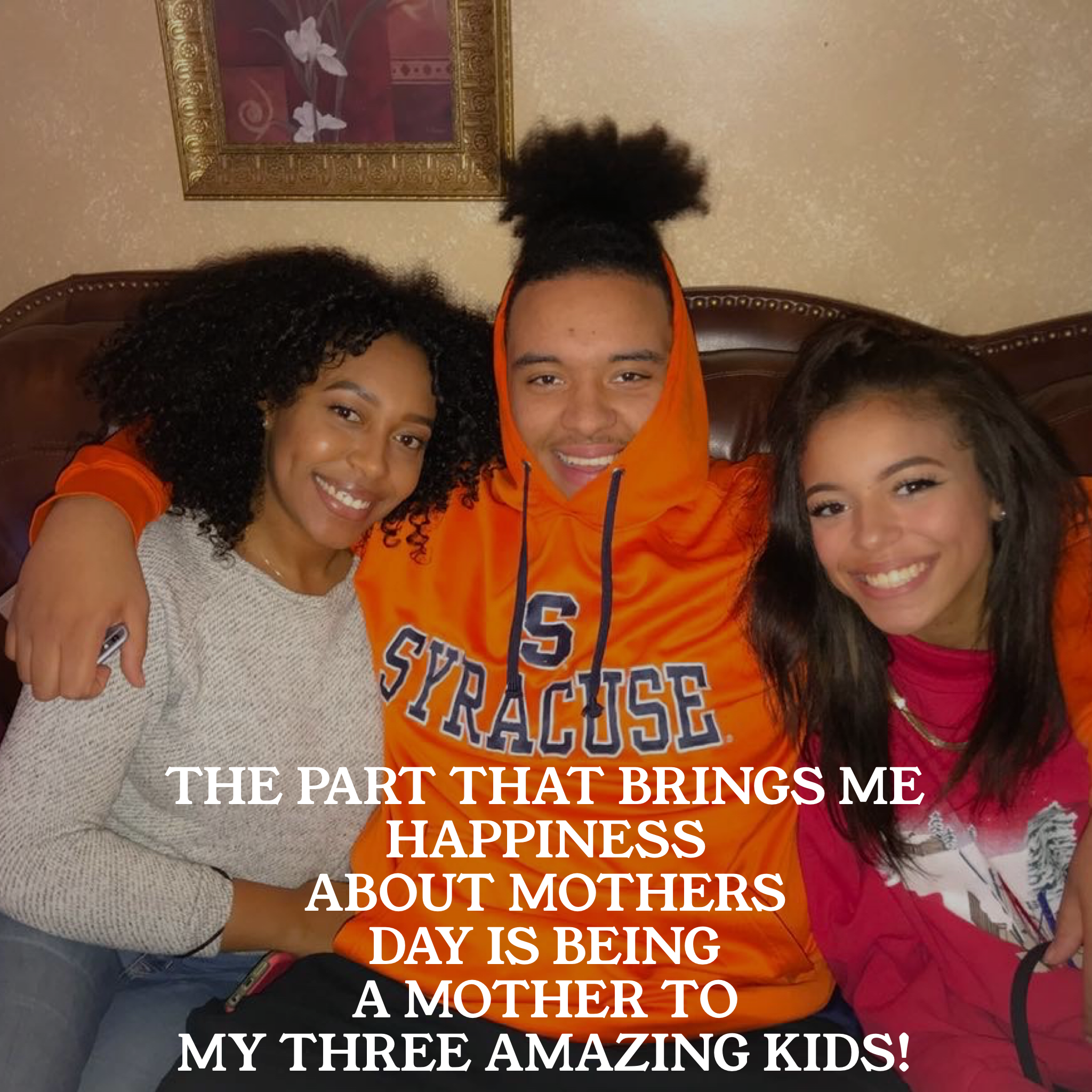 part that brings me happiness on Mother’s Day is being a Mother to my 3 amazing kids. Once I started to try to reframe my thinking from being REALLY SAD about the loss of a mother, and the gigantic mother wound and try to think about how awesome it’s been to be a mom, things got a little easier for me.
  midst you are able to celebrate YOU, because you survived this thing and you are wading through the trenches to survive daily! I think we all are truly doing the best we can. I hope you allow yourself to feel the grief and loss, and you also allow yourself some space to bring yourself some happiness on this day. Maybe get your favorite ice cream, or go outside and sit in the sunshine for 30 minutes and put your feet in the grass? Take a walk outside, and watch your favorite television show. Whatever your “thing” is, don’t forget to take care of you!
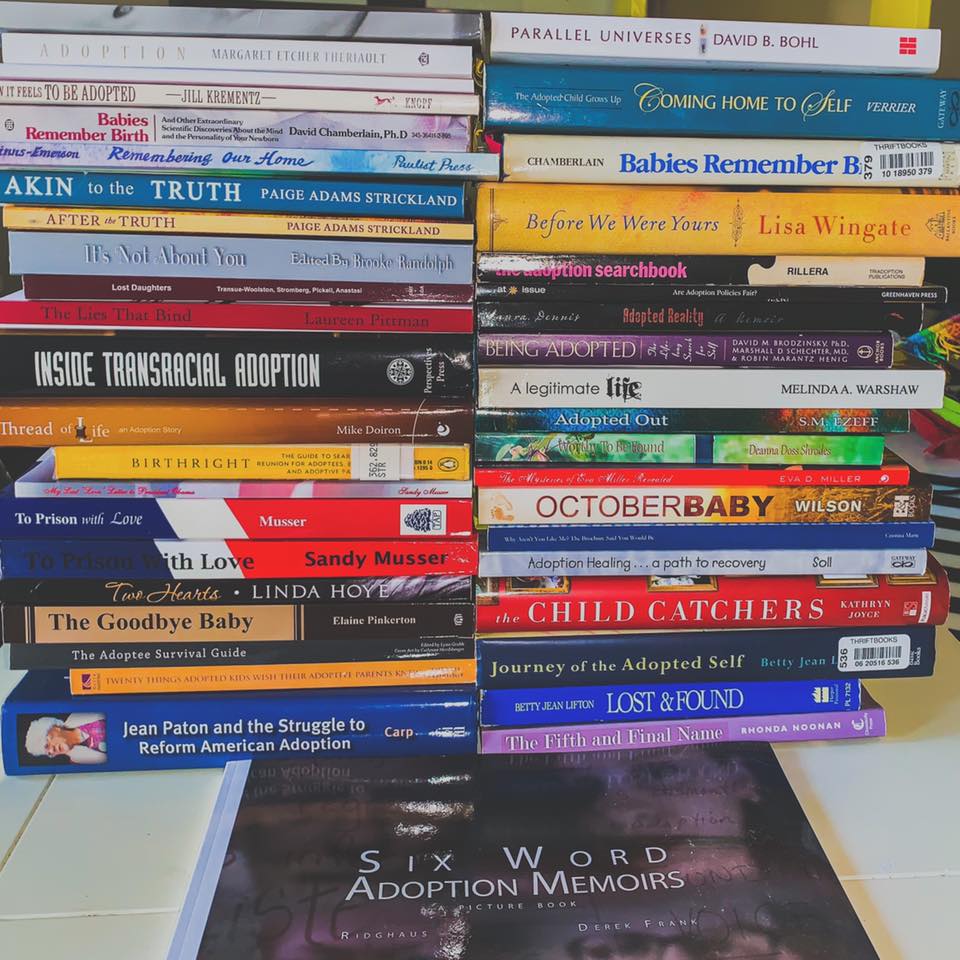


 I decided to write a short article about this topic, because over the years of coming out of the fog and being in recovery it’s come to my attention that so much of the adoptee experience is rooted and grounded in grief & loss. If we leave it up to the world we live in, they not only deny us the right to have anything but positive feelings, they also deny us the right to grieve our losses.
 adoptees in the world who have always had these negative voices about themselves. I wanted to create something that was a reminder of who we really are, who I really am. I think we all need that reminder every now and then. Click




 Pamela A. Karanova