Join host Marcie Keithley as she welcomes spotlight guest Pamela Karanova.
Pamela is an adult adoptee, living in Lexington, Kentucky, was born in Waterloo, Iowa, in 1974. Although Pamela’s roots are scattered all over Iowa, she considers Kentucky to be her home.
Over the last ten years, Pamela has dedicated much of her life to not only work towards healing regarding her adoptee journey but also pouring into the adoptee community. She’s created resources for adult adoptees and built relationships with adoptees all over the world!
Registered attendees will be emailed a link to the event on Zoom Meeting on Thursday and Friday. If you add the event to your calendar when you register you can launch the Zoom Meeting from the calendar event. (click the play button in the center of the event image)
IA HF855 – A bill for an act relating to access to a copy of an original birth certificate by an adoptee or an entitled person, providing for fees and including effective date provisions. (formerly HF 723, HSB 226)
I want to share that I am honored and proud to know Michelle Spear, one of the leading forces at Iowa Adoptee & Family Coalition behind this bill being passed. For over seven plus years, Michelle and many others have worked tirelessly to get Iowa laws changed for adopted adults to obtain their OBC’S. I have been cheering them on from states away during this time because I am an Iowa Adoptee, but I have lived in Kentucky since I was 17 years old. I have built a relationship from afar with Michelle and have admired her dedication and hard work in all these years to DO SOMETHING! Her hard work, and dedication hasn’t gone unnoticed. I am eternally grateful!
I remember being told of my adoption back to 5 years old and asking when I could find my biological mother. Year after year of my childhood, I received the same response. “Honey, the records in Iowa are sealed, but when we get enough money for an attorney, we will get the sealed records opened. But right now, we don’t have enough money.”
Sadly, my adoptive mom knew who my birth mother was my whole life, so this was just a lie. I was spoon-fed this lie to simmer my desire and curiosity to know my biological family. However, it never calmed down my desire to want these CLOSED records OPENED and find my people. I can remember wanting my Original Birth Certificate from the beginning of my life.
As I learned of this new Iowa Bill HF855 passing, a wave of excitement and long-awaited happiness has come over me the last few days because of Bill HF855’s passing; I will be one of those adoptees. Finally, a dream come true, and one that I always thought was so far out of reach I would go to my grave never getting to see my OBC.
While I celebrate this massive milestone in adoptee rights, SOME adopted adults in the state of Iowa will not be able to receive their OBC.
Here’s why.
Bill HF855 is subject to redaction at the birth parent’s request. Instead of point fingers at the Iowa Adoptee & Family Coalition that this bill is not a clean bill, I point fingers at the entire adoption system that has set adoptees up with fighting this fight, to begin with. Let’s shine a light on the ROOT of the problem, and not those who are spending year after year fighting tirelessly to shift the laws in Iowa.
While I was overcome with multilayered emotions that I would be getting my OBC in the near future, I was equally sitting in the sadness for many of my fellow adoptees. It seems we’re still infantilized, being treated like perpetual infants who have never grown up.
This saddens me to the core of my being.
The perplexing emotions that have swept through me the last 24-48 hours are complicated at best. One minute I am crying happy tears, and the next, I am crying sad tears. Such significant steps that SOMETHING is moving in the state of Iowa regarding adoptees to have their OBC’s, but we still have so much work to do. Thank you to all who have been there for me during this time!
Part of me is so happy I will finally receive my OBC, and so many other adoptees will as well. I honestly never thought I would be alive to see my OBC and that I would be one of the adoptees who go to their grave, never laying eyes on it. Yet, I always knew Michelle was doing her best to TRY to get something moving in Iowa in the back of my mind.
#simplepieceofpaper movement
It might be viewed as insignificant to many who have never lived without their birth certificates. Still, for many adopted people, we have been denied the right to obtain this simple piece of paper that most non-adopted people might take for granted. When someone is adopted, their OBC is kept secret, filed away in a cabinet, and the adopted person is generally never supposed to lay eyes on it as long as they are alive. They are never supposed to know who they are or where they come from. This knowledge is kept locked away for eternity.
What’s the big deal about having your Original Birth Certificate?
I want to know what information is on my OBC. Did my birth mother name me? Is my birth father listed? Does it have the correct birthday? Does it tell how much I weighed? It’s a tie to my truth, and no law should stand in the way of me having it.
I used to take care of a 86 year-old dementia patient named Pauline. I would go get her to bed at night, and even when she forgot her kids, and grandkids names, she would lay awake and stare at the ceiling and say, “I was adopted out of a home in Louisville, I never found out who my people were, but I always wondered who they were and where I came from. Were they looking for me?”
Even when she forgot many other things in life, she always remembered to her dying days she was adopted, and it haunted her not knowing who she was and where she came from.
How many Pauline’s have died before every learning their truth?
How many will continue to die before learning their truth?
I can share from the experience of building relationships with adoptees for over a decade that many feel like we aren’t alive because we feel like we were never born. Much of this goes back to being denied the right to know who we are and where we come from and to know our birth stories. Our OBC is a direct tie to our history and birth story, and every adopted person on the planet deserves to know their truth.
I also know that adoptees are 4x more likely to attempt suicide and they are over-represented in jails, prisons, mental health, and treatment facilities. These staggering statistics are alarming at best, and we have to understand that the closed adoption social experiment has failed and failed adopted individuals miserably.
Why are we still giving birth mothers anonymity and allowing adoptees to pay the price of shame and secrecy for life? It’s a fundamental human right to know who you are and where you come from. We all have a right to know who our siblings and biological families are. Adoptees are fighting for a document that most people have, and this document shares their truth. Hiding this truth never has been and never will be in the best interest of any child.
Truth and transparency are the only way to go, and anything rooted and grounded in secrecy and lies is only harming adoptees. We can’t heal from secrecy, lies, and half-truths because we don’t know what we’re healing from.
I’m a firm believer that every adopted individual should have UNRESTRICTED ACCESS to their original birth certificate under the law. While Iowa Bill HF855 is a shift I am eternally grateful for, we will continue to have work to do in Iowa and any other state that isn’t allowing unrestricted access to adopted adult’s original birth certificates.
I urge anyone who might read this article to share their voice and speak loud about the unjust treatment adopted individuals experience worldwide, just because we’re adopted. It’s never too late to get involved with supporting adopted adults and push for unconditional access to our OBC’S.
While I’m celebrating for Iowa, and I am celebrating for myself, I am celebrating that step by step, year after year, changes are happening for adopted adults. It’s just deplorable, so many people support adoption, but they don’t realize they are also supporting secrecy, lies, and half-truths.
ADOPTEES ARE DYING, NEVER KNOWING THEIR TRUTH!
We can’t afford to turn a blind eye any longer.
On the flip side, I’m honored to be a part of such a significant milestone for my home state of Iowa and show up to celebrate with them. Wednesday, May 19, 2021, I will be traveling to Iowa for the Governor’s formal signing of bill HF955 into law, allowing Adoptees to Access their Original Birth Certificates. I will spend less than 24 hours in Iowa, but I wouldn’t miss this event for the world! On January 1, 2022, I will be able to apply for my original birth certificate.
Wednesday, I will be wearing YELLOW as a sign of remembrance for Adoptee Remembrance Day, as well as all tribute to all the Iowa Adoptees who died before they ever found their truth. I would like to invite anyone attending this historic event to join in with me to wear yellow as well. I know my emotions will be running high, as many emotions will be that day. I have close friends attending, I will be in great hands.
I want to say a special THANK YOU to my close friends and family who have supported me through these past few days and my journey in general. Keila, Damia & Damond, Thanks for your continued love and support! Thank you Jennifer for being my side kick through this whole thing. Thank you Taylor & Clarita for covering work so I could go! You all have no idea how much your support means to me, and even just listening to me and saving space for my sadness and tears is healing in a million ways. I appreciate you, and I thank you from the bottom of my heart.
For all those who have had a part in this bill moving forward, Michelle, Susie, and the rest of the tribe… I salute you all, I thank you, and I love you. I will always hold a huge space in my heart for your efforts, your sacrifice, and hard work!
Don’t forget this article along with all my other articles are available in audio for your convenience, just look up Pamela A. Karanova Podcast on Google Podcasts, iTunes , Spotify. and Amazon Music. Interested in treating me with a coffee, to add fuel to my fire? Click here. Many thanks in advance to my supporters!
Love, Love!
Pamela A. Karanova
The views and opinions expressed in this article are that of the author, Pamela A. Karanova. Reproduction of the material contained in this publication may be made only with the written permission of Pamela A. Karanova
Trigger Warning: Abuse, Childhood Sexual Abuse, Rape, Suicide
Goddamn Green Girl -12 Years Old
Please consider reading my previous two articles before reading this one. They will help you understand this article better. You will find them here and here.
As I started to get my feet wet to learn about Internal Family Systems, the first part of me has presented herself.
I named her Gooddamn Green Girl.
It’s 6:11 am on Saturday, March 6, 2021. I set my alarm for 5:00 am this morning, so I could get up early and do some housework, brew some coffee and write an article about Goddamn Green Girl.
I’m already in tears, thinking about her. I’ve learned on my healing journey; tears aren’t something to run from; they are therapeutic. As soon as the thoughts about Goddamn Green Girl come to my mind, an enormous amount of pain follows her. Anger and rage are at the forefront of my perception. Goddamn Green Girl isn’t sharing her life for sympathy, or for anyone to feel sorry for her. She’s sharing because it’s evident that she’s never been heard or listened too so having the space to share her thoughts is a big deal to her, especially living a life never having a voice.
The IFS model has given her a voice, and that alone is a critical step for her. You would expect for me to start at the beginning, where the core of relinquishment trauma resides for me being adopted. However, Goddamn Green Girl has stood out to me first, as being the soul protector of self, making the most significant impact in my life. If I don’t start with her first, I don’t think I will identify my other parts to follow. To learn more about Internal Family Systems click here.
Goddamn Green Girl made her grand entrance around 12 years old. To read some of her pre-teen backstory, you can visit here. She was rooted in abandonment, abuse, and trauma, and as she grew in her persona, the hardness of her heart grew as well. She discovered alcohol, which was an everyday part of her life, beginning at 12 years old. She never fit in anywhere, not even in her own skin.
Her name is significant to her journey. Her adoptive mom would always threaten she would go to hell for using the Lord’s name in vain, so it made her want to do it more. Trust me; she did it more. She also told her she would hell for dating outside her race, but she never acknowledged Goddamn Green Girl didn’t even know her ethnicity. Dating others looking nothing like her seemed safer to her; at least she knew they weren’t a biological sibling. Knowing she was going to hell made her want to rebel more, and she did. Her favorite color was neon green, and this is why her name is Goddamn Green Girl. She was rebellious, and she was hell on wheels. At all costs, Goddamn Green Girl was a protector, because no one else was looking out for her.
In the deep space of Goddamn Green Girl, she was experiencing the biggest disappointment of her life. She found out she was adopted around five years old, and she set up a false hope that her biological mother giving her away had to be a big mistake. Who would give their baby away and mean it? She believed her birth mother would come back to rescue her, and she waited and waited and waited.
She hates waiting, and finds it to be a huge trigger.
Her adoptive parents divorced, and her adoptive dad remarried and moved away to raise a new family. She would visit her adoptive dad every other weekend during her childhood, where an older stepbrother sexually abused her. Her adoptive mom had always shown signs of mental instability. Before and after adopting two daughters, she showed signs of emotional and mental discord. The home she grew up in grew more and more toxic and emotionally abusive. I will write more about what I experienced in this home soon as I share more parts.
Pre-Goddamn Green Girl – 11 Years Old
Goddamn Green Girl was sprouted from a 10-11-year-old girl who grew up in an abusive adoptive home, and after escaping this environment each day, she found herself in the streets of Cedar Rapids, Iowa. The newfound freedom she experienced was a freedom she had never felt before. She liked it, but truthfully, she was acting out in pain. The reality had finally set in that her birth mother wasn’t coming back. Deep down, she was broken-hearted. No one understood the complexities of her grief, which showed up as anger, self-hate, and rage.
At 12 years old, she was arrested for the first time with a group of kids who burglarized a laundry mat. This was her first experience with breaking the law, and it was only the beginning. She soon became dependent on alcohol to take her pain away, and running the streets was a daily ordeal. She only went home to shower, change clothes, and hit the streets again.
She remembers looking in the mirror at this age and having no idea who was looking back at her. Who did she look like? Where did she come from? This was when her self-hate and sabotage began, and it was a deep part of her life for many years to come. In the back of her mind, being outside running the streets, she had a chance at running into her biological family. She was hopeful that she would find her birth mother one day, and her spirit was never going to be settled until she did.
She became acquainted with a family by becoming friends with two sisters, who took her in as a little sister. Their older brother, who was 18-19, showed Goddamn Green Girl attention, and around 13 years old, She was in her first relationship with him. She so desperately wanted to belong and be a part of a family; most of the time, she never wanted to go home. Let’s be honest; she didn’t want to go home anyway. This just gave her more reason to stay away. She spent close to a year going back and forth between this house and her own, showering and going right back. Keep in mind; alcohol was always available here, and soon, it would become her best friend.
Around the age of 14, she experienced the first physical abuse from the relationship she was in, and instead of run away from the abuse, she kept going back. She thought this must be what love is, right? Why would he go to the extent of abusing me if he didn’t care? At least he didn’t leave me as my biological mother did. The whole concept of him choking her and slapping her showed her he loved her. Kind of like her birth mother giving her away, love always equaled pain.
The abuse continued, and she started to fight back, which only made it worse. They set her up to be raped in an attic at a house party, and they succeeded. She wanted to belong so badly; even after this, she went back. Her view of love was utterly skewed. When your biological mother “loves you so much she gives you away,” it’s easy to have a toxic idea of love. It’s a mental mind fu*k in itself. They also tried to rape her on the kitchen floor in broad daylight, where someone else stopped them and helped her out of there that day. At first, she had no memory of it because they made sure she was intoxicated first. Later, pieces of these memories came back, and they plagued her mind for years to come. This information was tucked away, locked up never to be told to anyone. Shame took over. After the rape attempt, she decided she wasn’t going back to this house anymore, but it was only because someone else convinced her not to go back. If they hadn’t, she would likely have gone back. No one knew her experiences at this house, and she was ashamed and blamed herself. If she weren’t drinking alcohol, this would have never happened—more deep-rooted hate set in, more profound than before.
Goddamn Green Girl always had trouble in school and could never seem to focus on what was in front of her. Traditional school was not an option as anxiety being around so many other people would make her physically ill. She ended up dropping out of traditional school, and off and on she attended the school for “the bad kids.” The idea of being labeled as one of the bad kids, lined up with her feelings of being bad just for being born, and abandoned by her birth mother.
Badness followed her everywhere she went.
It was in her DNA.
Soon, she was onto the next abusive boyfriend. He had controlling ways, and her mind, that was also love. If he didn’t love her, he wouldn’t care or stay. Love leaves, right? He stayed. She ended up pregnant by him at 15 years old, and she miscarried the baby due to the abuse he inflicted on her. She often wonders about the child she would have had, at 15 years old. She always felt like he would have been a boy. What would he have been like? How old would he be now? This relationship and this kind of abuse was much more extreme than the first if you can even imagine that. She doesn’t want to go into much detail, but he was angry and rage-filled and was known in the city she grew up in as tough, and she was his punching bag. But she loved him, and she believed he loved her, so she stayed with him until she was 17 years old.
During that time, she was a runaway. She was in and out of several group homes, detention centers, drug, and alcohol treatment, and she broke the law more times than she can even try to remember. She hoped somewhere along the way, someone would kill her, but only after trying to take her own life didn’t work.
No one even noticed.
While in drug and alcohol treatment at 15 years old, she was put in a hospital room and handed the big book from Alcoholics Anonymous. It was apparent she needed to get familiar with this book, or she was never going to make it out of this locked facility. One of the first confusing areas for her was the concept of finding God, and that was something she had to do to make it out. She knew of God because her adoptive mom read the bible, read her devotionals, and threatened her with hell throughout her life. Is this the same God? Goddamn Green Girl decided to fake it until she made it out of this treatment facility. Not one time was her root issue of relinquishment trauma, compacted by adoption trauma ever discussed. Just like all of her therapy appointments throughout her entire life, adoption was never addressed.
Goddamn Green Girl hated herself, She hated the world, and She hated everyone in it. Her grief, loss, abandonment & rejection showed up as rage. She continuously provoked physical altercations with others, but her acts of violence on others were actually how she felt deep-down about herself. If her own mother didn’t want her, who else would want her? The more she hated herself, the more alcohol she drank, the more she was arrested, and the more she just wanted to die.
The reality was the pain was so great; she didn’t want to feel it anymore. Where was God? If this was his plan for her life, F*ck him. Dying seemed like the only way out. She just wanted to find her people; She wanted her truth; She wanted to find her way home, to her biological family, because all that was missing from their life had to be her. They were all that was missing from her life. In the back of her mind, She had a tremendous hope that they must be looking for her, and it was only a matter of time until she found her way back home. She felt that ANYTHING had to be better than the abusive adoptive homes she grew up in.
Therapy was a constant part of Goddamn Green Girls life, from the age of 5+. Therapists were never equipped to open the topics of root issues of relinquishment trauma or adoption trauma, so Goddamn Green Girl never worked on the root issues. Around 18 years old, she found herself in another therapist’s office. This time was the first time she shared the childhood sexual abuse from her oldest adopted stepbrother.
She was encouraged to contact her adopted father and her adopted stepmother to share this news. Over the next 30 years of her life, they ignored her and never validated her experience as valid. They never addressed the issue, and Goddamn Green Girl felt ignored entirely, which added further destruction to her life of being invalidated and heard.
Until the age of 21, Gooddamn Green Girl lived a life in the streets while paving a destructive path everywhere she went. What changed everything for her was having her first baby in 1994, who finally give her something to live for when she didn’t want to live for herself. She was up for many new challenges, learning how to be a mother when she never had a healthy example of one was at the top of the list. She was determined to go back to school, graduate and make something of herself. Goddamn Green Girl still shows up sometimes, and she will always be a part of Pamela’s life. She’s learning to acknowledge her and to give her what she needs, which is something no one else has done.
Goddamn Green Girls adoptive mom finally came clean at 21 years old after a lifetime of deception; (lying she knew Goddamn Green Girls truth) that she knew who who her biological mother was. Her initial reaction was more rage, for being lied too. However, she was set out on a new search, to find the woman she had dreamed about her whole life, her birth mother. Alcohol was still her best friend, and it was the only way she knew how to cope with a lifetime of pain, and what has passed and what was to come. From a runaway teenager, to a new mom – she finally had something to live for. Now Goddamn Green Girl was a mother, of a beautiful baby girl. ❤
Now that I (Pamela/Self) have been able to identify Goddamn Green Girl, and acknowledge her part in my life, I am able to sit with her and nurture her which is something no one else has ever done. She visits frequently, in different experiences I have in life, and she’s triggered frequently also. Learning the dynamics to Goddamn Green Girl, and her triggers is helping my SELF understand and make sense of it all. Through IFS, I’m learning that none of our parts are bad, even when much of this article is heavy, I acknowledge that Goddamn Green Girl is a part of me who was protecting other parts of me. And she was brought to life, out of my child and baby parts. I am currently identifying them as well, and they will be shared in the near future.
For my fellow adoptees, have you been able to identify any of your parts? Child, teen or adult? Have you ever used IFS therapy? What’s your experience been like?
The views and opinions expressed in this article are that of the author, Pamela A. Karanova. Reproduction of the material contained in this publication may be made only with the written permission of Pamela A. Karanova
My close friend Stephani has hipped me to the world of Internal Family Systems – IFS, and it’s changed my life. I will be candid, Stephani has been talking about doing “Parts Work” for as long as I’ve known her, but I had no idea what the context of “Parts Work” meant. As my relationship with Stephani has gotten stronger over the last few years, she’s helped me identify different parts of me when we’ve had conversations about life experiences.
Over time, it’s sparked my interest in wanting to get to the bottom of what “parts of me” even means.
IFS is a transformative, evidence-based psychotherapy that helps people heal by accessing and loving their protective and wounded inner parts. We believe the mind is naturally multiple, and that is a good thing. Just like members of a family, inner parts are forced from their valuable states into extreme roles within us. We also all have a core Self.
Self is in everyone. It can’t be damaged. It knows how to heal.
The more I learned about IFS, the more I began to identify different parts of me, and I started to evaluate what role these parts have played in my life currently and back to my childhood at my earliest memories. I am still at the beginning stages of learning about IFS, so my writing might be based on the level of understanding and experience I currently have with IFS. I feel the need to share this because I am still learning.
One of the many IFS dynamics I am drawn towards is the concept that we all have parts, and we all have SELF. Self is the true us and who we are. IFS guides each of us to know that we have no bad or negative parts, and all of our parts have served a great purpose. These parts have been protectors to help protect SELF from harmful experiences at some point along our journeys. They can surface at different areas of life as protectors, and sometimes they stay in the background, not surfacing at all.
Moving forward, I want to share some of the parts of me that I identify as I move forward with the Internal Family Systems Model. Example – I have already identified one of my teenage parts. I’ve named her and acknowledged different times when she shows up in my current life and what she protected me from in my teen years. I’ve been able to identify and tap into her feelings, and she’s already shared a lot of her role with other people. In doing this, she already feels she has a voice, which has never happened. She’s shared things about her that have been locked inside for 46 years. Sharing is healing, so even this small step has created an extended-release for me.
I’ve identified one of my five-year-old parts, and I’ve also named her. She played a pivotal role in my childhood. I want to share more about her in a separate article. I’ve identified one of my pre-five-year-old parts, and I haven’t come up with a name for her yet. She holds the terror and trauma from relinquishment separation from being given up for adoption. As I navigate my IFS journey and move forward with understanding these parts, I hope to know how these parts impact me to this day and what they have protected me from in the past.
This all might seem like a strange foreign language because I can relate. Those were my thoughts in the beginning. However, when I have tried EVERYTHING under the sun to heal my adoptee/relinquishee issues, and nothing has worked, it leaves me in a state of mind where I’m willing to try anything. The more I learn about IFS – the more it makes sense to me. It’s given me a new tool to discover and learn about layers of myself, which has given me a new fresh wind at trying to figure it all out. It’s given me a chance to provide a voice for all the parts of me who have so desperately wanted to be heard, but no one has been available to listen.
Some of the questions I have –
Why am I the way I am?
Are my ways serving me a good purpose?
What do I need to identify and change?
Now I can begin to understand my sensitivities and where they come from?
Healing can happen from these discoveries. I’m excited to start the IFS process and share some of my self-discoveries with you. I feel this model might be something that other adopted individuals might consider learning more about. One thing is for certain; healing isn’t going to come knocking on our doors. It’s up to each of us to seek healing ways out, and that’s going to look different for each of us. As I move forward with learning more about IFS, and the process of seeing a new adoptee/therapist I want to share my discoveries with you all. Even if it helps one adoptee, it’s worth the share.
A special shout out to my close friend Stephani – Thank you for your willingness in sharing your parts with me, thank you for encouraging me to learn my parts. Thank you for listening to me share about my parts. Thank you for your transparency, and most of all THANK YOU FOR YOUR FRIENDSHIP! XOXO P
To my fellow adoptees, do you know anything about IFS? Have you tried using it in the past? Are you currently using this model? If so, what’s your experience been like? Has it helped you? If so, how?
The views and opinions expressed in this article are that of the author, Pamela A. Karanova. Reproduction of the material contained in this publication may be made only with the written permission of Pamela A. Karanova
On February 19th, I had an accident where I slipped hard and fell on the ice, and I hurt myself badly. I was trying to get to work to take the lady I care for to get her Covid-19 Vaccine, and time was in a significant crunch. It was 6:30 AM on a Friday, and the sun hadn’t even started coming up yet.
As my feet slipped out from in front of me and my back and backside landed hard on my three front steps covered with ice. My left hand was mangled in the railing, my car key snapped off the keyring and flew in the snow. My right palm tried to help me land but ended up being bruised and hurt as well.
I tried to find my car key, but I was completely taken back, and now I didn’t even have a car key to get to work. I started to become frantic while my pinkie was bleeding, swelling, and causing me a lot of pain. My backside was doing the same.
I remembered I had a spare key inside, but I had to find a battery. Thankfully, I was on my way to work, pretty banged up. I arrived one minute early. Over the next few hours, a football-sized bruise appeared, and the color changed from dark purple to almost black. The swelling was out of this world. I still had to work, which was not easy.
As the days passed, my pain set in, and I was beside myself. After nine days, I hoped my pain would be better, but I was still in a significant amount of pain. While the bruise was getting lighter, the knot in the middle of the bruise was the same size, about 5in x 6in, and the pain was still about an 8. I decided this past Sunday I was going to the ER to check it out to make sure nothing else was going on. I also wanted to discuss some pain medication for nighttime which seemed to make sleeping impossible.
All CT scans came back normal, which I figured they would, and they ended up sending me home with some pain meds, and they wanted the hematoma that was causing so much pain to absorb itself back into the skin. In the meantime, they gave me a shot in my arm of pain meds.
This shot was so painful; I had immediate tears stream down my face, and at that moment, it hit me. Something that never hits me.
I wanted my mom.
This wasn’t the familiar daily feeling of wishing I had a mom as an adult; it was much deeper than that. I want a mom every day, and I’m constantly reminded I don’t have one but this was a deep and sad longing, one that has rarely ever come out in my adult life.
Is it a sign of healing?
Is it a sign of saving space for my inner child to come out?
It was a new experience for me because my story is a story that has unfortunately set me up to live a life MOTHERLESS. As the thoughts of wanting a mother came over me, this deep sadness came over me. I was in the ER hospital room alone, and I realizedI didn’t have a mom.
It’s not that my moms are dead, and I had a lifetime of beautiful memories with them, and they just no longer existed because they passed away. Both my adoptive mother and biological mother have passed away. It was more so the sadness set in that the biological mother I wanted and needed didn’t want or need me. And the mother that wanted me couldn’t care for me; she wasn’t there for me. She was mentally ill, and she was emotionally and mentally abusive in a lot of ways. She caused me a lot of childhood trauma, and I never felt connected to her or bonded with her. I felt like I was forced to bond with her, which was traumatic in its own way.
This reality set in, and tears were nonstop. I let myself cry and sit in the sadness. I couldn’t help but think about the last time being connected to my biological mother in a hospital, which was 46 years ago, the day I lost her on 8.13.74. Did you know the maternal bond that’s formed with your biological mother is the core bond that sets the tone for the path of your life? There is lack of resources for adoptees on this topic that directly connects adopted individuals who are relinquished by their biological mothers but there are many studies and articles for adoptive parents, and non adopted individuals.
Robert Winston and Rebecca Chicot explain –
“Infancy is a crucial time for brain development. It is vital that babies and their parents are supported during this time to promote attachment. Without a good initial bond, children are less likely to grow up to become happy, independent and resilient adults.” – The importance of early bonding on long term mental health and resilience in children.
David Chaimberlain, Ph.D. says –
“Separation of mothers and newborns is a physical deprivation and an emotional trail. Mothers know deep within themselves what scientists are just discovering – the relations between mothers and babies are mutual, reciprocal, even magical. A baby’s cry triggers release of the mother’s milk, the only perfect milk on earth for babies. In addition, there is a vital power in the baby’s look and touch to turn on feelings and skills necessary for successful mothering.” – Babies Remember Birth.
Where does this leave relinquished newborns in regards to the prenatal and perinatal bonding and the traumatic separation at the beginning of life?
When I was a child, I used to have a reoccurring dream that I was about 4-5 years old, running down a maternity ward’s long hallway. Everything was white. I had a hospital gown on, no shoes, and the hallway went on forever and ever. I remember a clock being at the end of the hallway, and the time was disappearing minute by minute as I ran. I remember jerking all the curtains back, one by one in terror, as I searched for HER. It went on forever. I never did find her, but this dream was reoccurring through most of my life. Did this hospital visit connect me to that dream subconsciously? It’s hard to fathom I’m 46 years old, and discovering these connections and truths are still impacting me greatly.
I’ve recently started to become familiar with IFS – Internal Family Systems by recommended by a great friend, Stephani H. (TY STEPH!) Watching the video will explain what IFS is the best, but in a nutshell, you identify different parts of us that have been parts of us back to the beginning of our lives. It helps us learn our parts are all welcomed and a part of us.
Stephani mentioned that it was my inner child part that wanted my mom, and when she said that, it made total sense to me. It was the little girl in me that just really needed my mom with me, and the entire concept that she wasn’t there, and she has never been, and she never will be set in. It was a hard pill to swallow. I was in a significant amount of pain, and that didn’t help me any.
The best part is, I’m learning that my feelings of sadness are not feelings to run from; they are feelings to sit with. I didn’t realize that was my inner child feeling that way until after I was already home and Stephani mentioned it to me. I was blown away because it made total sense.
If I thought of that while I was at the hospital, IFS teaches us to talk to the parts, welcome them and give them what wasn’t given to me as a child. I didn’t realize it until I was already home, but my sadness consisted, and I got comfort in understanding the dynamics of my child part coming out while I was at the hospital.
I have recently decided to give IFS therapy a try, and in the last month of learning about it, it is a miraculous and fantastic tool. I don’t want to share much here, but I plan to write about my experience with IFS because I want other adoptees to consider using it as a healing tool.
At a very young age, I was disassociated from the entire concept of wanting and needing a mother to protect myself. When those feelings came, it caught me off guard. I’m usually a strong person, and tears are something in the past I have held inside. But this time, these feelings wouldn’t let me. Even when I tried to stop crying, the feelings of wanting my mom overwhelmed me. I’m 46 years old and still navigating the aftermath of adoption.
As I learn more about IFS, self & my parts, I want to share them with you! I’m also starting therapy with a new therapist who is an adoptee! I am excited about this process. It seems I’ve done a lot of self-work, but I have never done trauma work. I have work to do. I think acknowledging these parts is the first step, and making the choice to sit with them, and no run is the next step. What’s next? I hope to share with you what the process looks like by trauma informed therapy, IFS and other techniques I am using to navigate the healing process from an adoptees perspective who also lives a life sober of alcohol.
Adoptees, have you ever been in a situation where you wanted your mom on a deeper level? Did these feelings surprise you? I would love to know how you describe them? What helps you navigate them when they come?
Don’t forget this article along with all my other articles are available in audio for your convenience, just look up Pamela A. Karanova Podcast on Google Podcasts, iTunes , Spotify. and Amazon Music. Interested in treating me with a coffee, to add fuel to my fire? Click here. Many thanks in advance to my supporters!
The views and opinions expressed in this article are that of the author, Pamela A. Karanova. Reproduction of the material contained in this publication may be made only with the written permission of Pamela A. Karanova
We are eager and enthusiastic to unveil the Adoptee Remembrance Day website with you! As the very first Annual Adoptee Remembrance Day launched in 2020, it’s created a firestorm of activities across the globe that take part in this day. Such a symbolic day for the adoptee community needed its very own space to share upcoming news, events, articles, and all things – Adoptee Remembrance Day.
What is Adoptee Remembrance Day?
Adoptee Remembrance Day – October 30th serves several purposes.
It raises public awareness of crimes against adoptees by adoptive parents, an action that current media does not recognize. It also allows us to publicly mourn and honor the lives of our brothers and sisters who we have lost who might otherwise be forgotten. It raises awareness about adoptee suicide, shining a light on a difficult topic. Through these actions, we express love and respect for the adoptee community. Adoptee Remembrance Day reminds others that we are their sons, daughters, parents, friends, and lovers. Adoptee Remembrance Day gives our allies a chance to step forward with us, memorializing those who have died too soon, and it also recognizing the loss all adopted people experience, before they’re actually adopted.
While this topic remains sensitive in nature, adoptees who are murdered by their adoptive parents is increasing around the world. It is a time to honor their legacy by setting aside a day just for them. While those who have passed away before us, are no longer able to speak and share their stories or voices, there are many adoptees today who are paving the way for the voiceless to become strong enough to share their voices and stories. We are the voice of the voiceless.
We also recognize that there are international adoptees who are living without citizenship and/or have been deported due to mistakes by adoptive parents, adoption agencies, attorneys, and ultimately, the U.S. adoption system. Some international adoptees must survive abuse and neglect, including in regards to their citizenship, from their adoptive parents. We honor the adoptees who did not survive or are struggling to survive their deportations to countries they left as children where they have no support network and limited access to support services, including mental health care, clothing, food, and shelter. Lack of citizenship is a tragic and often unacknowledged issue facing the adoptee community. Please visit Adoptees for Justice to learn more.
This is what Adoptee Remembrance Day is all about.
While our first annual Adoptee Remembrance Day in 2020 was a day that was echoed all around the world, it is evident that it was only the beginning. As the years pass, our hope is this day grows larger and continues to expand across the globe. We hope that the truth about relinquishment trauma is recognized, acknowledged, and addressed as a critical component before any adoption ever takes place. We want to raise awareness of the complexities that adopted people experience by hearing the voices of those who have the lived experiences, the adopted individuals themselves. We want to honor those adoptees we have lost from suicide and at the hands of their adoptive parents by setting a day aside to recognize them and the loss we feel without them.
We are honored to share the first story on the new Adoptee Remembrance Day website by the highly thought of Sara Graves. Sara has agreed to share her story publicly, and we couldn’t be more proud of her and honored to share it as we unveil the new website. We admire her willingness to share her story and applaud her strength in this process. To help us celebrate Sara and her story, please visit the Adoptee Remembrance Day website and leave her a message of support and love. You can view Sara’s story by clicking here.
Don’t forget to follow the Adoptee Remembrance Day website and the Facebook page. You can RSVP to the next Adoptee Remembrance Day by clicking here. Have an idea for the next Adoptee Remembrance Day? Please submit it here.
To everyone who has participated on this day, thank you. We’re sending love and light around the world, and as adoptees share their truth, our voices get stronger together. Adoptee Remembrance Day 2021 is only a few months away. Please reach out to us if you would like to get involved by sending us a message here. – Pamela Karanova, Adoptees Connect, Inc.
Help Support the Growth of our Growing Network!
Adoptees Connect Inc. is an IRS approved 501(c)(3) public charity. Donations to Adoptees Connect are tax deductible as allowed by law. Please consult your tax advisor regarding deductibility. EIN: 83-1862971. Thank you for your generosity in helping our vision move forward.
I’ve come to a recent discovery after doing some self-reflection that I am someone that takes longer than your average person to process feelings, especially ones that are considered heavy or disheartening. I’m naturally a BIG feeler and a deep thinker.
While discovering this, it has been said that this is a “hang-up” or a “bad thing.” As I ask myself, “am I defective for taking so long to process things?” or “is something wrong with me for taking so long to process things?” I’ve been trying to process why I am this way, and I had an epiphany this morning.
I take longer than the average person to process things, because I’m feeling the feelings and processing them. I’m not side stepping or avoiding truly feeling and processing feelings. I’m doing the work, I’m evaluating my part, and caring enough about myself to not rush the process. This is self-care. This is self-love. This is putting myself first, and in return I can show up for others in a more grounded way. I spent 27 years drinking alcohol to numb my reality, to escape.
While running, I didn’t have to put in the work to feel the feelings and process the pain. I jumped from one shit storm to another for 27 years. I didn’t show up but a shell of me did. Avoidance worked until I decided I wanted to get real with myself, and all the problems I had been running from for 27+ years showed up at my front doorstep. I could only run for so long… 27 years is ALONG TIME!
The difference in today…
Today, I’m no longer running home to drink so I don’t have to feel. A shell of me is no longer showing up, but all of me is, along with my imperfections. As I approach a 9-year milestone in my recovery and alcohol-free journey (8/13/12) I am taking note of the way things are for me now, verses the way things used to be. I’m no longer depending on alcohol to take the pain away; I’m depending on myself to put in the work to do that.
This takes a while.
I’m not a robot.
While others might say this is a negative thing, or something they can’t live with or tolerate, I can say I’m proud of myself and how far I’ve come. It’s taken a lot of self-work, blood sweat and tears to learn how to process real and raw feelings after spending 27 years escaping them. No one has shown me how to do this, I have no mother, father, siblings, aunts, or uncles pouring into me. I have figured it out on my own.
Let me add, responding after a trauma response is triggered, is a whole new beast. Acknowledging the problem is half the battle. Admitting and committing to help is another piece of the battle. I’m a work in progress as we all are but I’m not sitting in denial. I have work to do.
It’s all a part of the growth process, I think. As we grow and move forward in life, we discover new things about ourselves. Some of them will make us pick our face up off the floor, and some we ease right on into depending on the circumstances. We’re all a work in progress, and we’ve all adapted to life’s circumstances using survival skills, some healthy and some unhealthy. It’s up to each of us to put in the time, work, and effort to figure out new ways to work things out, especially when the old ways don’t necessarily serve us a great purpose.
Sharing because if I’m ever late to the party, likely I’m over here processing and feeling the feels just so I can show up at all. But when I show up, I will show up with all of me. Not fragments or broken up pieces of me like I did for 27 years. I won’t show up avoiding my reality, masking my feelings with alcohol. I call it self-loyalty and being true to me. It’s not for everyone to accept and not everyone will understand this. That’s okay. I’ve accepted I’m not for everyone.
My main focus is on being true to me. Then, I can show up genuinely for others in a more well rounded way. Wherever you are in your healing and processing journey, be easy on yourself. You are right where you need to be.
Don’t forget this article along with all my other articles are available in audio for your convenience, just look up Pamela A. Karanova Podcast on Google Podcasts, iTunes , Spotify. and Amazon Music. Interested in treating me with a coffee, to add fuel to my fire? Click here. Many thanks in advance to my supporters!
It is not enough to lose your biological mother at the beginning of life. Still, adopted individuals also must live up to unrealistic expectations set upon us by society and our adoptive parents. We must fit in the shoes of the fantasized biological child our adoptive parents would have had; could they have had children of their own. They have big plans for us like most parents have for their children.
News Flash: We can’t fit into those shoes or that role. It’s impossible. I’m very sorry for your loss, but its not my job to fix it or make up for it. I shouldn’t have to carry that burden. However, adoptees continue to be presented as a clean slate when we meet our adoptive parents’. Every one of us has a [his]-story & a [her]-story before we’re adopted, and it’s a critically important part of US.
I’ve experienced in my journey and learned by listening to my fellow adoptees that, more times than not, our adoptive parents have never fully healed from the unsettling truth that they couldn’t have children of their own due to infertility issues. This causes significant problems for the adopted child because we will never live up to the expectations as if we were a biological child, but this demand is high. When healing hasn’t happened first, it can be a disaster in the home.
We’re born experiencing immense trauma by being separated from our biological mothers. This separation trauma impacts every area of our lives showing up as grief, loss, C-PTSD, abandonment, rejection, anger, rage, addictions and so much more. The weight the adopted child feels and carries into adulthood is tremendous alone. Still, it’s compacted by the expectations set upon us to be something or someone we aren’t by our adoptive parent’s expectations. This weight carries on into adulthood and impacts every area of our lives.
When our adoptive parents have significant unhealed issues with the loss of not having children of their own, it surfaces in every area of the home.
In my story, I remember my adoptive mom never being well, and she was always taking pills. When I was a child, I didn’t understand what was going on, but now I know “never being well” was depression, pill addiction, and manic depressive suicidal episodes. The depression was rooted in untreated mental illness, the aftermath of not being able to have children of her own, and marrying and adopting two daughters, only to divorce one short year later. I was told she wasn’t capable of parenting one adopted child, but somehow she ended up divorced, alone with two adopted daughters.
A glimpse of my childhood consisted of me being my adoptive mom’s caretaker. She was abnormally emotional every day and cried daily, saying repeatedly she wasn’t worthy of being a mother. I was the comforter and “Good adoptee.” I would sit with her on the edge of the couch and comfort her by rubbing her back and saying, “It’s okay, mommy, I’m sorry, mommy, It’s okay.” I must have said, “I’m sorry,” 100X a day sometimes. I remember being sad all the time and wanting her to stop crying. She never did, but when she wasn’t crying, she was sleeping in the daytime, and she also had a compulsion of wanting to threaten to commit suicide in front of us, which she frequently did. Learning and focusing in school was impossible most days, because I was I was riddled with anxiety and fear day in and day out.
Is it possible her infertility issues were the root of her behaviors? Being 46 years old and evaluating my childhood, I would suggest so. I don’t have the definite answers because she never got help for those issues; she adopted to fill the void instead. It was my responsibility as far back as I could remember to take care of her, cater to her, and be there for her. I was a slave to her.
I’ve recently discovered that I’m a people pleaser, and this characteristic was developed early in my childhood as a direct reflection of wanting to make my adoptive mom happy. I did everything I could think of to bring her happiness, and in the end, I always fell short. A co-dependent relationship was created, but I had no choice in the matter. I felt trapped in this cycle of co-dependency for most of my life due to my adoption experience.
Where was I going to go?
How was I going to get out?
It was all I knew.
I recall my entire childhood was focused on ways to make my adoptive mom happy, at the expense of my childhood happiness. Everything was all about her. I felt like a child servant with a list of tasks to complete daily, and most of them were centered around making her happy. I was brushing her hair, putting makeup on her face, massaging her arms, legs, and back with lotion, filing paperwork for her, cutting coupons, cleaning far beyond everyday routine childhood chores. I was never able to be a kid in this home. My feelings were never validated, nor were they important. Her adoptive parent fragility reigned supreme over all things in this household.
Please understand that this didn’t stop in childhood. It only stopped when I packed up a 22 Foot U haul and left this toxicity. I moved across the country with my three young children at 31 years old. It felt like an escape, and I have never looked back or regretted my decision but it hasn’t come without more heartache.. When I arrived back in Kentucky, I had no job, no car, no money, no home, no place to live, and no keys to anything. Thankfully my twin’s grandmother was kind enough to let us use a bedroom, where we all 4 stayed for the next few months to get on my feet. Little by little, I made a way for my children.
This escape didn’t come without a cost. Unfortunately, it’s taken me 15+ years to recover, and I’m still recovering daily. It’s going to be a lifelong process for me, as it is most adoptees/relinquishees.
My adoptive moms’ actions throughout my childhood and lifetime caused significant damage that has radiated throughout my life course. When I left at 31, I had to sever ties for my mental health, but it wasn’t before I tried to set boundaries first. She overrode every boundary I asked of her, which were simple things like please put your pills away. I asked her to please not cry around my kids. I asked her please not talk negatively about me behind my back to my children. She broke everyone, so I cut all contact. She was not going to do to my children what she did to me. Moving across the country and cutting ties was the only option.
It was the hardest decision I ever made.
Being groomed to put my feelings aside and caretake to her and her feelings have been a pattern I have picked up into adulthood. I put everyone else ahead of myself, and I never learned how to say “no” or even have an opinion about anything. This has caused me a lot of problems in relationships and my personal space and life. Caretaking is something I was conditioned to do from a very early age; it’s no wonder I am a caretaker by career and have been for 15+ years. This role wasn’t healthy for me as a child, and it’s not healthy for me as an adult.
I was forced to pretend, and I ended up being a professional at this game of make-believe. Better yet, I was conditioned to assume the role of expectations from a very early age. In this game, I learned early that my true feelings of grief, loss, and sadness from the loss of my biological mother and families’ weren’t welcomed. If I shared them, I took the chance I might hurt my adoptive parents’ feelings.
With my adoptive mom crying daily, sometimes hourly, having mental health episodes, she was likely already hysterical. My feelings of sadness would only add to this problem. I learned to keep things inside locked away. I learned my feelings weren’t important, and they didn’t compare to her outbursts. The safest place for them was to pretend like they weren’t there. I think I learned to disassociate and became a professional at it as a survival technique. There was a split created between the real true me, and the me she needed me to be.
As an adult, trying to recover from this childhood, I have done countless healing exercises to help myself try to make sense of it all and heal. One of the things I did was put myself in her shoes to try to gain a better understanding of why she was the way she was.
Untreated mental illness has always highlighted itself in a way that I’ve put it at the top of the list of why she was the way she was. I didn’t understand this as a child, but It’s more than evident mental illness is front and center when her suicide attempts of laying in the middle of the street play like a repeated movie scene in my mind from my childhood. She was sick, but I didn’t understand mental illness as a child.
I can’t help but wonder how my life would have been different if my adoptive parents had gotten some therapy for infertility issues before choosing to adopt. I think about it from time to time; although non of us get any “do-overs” in life, I sure would have benefited in a positive way to have a happy, healthy mother figure to think about in my lifetime. I blew it in this area not once, but twice. A total crap shot.
Instead, the trauma of her attempting suicide, her untreated mental illness, pill addiction, and her manic depressive episodes trump all the good memories there were. Traumatic memories seem to have a way of showing upfront and center in our lives when we least expect it.
Over the years, I have heard countless stories from my fellow adoptees. They experienced similar childhoods and lives. Our adoptive parents adopted a child to replace their biological child they might have had if they didn’t have infertility issues, never healing from infertility issues first. It’s no secret in the adoptee community; we weren’t chosen. We were next in line.
This breaks my heart for my fellow adoptees because many of us didn’t stand a chance at having happy childhoods. There is nothing a relinquishee/adoptee can do to make up for the loss one feels who cannot have their own biological children. Nothing. Yet here we are, forced to fit into a role we can’t possibly fit into.
But we fake it until we make it, and we try because we have no choice. We learn to adapt, or we die trying. This sets us up for a lifetime of a false sense of self, never really knowing who we are or who we aren’t until we break away altogether. And some of us never make it to that place of self-discovery. Breaking away is difficult, if not impossible, for most of us. It’s no wonder adoptees are 4x more likely to attempt suicide. Look at the paradox we are forced to be in the center of.
The sensitivities around this topic echo throughout our lives. Many times it creates an adoptive parent fragility that adoptees are forced to be sensitive to. We’re groomed to put everyone’s feelings above our own, and it can and will create and a lifetime of struggles.
It’s taken a lifetime to be able to look myself in the mirror and say, “You are important, and so are ALL of your feelings!” because no one ever did this for me growing up. My life was centered around her and her feelings. It was never about me.
I remember conversations with my adoptive mom way before I reached adulthood, where she wanted to make sure I knew she didn’t want to go to a nursing home when she got old. She also had talked about me being her power of attorney way before I was even an adult. It became evident to me at a very early age, and these were the reasons she adopted two daughters. She had a motive the entire time, and it wasn’t hard to piece it all together as I grew up.
I never was and never will be the daughter my adoptive parents signed up for. I’m pretty sure I’ve turned out quite the opposite, to be honest. I’ve committed to spending the rest of my days trying to recover from this childhood of pain, not just for myself. For my kids, so they have a chance at seeing a happy and healthy mom, which I never had. Even on the days where I didn’t have the drive and motivation for myself, I do it for them.
Suppose you’ve made it this far, and you are possibly a prospective adoptive parent. In that case, I ask you to please consider intense emotional and psychological therapy before you even think of adopting a child. And then before you choose to adopt, visit pages like @askanadoptee and @howdoesitfeeltobeadopted and read and learn what adoption is like from an adoptee’s perspective. Ask questions on the Ask an Adoptee platform because one thing for sure, adoptees there will tell you the truth, even when it hurts. Have you accepted that relinquishment trauma is a real thing? Do you know anything about it? If you don’t you need to learn from adopted adults. We hold the keys of knowledge but you have to have the willingness to listen and learn.
If you are an adoptive parent already, I urge you to seek deep within ourselves to find out where you are in your recovery and healing with your infertility struggles. Please do this immediately before you project your pain onto your adoptive child. Also, know that we never can and never will be what your biological child would have been. Unless you have accepted this, you still have work to do.
For my fellow adoptees, I’m so sorry for your pain and heartache. I’m sorry for the unrealistic expectations that have been placed upon you to fill the shoes of a child you were never meant to fill. I’m sorry you weren’t listened to. I’m sorry you haven’t felt your feelings are important as a child or an adult. Your feelings are important, and so are you. Can you relate to anything I have shared here? I would love to hear from you!
Don’t forget this article along with all my other articles are available in audio for your convenience, just look up Pamela A. Karanova Podcast on Google Podcasts, iTunes , Spotify. and Amazon Music. Interested in treating me with a coffee, to add fuel to my fire? Click here. Many thanks in advance to my supporters!
Love, Love.
The views and opinions expressed in this article are that of the author, Pamela A. Karanova. Reproduction of the material contained in this publication may be made only with the written permission of Pamela A. Karanova.
As Adoptee Remembrance Day is approaching, I have felt like it would be essential to share a few things that we need from our friends, family, loved ones, and even those who aren’t close to an adoptee but maybe they know one. If you need a moment to reflect on what Adoptee Remembrance Day is about, please visit this link.
First things first, this day is 100% focused on the adoptee experience, and all it entails regarding adoptee grief, loss, abuse, mental health, deportation, and adoptee suicide.
While each topic carries significant weight, what we need from non-adopted individuals is for them to search deep in their hearts and understand that adoption might not be all it’s cracked up to be. Our society has failed miserably on every level of bypassing and ignoring the TRUTH regarding how adoption impacts adopted individuals. While adoption has been celebrated worldwide, the adoptee suffers in silence significantly.
Adoptee Remembrance Day is a day to step into a new light that there is so much more to the adoptee experience than what our world has lead non-adoptees to believe. It’s a day to seek deep in your heart to find the willingness to listen and learn from adopted individuals that there is much more to the adoptee experience than what the adoption agencies, adoption attorneys, news, and society tell you.
I know you mihgt know an adoptee, and they say they have no issues at all.
Well, I know thousands of adoptees that DO have problems with it, and I have dedicated over ten years of my life to building relationships with them, listening to them, and validating them. We must collectively step out of a space of denial into an area of truth to better understand the trauma in relinquishment and adoption, regardless of all the given love.
While our world is focused on pushing positive culture, this is a day to reflect sorrow and sadness. Please understand that there is nothing wrong with this. Adoptees have never ending things to be sorrow-filled about and sad. Adoptee Deportation and Suicide are significant issues within the adoptee community. Adoptee grief and loss are not acknowledged by the Adoption community. Please save space for the adoptees on this day who need to sit and be sad. All they need from you is for your to listen and have the willingness to try to learn how they feel. If you are close to them, wrap your arms around them while they cry. Allow them the space to cry.
I’ve said it before, and I will repeat it, love isn’t enough or a house full of stuff. Love does not replace our lineage, lost memories, relinquishment trauma, grief and loss process, ethnicity, medical history, answers to our truth, citizenship, knowing who our siblings and biological kin are. Nothing can replace what is lost in adoption for the adopted individual, and until we can start to have these candid and raw conversations, adoptees will continue to die.
Adoptee Remembrance Day is a day for non-adopted individuals to press into this day and do everything they can to listen and learn. There are genuinely countless layers to the adoption experience, and they deserve to be addressed and brought to light. We’re asking for your support as you open your heart to learning that every adoption begins with a loss so significant, it could very well impact an adopted person for the rest of their lives.
We were hoping you would consider showing up in some way by making a public statement acknowledging the sensitive topics of this day. Maybe you will take part in this day by sharing articles and posts about this day. We were hoping you could support us by RSVP’ing to the Facebook event and invite your followers, friends, and family to the event.
Search the hashtags #ard2020, #adopteeremembranceday, and #adopteesweremember and soak in all you can on other adoptee experiences. This is a day to save space for adoptees’ experiences in deep pain, grieving losses they have been denied the right to grieve for an entire lifetime.
There are adoptees out there who consider themselves “saved by adoption,” and they might even be “thankful they were adopted,” however, I encourage them to step into this day with the notion of understanding that not all adoptees feel this way. I challenge you to learn, grow, and expand in your current knowledge and insight on how adoption impacts your fellow adoptees. Step into a space of grace and understanding to try to listen and learn how your fellow adoptees might feel. Please, whatever you do, don’t say, “That’s not how I feel” when another adoptee shares their feelings. We all deserve space without someone else coming behind us, running over our feelings, reminding us we need to be thankful or grateful.
If you don’t know any adopted individuals, you can still get involved on this day, and we need your support. Here’s an article that share’s ways you can help promote this day. Promoting Adoptee Remembrance Day. Don’t forget to read how you can get involved on this day and the different things you can do to participate. Read here.
Last but not least, Adoptee Remembrance Day is going to be an emotional day for Adoptees everywhere. I am already crying daily just because we finally have the day to recognize the truth in adoption that I get emotional even thinking about it. I’m pretty sure on October 30th, 2020, and I will likely have a box of Kleenex with me all day because I know my emotions will be all over the place. Be easy on your fellow adoptees or any adoptees in your life. It’s not going to be easy for any of us, but so overdue and so very needed for the Adoptee Community.
For those who might not support this day or for whatever reason don’t feel it’s necessary, we respect your right to feel that way, however adoption has stolen enough from us. What we won’t allow is those who don’t support this day for the adoptee community to hijack this day by spinning the adoption is wonderful narrative. Sometimes being frank is the only way I can be because I always have to be true to me and the adoptee community. We invite you to take a seat, close your mouth and make the choice to not participate. Thank you very much.
Please realize that we’ve invited everyone to get involved on this day, and that includes biological parents, adoptive parents, and friends and family of adoptees. We’re saving space for you to share your thoughts on this day. Together, we hope to share our feelings, so healing begins to happen.
We will be sharing an Adoptee Remembrance Day Agenda in the coming days. Be sure to share it online with your friends, families, and in your adoption circles.
As Adoptee Remembrance Day – October 30th approaches, a fundamental component to this day is to encourage all the adoptees to share their feelings on this day. The ways to get involved are limitless, but I have created a comprehensive list of how to participate on this day. You can visit the link by clicking here.
Express Yourself
I’ve suggested that adoptees express themselves by writing and sharing that writing on Adoptee Remembrance Day. You might want to share it with a few co-workers or at a Friday dinner with a few friends. Whatever your plans are, sparking conversations about what this day is all about is the key to opening up the discussion on how you feel about Adoptee Remembrance Day.
For those who don’t know, Adoptee Remembrance Day was created to pause before National Adoption Awareness Month and put a focus on remembrance of all the adoptees who didn’t make it out alive. Maybe the adoptee was murdered at the hands of their adoptive parents, or they took their own life because the pain was just too great. Perhaps they are an international adoptee who’s adoptive parents failed to complete the proper paperwork for citizenship, leaving the adoptee in limbo, a lot of times deported from the only country they have ever known.
Express Yourself
Adoptee Remembrance Day is a day to reflect on adoptee loss. While our world seems to dismiss the side of adoption that doesn’t acknowledge this loss, the adoptee lives with this pain our entire lives. Most of the time, never being able to articulate the words at a young age, so we spend our whole lives trying to process how we feel inside.
Express Yourself
Adoptee Remembrance Day is to share those feelings at your comfort level. It’s a day of acknowledgment. It’s a day for adopted individuals and our allies to come together and raise our voices on areas that we are passionate about and our feelings about this day.
Express Yourself
You don’t have to be adopted to acknowledge Adoptee Remembrance Day. Maybe you are a friend or family member of an adoptee, and you’ve seen this adoptee experience heartbreak and pain regarding their adoption journey. Perhaps you are a family member of an adoption that was closed. Maybe you are the adult child of an adoptee, and adoption has echoed throughout your life, and loss has been prevalent.
Express Yourself
Adoptee Remembrance Day is a day for adoptees worldwide to be heard, validated, and acknowledged. Whatever your feelings are about this day, I encourage you to focus and reflect on the places you hold deep inside and consider letting them out. Maybe sharing them is too much for you at this time, but writing about them and letting them out is one of the most critical steps. Start a journal, and keep writing. Consider making a video or a song. Being creative in art, spoken word or poetry would fit right in. Anything you can do to share how adoption has made you feel…
Express Yourself!
If you would like to share them publicly, visit the Adoptee Remembrance Day – October 30th Facebook page and learn how to get involved. Invite your friends and family to this page and the event as well.
You can view the Adoptee Remembrance Day Agenda (we will insert the link once it’s ready) to find out a list of events and activities that are going on that day.
The key is to do something!
Express yourself in whatever way feels natural and organic to you.
Share the love and get involved.
A special shout out and THANK YOU to the individuals and organizations who have reached out to me to collaborate to add an activity to this day. Thank you! I couldn’t pull this day off without your willingness to participate.
If you’re an adoptee who wants to share your Adoptee Expressions on Adoptee Remembrance Day, please email me at adopteeremembranceday@gmail.com for guidelines.
This isn’t an easy topic for me to write about, but I feel it deep in my soul that it’s a topic I need to bring to light. Especially right now in our current times.
I have never acknowledged that depression has impacted me, and I’ve really never written about it. However much of my life experiences and feelings along the way have given me every reason to acknowledge it. There is a reason for this denial, and I would like to share it with you.
Adoptee sadness has riddled every area of my life, along with daily feelings of constant anxiety. I can guess it’s been similar for many of my fellow adoptees. Grief & loss due to my adoption experience is something I will process until I leave this earth and go to my grave. I’ve accepted it’s here to stay.
But is grief and loss the same as depression? I think each persons journey is unique to them, as well as their struggle with depression. There is no cookie cutter one size fits all. I’ve never been good at gauging feelings and how I feel and putting it into words. I think it’s partly because no one ever asked me my feelings growing up, and the feelings I did have we’re pushed so deep inside due to gaslighting from my adoptive mom I never was able to process verbally how I felt. It’s still hard for me to do this but I’ve gotten better over the years. Here, I hope to articulate how I’m feeling.
One of the most significant examples of depression I have experience within my life is that of my adoptive mom. She was mentally ill in many ways, but major depression was one of the issues she had. She suffered from narcissism, manic depression, pill addiction, and the list could go on. Her pill addiction and the examples she set were very unhealthy ones that have impacted me my whole life. She was never a happy or healthy mom, ever. I think I remember 2 days of my whole life where she said, “I feel good today.” She was always in bed, crying, sleeping, or in the middle of a suicidal manic episode which overrode any positive experiences I ever had wither. I’m sure I have some, but the trauma in her home is bigger.
I have done everything in my power to not be like my adoptive mother or my birth mother. All I have ever wanted was for my kids to see a happy and healthy mom because that’s something I never had. Giving them less than that I feel like a failure as a parent, defective.
I have always done a great job at hiding things, and I stop anyone from knowing my issues, because I don’t want to burden people. I have a few close friends who I can confide in when times get tough, but no one really knows the inner thoughts of me or my struggles daily. I will put on a smile, try to find the positive in every situation, and tell you everything is just great.
I’ve been able to find joy amid the pain and I have always preferred to share the joy with others in a way to bring them a positive outlook on what life can truly be. But what about when things change, and things aren’t looking so positive anymore? What if all the things that brought you inner and outer happiness are no longer able to be found? What if the same people you’ve been able to turn to are going through their own struggles? What if the pain is so great, you spend day after day just surviving, sitting in sorrow?
I feel guilty on top of feeling this way.
Things I think about, are the fact that other people are struggling much worse than I am. I still have my job, I have my physical health, I have 3 healthy kids, a home, and a roof over my head. I’ve survived a whole hell of a lot, just like all of us have. But I still am feeling sadness and sorrow daily. It’s not been something I can shake like I’m used to doing. Usually it comes for a few hours, or a day or two and it tapers off. Currently, I’m going on 6-8+ weeks. I realize some people have lived with depression their entire lives. If I’m transparent, I think it’s impacted me my entire life as well. However, I’ve denied it because I don’t want to be like my adoptive mom, or to show signs of being an unhealthy mom like she was.
I realize currently many things can play into how we are all feeling. Let’s be honest, our current state of affairs are enough to let anyone feel this way all alone. Then you add real life struggles to it, or crisis situations, and it adds to the current situation. I think everyone is having a hard time right now, and it’s so understandable.
I noticed a few months ago when the situation happened with the adoptive mom/therapist (can read here) it was the beginning of a downward spiral for me and I haven’t been right since. It left me feeling hopeless. Seeking therapy, one more freaking time was a HUGE step for me. It was truly a last resort, and I was at a place where I was willing to do ANYTHING to not feel the way I was feeling and to work on adoptee triggers. I knew these experiences that drove me to therapy (once again) were rooted in RELINQUISHMENT TRAUMA but no one can HELP ME! I was faced with the hard reality that I will have to live with these issues for the rest of my life because I give up on therapy.
While this situation had me “down and out” another situation happened within a few days. My son and daughters close friend committed suicide, who was an adoptee. Sadness and sorrow sunk in for so many reasons. I knew this young man (22 y/o) personally for years, and I looked at him like another son. He reached out to me in June by phone. He said he was online, looking for adoptee resources because he was having significant abandonment and self esteem issues and he needed some support. He found my information regarding Adoptees Connect and called me. I was so happy he did. I let him know our group would be meeting again in August, and I would love to meet with him between now and then. We text several times between June and August, but we never got to get together in person. I had just text him the end of July to let him know our meeting time and date was August 2nd, and that I would love to see him. but I got no response. I also text him in July to see if he wanted to meet to talk, but I got no response. On August 11th was the day he decided to end it all and he committed suicide. If only I did more. I will always wish I did more. My heart is broken is an understatement.
The sadness that our entire family felt, and the sadness I carry is a sadness I don’t think I have ever felt in this way. It’s been constant, and I really can’t see past it for long. This situation happening, along with the therapy situation made me realize a lot of things. I always knew there really isn’t enough professional help for adoptees, but this hit so close to home. We’re on our own. If we don’t connect with one another, we will die alone and die trying. It really made me realize even more so how important Adoptees Connect, Inc. is to the adoptee community. However, we still can’t be responsible for walking someone through processing relinquishment trauma. We aren’t equipped! We aren’t therapy groups. We’re primarily listeners putting an emphasis on CONNECTING IN REAL LIFE. It’s made all the difference in the world to have this community, but even then it’s sometimes not enough.
My thoughts have scared me the last few months. I have thought many times, daily sometimes hourly that I wish I could just die and end it all. There is a difference between wanting to commit suicide, attempting suicide, and thinking about suicide. Please understand I am not going to harm myself. I would never put my kids through that because I’m all they have. If I didn’t have them, I would have been gone. I hate adoption and all the pain it has caused me and all of my fellow adoptees I love and care about. Yet our fu*ked up world continues to celebrate mothers and babies being separated. Adoptees are dying from broken hearts, relinquishment trauma and adoption trauma yet they still celebrate our trauma. F*ck them and f*ck adoption.
I have a list of self-care things I do when I feel sad, or blue. They have been great for my mental health, but at this season they aren’t working like they always have. This is when I started to realize that I was struggling with more of a depression, than just grief and loss. I say they both intertwine for me at times because my grief and loss due to adoption is never ending. It’s been hard for me to tell them apart. I will also share; these are not the only situations that are currently on my plate. There are several more, however I wish to keep them private. I’ve become a professional at hiding my true feelings, all the way back to being 5 years old learning I was adopted. Isn’t that how us adoptees are programed and gaslighted from the beginning? “Be thankful you weren’t aborted” or “Be thankful someone took you in when your own mother didn’t want you.” We’ve had to break through mile high barriers just to tap into our pain. Some adoptees never get to that point, and they die taking it to their graves.
I took a few pictures on my birthday which was August 13. You couldn’t tell by the pictures that my heart and soul was ripped to shreds, yet I knew I needed to put on a dress, some red lipstick and a smile so at least when it’s all said and done, my kids will have some pictures of me to remember me by. At that time I was able to share how I have stayed sober for 8 years. That day was hard to get through with so much happening during the weeks that lead up to that day, but I was still able to find the goodness in life. Even celebrating my RE-Birthday , it took everything in me to celebrate that day, and I got my sh*t together just enough for my kids. I just wanted the day to be over.
I tried therapy, that didn’t work. As a last-ditch effort to straighten my mental health out I decided to ask my doctor for an antidepressant. I would like to stop feeling like I want to die. If you understand my history with my adoptive mom, and her pill addiction, and mental health issues you would understand why this was such a hard decision for me. I tried one medication, that made things worse. So, I’m currently trying another. If this doesn’t work, I give up on trying medication. I have no more options.
If you read over my blog all the way back to 2012 you can’t say I’m not trying to help myself. I think I’ve tried everything under the sun to heal relinquishment & adoption trauma.
I think there are several reasons I’ve decided to share this place in my journey. But first let me share what it costs for me to be here, pouring my feelings out on my website. I run the risk of the ENTIRE WORLD learning my feelings. Being vulnerable in that way isn’t an easy thing. I worry about prospective jobs finding my website, current employers, adoptive and biological family I have severed ties with reading it. I worry about people close to me reading and wondering what they will think. But most of all, I worry about my kids reading it. This article doesn’t show them the “Happy Healthy Mom” I so desperately want them to see. I hope they never read it, but if they do, I would like to tell them I’m sorry.
The other reason I’m sharing is for my fellow adoptees and that whatever they are going through they aren’t alone. I will share it all, if one adoptee can somehow benefit from my story. I also want to share that I believe deep down that this is a season. I refuse to accept depression and the way I am feeling is going to always be here. I think it’s been extra hard accepting the fact that this is it, this is the cards I was dealt and there are no more chances things will ever change for me regarding my adoption experience. Some days are harder than others.
It’s National Suicide Awareness month, and October is National Mental Health Awareness month. I hope me being transparent with my struggles, encourages you to be transparent with yours. Sometimes sharing can be a great healing tool. I’m not looking for sympathy or to be fixed or saved. I’m the only person that can figure this out.
Many of my fellow adoptees around the world are feeling the same way I am, and non adopted people too. I know I’m not alone although I feel like it much of the time. I’m thankful for this space where I can share my feelings. It’s been invaluable over the years. As I learn to be patient with the world, due to our current situations, I just ask others be patient with me. We have no idea what other people are carrying. I will keep pressing on, I’m behind in emails. Sorry. I’m isolated, as so many of us are. I’m doing what I must do to stay afloat, and I hope whatever you are doing, you do the same.
If you reach out to me, I’m going to tell you “I’m good” because I really don’t know how to talk about all these things, nor do I want to talk about them. It’s hard enough just living them and thinking them and feeling them. It does feel good sharing them here, but then there is always the risk of what others will think. But I honestly don’t even care anymore. I care more about the adoptee who might read this, who’s feeling isolated and all alone. I think we’re all in survival mode. All we can do is take it one day at a time.
I look forward to brighter days, and for a future where adoptees don’t have to carry their heartbreak and pain to their graves. I have a feeling many of us are feeling similar ways? If that’s you, what’s helped you?
Don’t forget this article along with all my other articles are available in audio for your convenience, just look up Pamela A. Karanova Podcast on Google Podcasts, iTunes , Spotify. and Amazon Music. Interested in treating me with a coffee, to add fuel to my fire? Click here. Many thanks in advance to my supporters!
At 5 years old I remember the first time I sat in a therapist office. It was my adoptive mom, my adoptive sister and me. She used triangulation tactics to turn my adoptive sister and I against one another. It was a regular scene at our home that all hell would break loose and things were chaotic on the regular. I’m not sure who directed the therapist visits, but if I were to make a guess it would have been my adoptive mom. It should have been social services or the courts but somehow, they never were called.
I remember having alone visits with the therapist, as well as visits with all of us together. Adoption was a topic that impacted our family in every way, however it was never talked about in the therapy sessions.
What was talked about is our adoptive moms parenting skills, and our responses to them as children. When we would share the experiences in this home, the therapist would encourage us all to do some different things to help calm the house down. One of those things was going to our rooms to allow time to calm down when all hell would break loose. We tried to keep our end of the bargain; however, our adoptive mom would constantly come banging on our door, manic demanding we open them.
I didn’t have the language for it then as a child, but now I do. My adoptive mom was narcissistic, she would have manic depressive and paranoid schizophrenic episodes, she was addicted to prescription pain pills, and she was suicidal. She battled major depression and would try to commit suicide on the regular.
Anytime the therapist would guide her to do something different as a parent, she felt targeted. She stopped going to that therapist soon after, and eventually she would find another one. I remember therapist my entire childhood, but adoption was never talked about.
I started to run away around 12-13 years old. I hated this home and found being in the streets a new freedom I had never experienced before. I started getting arrested at 13, and spent my juvenile life locked up in detention, drug and alcohol treatment and I also spent a lot of time in group homes.
Compared to the house I lived in, I always felt a peace in any of the places I was locked up at, over the home I was adopted into. Structure was something I wasn’t used too but I liked it. It was peaceful. But you would never believe of all the places I was, and all the therapist I saw throughout my juvenile years, Adoption was never talked about. It was very much on my mind looking back, I wonder why I didn’t say anything?
I wonder why they didn’t say anything.
I remember sitting in from of my probation officer, Kathy Lake. She was very stern, and by the book when it came to probation, but she never once asked me, “Why do you keep getting in so much trouble? What is making you angry? What’s happened to you in life that’s hurt you so bad you keep breaking the law?” I always wished someone got to the bottom of adoption issues, but at that time the outbursts in the home were at the forefront of all hell breaking loose. I took my anger and pain outside to the streets.
Part of me feels like I didn’t’ mention adoption being the root of my pain because I didn’t understand the links between the way I was behaving and feeling and adoption. I also feel I was gaslighted from an exceedingly early age to be thankful and grateful that a family took me in when my own family didn’t want me. I was my adoptive moms greatest joy because I gave her the title “Mother.” How could I share my real feelings, especially when they all tell me to be thankful? My true feelings would hurt them. I didn’t know how to process this as a child.
I think one of the biggest issues I had was being told to feel a certain way, but inside I didn’t feel that way at all. I wasn’t thankful or grateful. I hated the home I lived in. I didn’t have the language as a child to come up with connecting the dots on these topics and no one else helped me find this language or open conversations to talk about it. My adoptive parents, therapists or adults in my life ever helped me gain an understanding that relinquishment trauma very well could be the root of my issues, compacted by adoption trauma. I feel they all failed me miserably even all the way to seeing a therapist at 18, because I was suicidal. They never brought adoption up, nor did I but most of these years of experiences with therapy I was a child.
I can’t help but wonder if it’s the same way for my fellow adoptees who are children sitting in the therapy rooms today? Has anything changed? Have the therapist failed them too? Is this a big reason why adoptees are 4x more likely to attempt suicide, as well as over representing prisons, jails, mental health, and treatment facilities? I can’t help but wonder.
Where does the real problem lie?
It was up to me to do the self-work as an adult and try to get to the root of my problems. No one was going to do it for me. After spending 27 years addicted to alcohol, angry and mad at the world, running a rat race trying to get to the bottom of what my problem was, let’s all share a drum roll please…
Relinquishment Trauma was the root, compacted by adoption trauma. Surprise, surprise. I have tried many times to get therapy as an adult as I’ve emerged out of the fog, and into my truth. There have been times my pain was so great, I just wanted to end my life. But instead I have hung onto hope for many reasons. Mainly my children, and my fellow adoptees.
As my experiences with therapy as an adult have been significantly different than when I was a kid, at the end of the day they have still failed me. I have tried several times to find a new therapist, begin to build a relationship and I find myself explaining all the dynamics to the adoption experience so that they can understand the magnitude and depth of my root issues. Complex PTSD, Complex Grief, Loss, Abandonment, Rejection, The Primal Wound, Relinquishment & Adoption Trauma, Bonding, (or lack of) Identity Issues, Anger, Rage, and the list could go on. Each time I have found myself therapying the therapist. At that point, I feel like I should be the one getting paid. At what point do I realize this therapeutic relationship isn’t going to go anywhere because this person isn’t educated on all these levels of adoption and relinquishment trauma so they can help me? It’s more like I’m helping them.
I’m tired of therapying the therapist.
I recently had an experience that left me with no hope that I will ever be able to receive therapy ever again. I shared on my website an article called My Experience with Accelerated Resolution Therapy (ART). At the end of the second session ( I committed to four) my new found therapist lets me know she’s an adoptive mom, and she asks me if she could share my information about Adoptees Connect, Inc. with some of her friends and colleagues. I won’t lie, it was a huge red flag learning she was an adoptive mom. However, due to my two ART sessions being great experiences I expressed that would be fine, and they could reach out to me if they had any questions.
A few days later, I get an email from my therapist as follows:
The message above was copied and pasted to me via email, from my therapist. She did not include the identity of the colleague/parent/therapist.
I can’t even begin to express how upset this made me. First of all, there is one adoptive mom on this entire earth that I have had a great relationship with and that’s because she’s my friend of over 25 years, and she is 100% receptive to learning the adoptee experience in hopes to understand her adopted children better. She’s it for me. The rest of the experiences I’ve had with them haven’t been great. I will add this experience to the list of them.
When I read this email, my stomach sank. It’s been said by a friend close to me that she likely thought “I could handle it.” I think she’s right, but that doesn’t excuse the message that was sent concealing her colleague/adoptive mom/friends’ identity, meanwhile mine is wide open for her to learn. In her defense, I agreed that would be fine to share my information, but this was taking it was too far IMHO. Her friend should have contacted me directly. I found this to be very unprofessional.
As soon as I read the email, I felt like I had two adoptive moms against me and that I was all of a sudden in a position where I not only had to defend myself, but my nonprofit and also every other adopted person on the planet. It was an awkward and uncomfortable situation to be in. I immediately had to put my Adoptees Connect, Inc. hat on and that made me even more upset.
As feelings started to boil over, I woke up early the next morning to craft the email I would soon send to my therapist and her friend who are both adoptive moms. After this, I sent an email to this new therapist letting her know I couldn’t keep a therapist relationship with her due to the conflict of interest of her being an adoptive mom. I had someone mention that I let her off the hook, which is true. I resent that, but one more time I had to put my Adoptees Connect hat on, and it overrode my own feelings and I was really angry that I was put in a position where I had to do this. As I crafted this email to these two adoptive moms, here I was once again therapying the therapist/s.
This situation tainted and ruined the once trusted relationship that I was trying to build with this new therapist. It was over. This situation left me feeling so discouraged and upset, it was the beginning of a downward spiral of sadness and emotions I hadn’t felt in alone while. I’m still not over it. This was a last resort for me. Not to mention this experience tainting the two positive therapy sessions I had.
I realize there are many adoptee’s who are stepping up to become ADOPTEE COMPETENT therapist, but there are none in my entire state, and I’m sure that’s the same for many of my fellow adoptees. Major kudos to all those who are adoptees and therapists, and those who are in the process of becoming therapist. I personally know many of you, and I am so thankful for what you give our community!
I will share the list that is a recommended resources on the Adoptees Connect website and that’s Adoptee Therapist Directory if by chance you are an adoptee in search of an adoptee therapist please feel free to check this website out.
I genuinely believe there is an incredibly significant inadequacy when it comes to therapist and their general knowledge regarding all the different dynamics to relinquishment and adoption trauma. So much missing data and information to be learned and it’s so needed for the adoptee population. From my experience in therapying the therapist and their lack of being able to help me, is one of the reasons Adoptees Connect, Inc. was created and founded as a nonprofit. Because the world has failed adoptees, and we’re truly all we have when it comes to being able to share our experiences with others who get it. And many days that doesn’t seem like enough. We can listen and be there which is what the Adoptees Connect groups are focused on but we aren’t equipped to counsel other people’s trauma.
If you are an adoptee and have had a great experience with therapy, or even an adoptee who is considering therapy please don’t take my article as a reason to discontinue or disconnect from therapy. You might have a better experience than me. If you do, I’m happy for you. I encourage therapy if the relationship is serving the adoptee in a positive way and I feel it’s very needed to be able to heal from the adoptee experience. Unfortunately, after 46 years of being on this earth, I have yet to find that relationship but I’m happy for those to have.
Maybe one day all the adoptee therapist can get together and write some adoptee centric literature for therapist and adoptive parents that can help teach non-adopted therapist about the truth about adoption? I know it’s a far fetch, but it needs to happen. We need adoptee therapist and more adoptee centric resources; our lives and survival depend on it.
For my fellow adoptees, can you relate to any of what I have shared here? If you feel up to it, please share your experiences.
Don’t forget this article along with all my other articles are available in audio for your convenience, just look up Pamela A. Karanova Podcast on Google Podcasts, iTunes , Spotify. and Amazon Music. Interested in treating me with a coffee, to add fuel to my fire? Click here. Many thanks in advance to my supporters!
Disclosure: This article does not mean I’m quitting Adoptees Connect, Inc. It means I’m taking the Adoptees Connect hat off when I share certain things about my journey, as well as when I write here in my blog.
One of my biggest struggles over the last few years of my life is the Adoptees Connect hat I wear. It seems the role I have taken on with Adoptees Connect is such a significant role, sometimes I’m wearing that hat more than my own personal hat. This is one of the reasons I’ve been working hard at setting some very consistent boundaries for myself.
When Adoptees Connect launched in January 2018, I truly had no idea what a commitment I was taking on, or how this would impact me personally or professionally. All I knew was that adoptees were dying, and they needed an in-person space to call their own. The internet was great for some things, but when an adoptee is at ends rope, ready to leave the world it’s unrealistic to expect them to have enough energy to get online and ask for help.
I set out on creating in person communities of others who understand their pain. I didn’t want this for ONLY my community, I wanted it for every adoptee community. I knew it was life or death for adoptees everywhere. Whatever I was taking on I knew it was worth it, because I finally found purpose in all the pain I had experienced in my life. It brought glimmer hope and healing to myself, as well as my fellow adoptees.
That doesn’t mean it’s been easy.
I’ve learned that even setting personal boundaries, and having an in person adoptee community that sadness can still set in, as well as complex adoptee issues. One of the many hard parts for me is having to wear the “Adoptees Connect” hat and represent Adoptees Connect, Inc. which has sometimes shadowed over my own thoughts and feelings. I’ve had to put Adoptees Connect first along with the vision and mission. In many situations that has caused discord with people for the simple fact I’ve felt like I’ve had to protect my vision, especially when I feel it’s been threatened. I absolutely hate this part of my role in Adoptees Connect. It’s been the worst part for me because I don’t like or enjoy discord. I do realize it’s a part of life but I will never like it.
I’ve learned that different people love what Adoptees Connect is about, and they want to be a part, and make commitments but when it comes down to doing the work they aren’t committed. I’ve learned that different people love what Adoptees Connect is about, but they have their own agenda which doesn’t necessarily align with the vision and mission of Adoptees Connect, Inc. They attempt to apply their vision to the Adoptees Connect vision and when it’s not in alignment, it creates discord, disconnect, and hurt feelings. It’s been very draining to say the least.
At the end of the day I’ve felt more times than I can count how many times I’ve had to confront people that due to our visions not being in alignment, and the outcome is it’s best we disconnect from partnership. This isn’t an easy thing for anyone to do, but to keep the commitment to the AC vision, it’s had to be done.
In my own personal life, this load has taken a toll emotionally, mentally, and even physically. Never once have I wanted to throw in the towel on Adoptees Connect, but sometimes I want to take the Adoptees Connect hat off when I share my feelings. Especially here on my own website when I share my feelings on my own personal journey.
I’ve always felt like my dedication and Adoptees Connect “Hat” has taken the forefront, even before my own personal life. I’ve kept a lot quiet because of fear of how others will respond to my struggles, and the role I play within Adoptees Connect, Inc. I can no longer do this for my mental health. One of my fears is, “What will others think of me?” “How will they respond that I’m feeling the way I am?”
This article is sharing that moving forward, at least on my website I’m having to take the Adoptees Connect “Hat” off so I can share my own personal struggles and experiences. I have promised myself I would be true to me, and in that I want to be able to help other adoptees with different struggles they might be having as things are so significantly changing for so many of us in our lives.
I hope my articles moving forward will help someone, and I hope others will give me grace in understanding that I’m human too like the rest of you. We’re all experiencing things differently than we ever have and allowing space for the different hats and changes we all wear is important. We should never have to hide pieces of ourselves to make others comfortable or out of fear. Thank you for understanding that making these changes for myself is a part of my self-care and personal boundaries.
Thank you for reading and I hope you are making changes in your life to accommodate your emotional and mental wellness at this current stage of your life.
September is National Suicide Prevention Month; October is Mental Health Awareness Month and I can’t help but put an emphasis on the adoptee community as these occasions approach. I’ve learned in my own personal journey, that one day I can be sitting on the mountains, living life to the fullest and the next day I can be navigating a downhill battle that last for hours, days, weeks and sometimes months.
Whatever I experience in life weather it be hardships, or things to celebrate I like to share them with people, especially the adoptee community. Let me be clear, I can’t even sit here and act like I have all my sh*t together. I don’t and the last 4-6 weeks of my life have been exceptionally difficult. I tend to stay to myself, I get quiet, I withdraw, and I embrace a season of solitude so I can “get myself together.”
As an adoptee, I can pour myself into areas where other people “need me” but when I need the same services, “Everything is fine.” I have no idea how to ask others for help when I’m down and out. I have learned by being adopted, suffering in silence is what feels natural and normal to me because I’ve been doing that my whole life.
It is my normal.
However, I recently am trying to change things to be an example to others. I know it will be easier said than done, because I’ve been isolating and embracing seasons of aloneness for 46 years when I have adoptee problems. It’s hard to just “step out of the boat” and say, “EVERYTHING IS NOT OKAY! I AM NOT OKAY.”
We’ll today I decided I want to be transparent with a few areas I have been struggling with, and it’s not easy for me to do. I just hope it will help another adoptee be “okay” with the space they are at, and embrace all the season in our lives, not just the upbeat, happy and positive ones. One way I’m working on changing things for myself, is I’m going to write about it but first things first.
I AM CURRENTLY NOT OKAY.
MORE THAN LIKELY, MANY OF US AREN’T OKAY.
It’s okay to not be okay…
I will write about it soon, but for now I want to touch on another topic.
When so many people are spinning “Positive Culture” narratives, it doesn’t leave room for anyone’s heartache, mental health issues, and pain. Don’t get me wrong, there is a place for the positive culture vibes, but we’re in the middle of a pandemic and all the racial tensions, and the elections coming. Covid-19 is here and it’s not going anywhere anytime soon, nor are the other circumstance so many are going through. We really must save space for others to sit at our table who are having real true struggles. Adoptee struggles and non-adoptee struggles. Let me be honest, most of the time people need a listening ear from someone who won’t cast judgement. Believe it or not, that’s so hard to find these days.
For those who don’t seem to be struggling like others, please, please, please don’t forget to save space for others who are having a hard time. We can’t fix other people, or their circumstances, but we can listen, be there and be an ear for them to share their hearts. It could be life or death.
I have significant struggles not wanting to be a burden to anyone and reaching out to other for help in a typical way is almost always nonexistent. I have a few select close people who I know I can be transparent with, but even then, it’s hard to actually “Ask for help.” What asking for help looks like to me is sharing with those I’m close too that we need to talk on the phone or in person so we can “TALK TRASH!” What does talk trash mean? Having a huge b*tch session. Whatever we are going through at that time, we save space to b*tch about it with no judgement. I need those kinds of friends in my life, and I have a hard time allowing anyone in my life where I can’t be myself. B*tching about our realities is a new way of life! Especially in the middle of a pandemic. I can assure you, that after you release all the things being held inside, you will feel better! It’s a matter of finding the right people to allow you to have a relationship where b*tching is welcome.
As National Suicide Awareness Month Approaches as well as National Mental Health Awareness, I want to start writing about some of my experiences and struggles I’ve been having over the last few months. I want to b*tch. I want to be real, raw, and transparent because I know so many of my fellow adoptees will be able to relate to these struggles, and non-adoptees as well. Sometimes writing is the easiest way for me to share my feelings, because no one can interrupt me, shut me down or try to tell me how to feel. This is something that’s happened to adoptees since the beginning.
Writing changes the game for that. As I wrap this up, I would love to challenge you to find a way to share your feelings regarding all we are going through in our current lives. It might be starting a blog, where you can pour your thoughts out or even starting a v-log. It might be creating a public Facebook page or website where you can share your thoughts. It might be finding that one friend you can call and TALK TRASH WITH!
Please believe that you aren’t alone in feeling the way you do, and you can and will inspire others when you share your struggles, strengths, and experiences. Especially now.
Let’s get to b*tching.
Adoptee Transparency, If no one else in your life is saving space for you to b*tch, I’m saving space for you to b*tch.
Ready, set, go…
Adoptee Love Forever,
Don’t forget this article along with all my other articles are available in audio for your convenience, just look up Pamela A. Karanova Podcast on Google Podcasts, iTunes , Spotify. and Amazon Music. Interested in treating me with a coffee, to add fuel to my fire? Click here. Many thanks in advance to my supporters!
[DREAM] – Indulge in daydreams or fantasies about something greatly desired.
[LOST] – Having gone astray or missed the way; bewildered as to place, direction, etc.
Dreaming – One more adoptee robbery to add to the list of LOST. The traditional concept of dreaming has been out-of-place for most of my life.
While other little girls were dreaming of what dolls they wanted for Christmas, I was dreaming of finding my birth mother, living in mental torment every day. She was nowhere to be found.
While other little girls were celebrating their birthdays, I was wishing my birth mother would come back to get me, feeling like an outsider on the island of LOST.
Being adopted comes with a heavy cost.
While other little girls were thinking about one day getting married and having children, I was obsessed with finding my birth family. Who were they? Where were they? Why haven’t they come back to find me?
While other little girls were dreaming about what college they wanted to go to, and what they wanted to be when they grew up, I was fighting the world to find out WHO I AM? Where did I come from? Who do I look like? Why am I so tall?
While other little girls were playing with barbies and baby dolls, I was searching for my people. Everywhere I went, I was looking for them. Who matches my hair and skin tone? Could they be my people? Is that my mother? Is that my sister or my brother?
While other little girls excelled and enjoyed school, I was riddled with anxiety and fears about the previous nights traumatic experience in my home. Concentrating on school and school work was impossible.
While other little girls were playing outside with their friends, I was trying to escape the prison I was adopted into. Chore lists the size of poster boards was all I knew. The work was never done. Ever.
While other little girls were watching Saturday morning cartoons, I was searching in my adoptive moms filing cabinet looking for any clue as to who I really was.
While other little girls sit back in awe as they hear their birth story shared by their families, I had no birth story. When you have a birth story, you feel real. Feeling REAL has always been a struggle. Having no roots contributes to the magnitude of being on the island of LOST.
While other little girls were having sleepovers and telling their friends which boys they liked, I was rubbing my adoptive moms back, feet and legs. Brushing her hair and putting makeup on her. Running her bath water and scrubbing her back. Fetching her Pepsi’s and pills.
While other little girls were being spoiled by their grandparents, I was recovering from witnessing my adoptive mom trying to commit suicide. Over and over. Trauma wounds piled up.
Mental torment was my constant companion, and I did not have time for typical little girl dreams. A childhood misplaced, but I have survived. It has taken me 46 years to feel even a little alive.
I must make up for all the lost little girl dreams, it seems.
I want to be free, with the sunshine all over me. I want to see the rainbows even on the darkest days and climb trees to the top. I want the teardrops to stop, to sit on the mountain tops and make new memories with those I love, nonstop.
I want to love and be loved with no agenda. I want to be surrounded by friends where I do not have to censor my thoughts. I want to connect with mother nature because we are one – This is just for starters.
I am not close to being done.
I must make up for whatever has been lost, no matter what the cost. The future belongs to me, but I must be the one to see. Brightness is all around, no more letting others let me down.
Smile. Be Free. The future is bright but only if you see that beauty surrounds us in everyday life. I have learned to embrace feeling LOST, because being adopted comes with a hefty cost. I’ve learned that in feeling lost, I’ve actually been found.
Dream little, dream big, I must be true to me and do whatever it is I love to do. It is never too late to look myself in the mirror and embrace what I see, the key is learning to love ME.

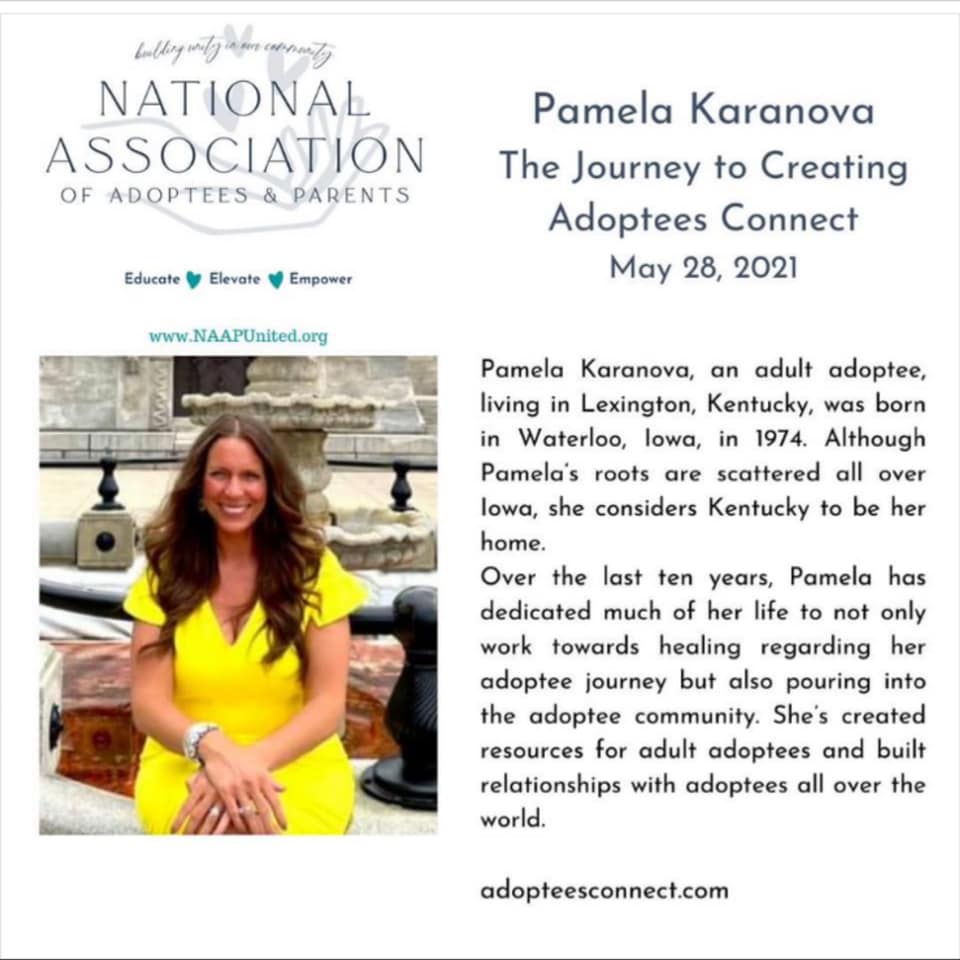

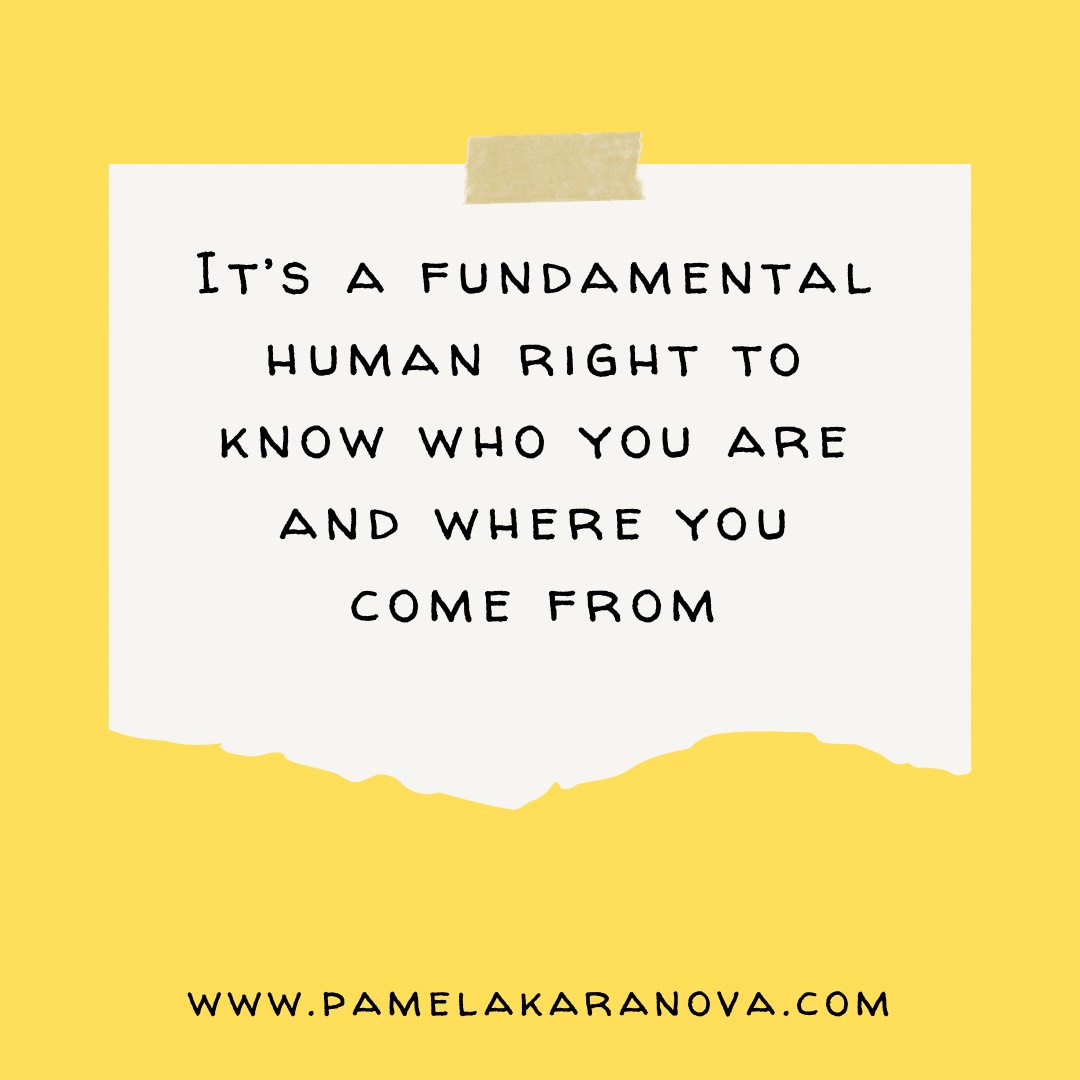
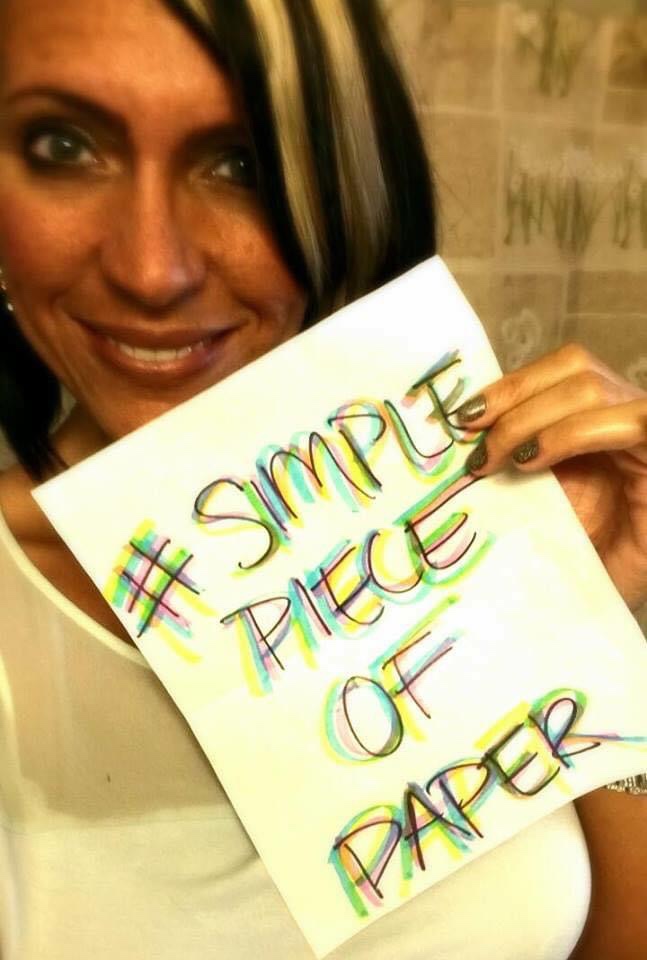
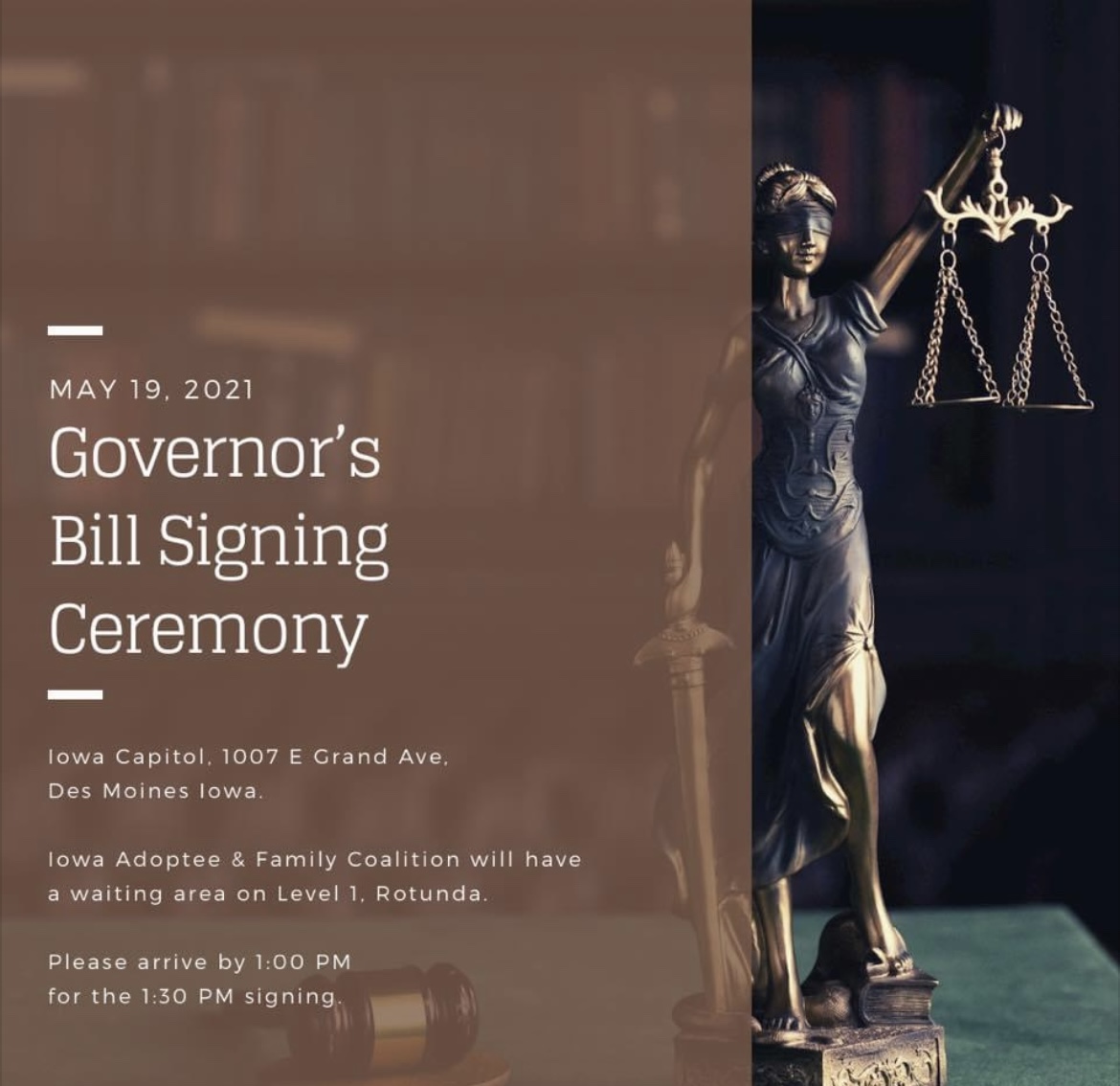


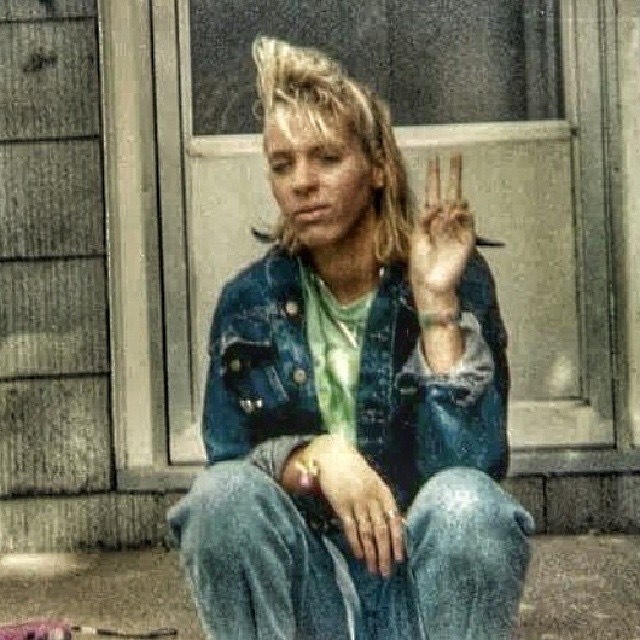
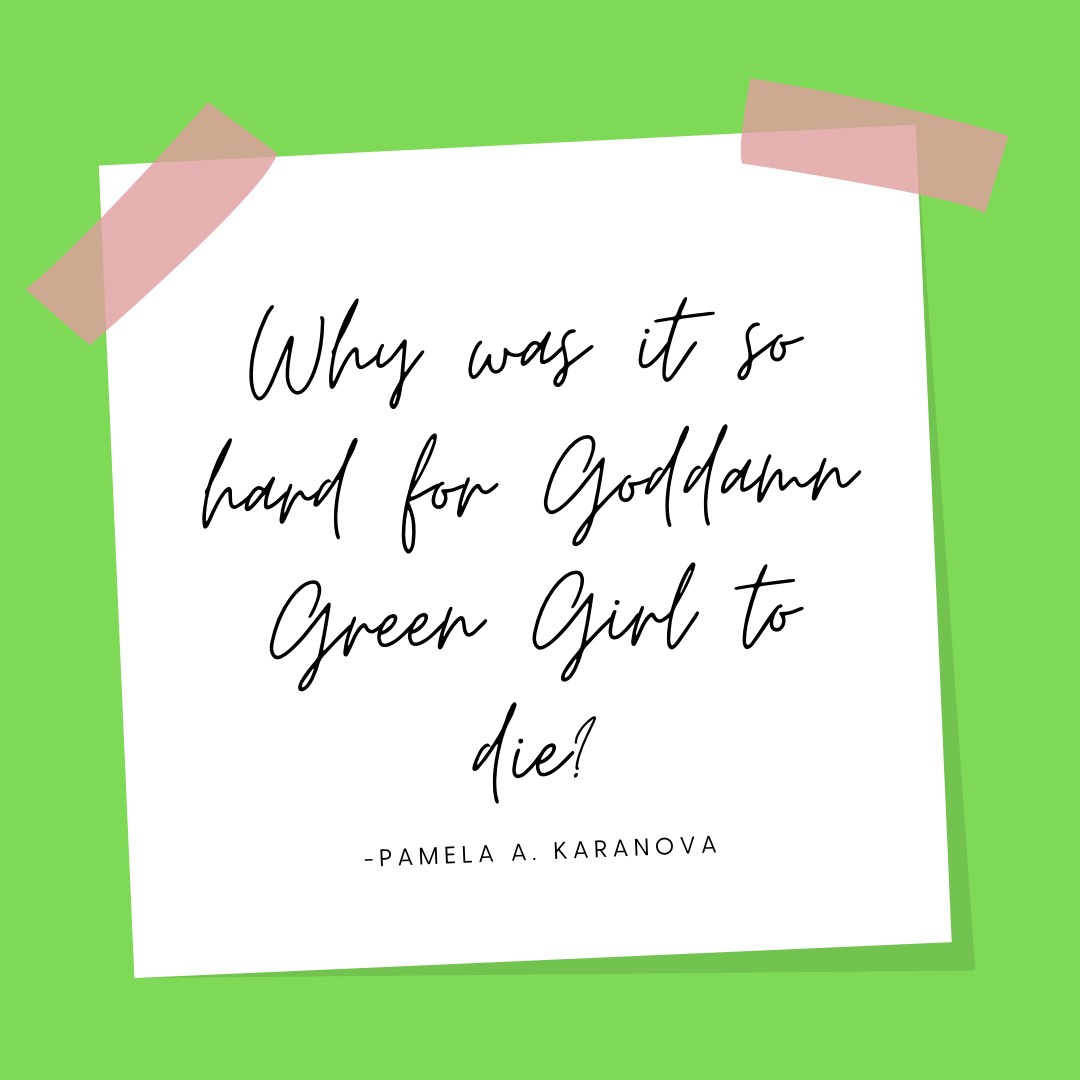


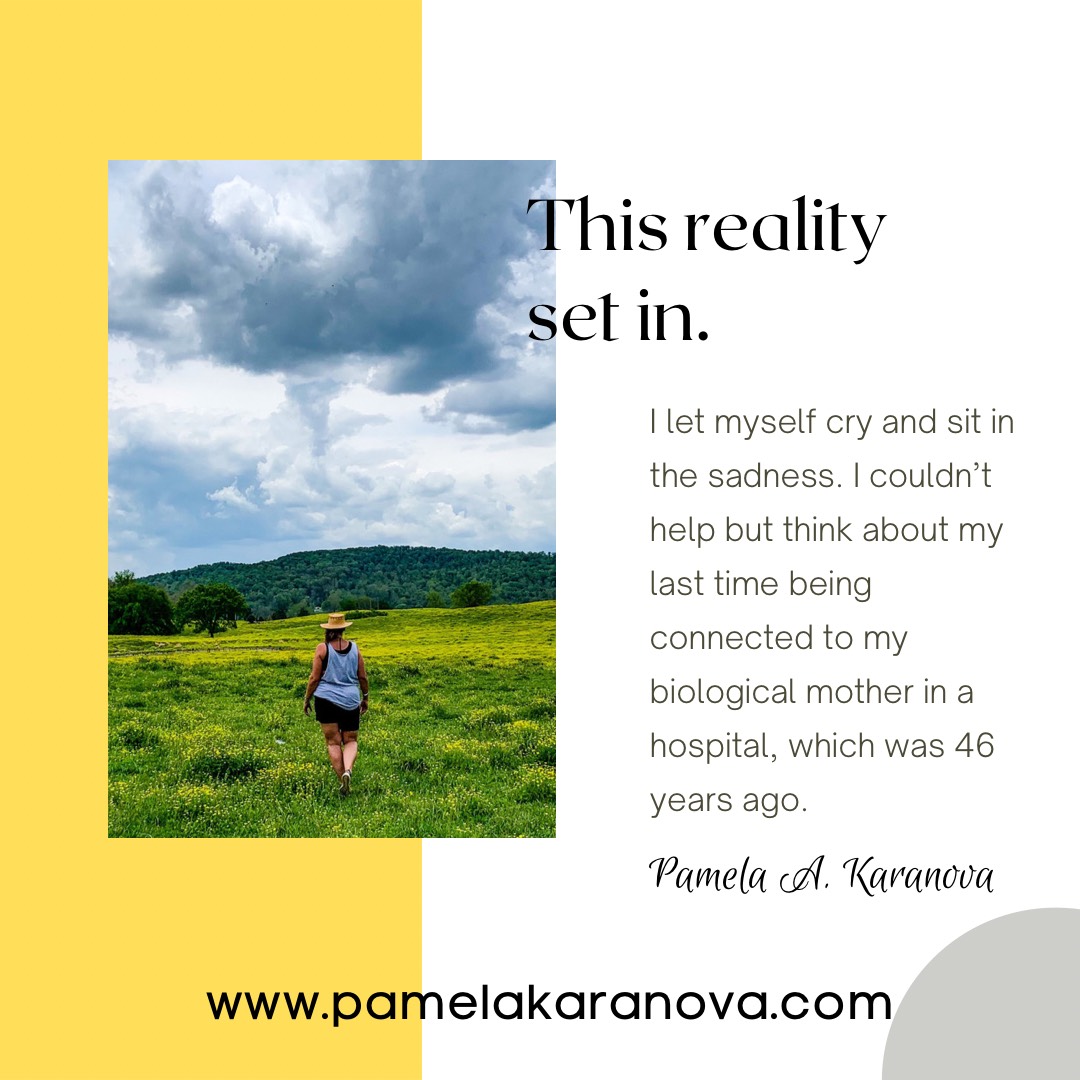
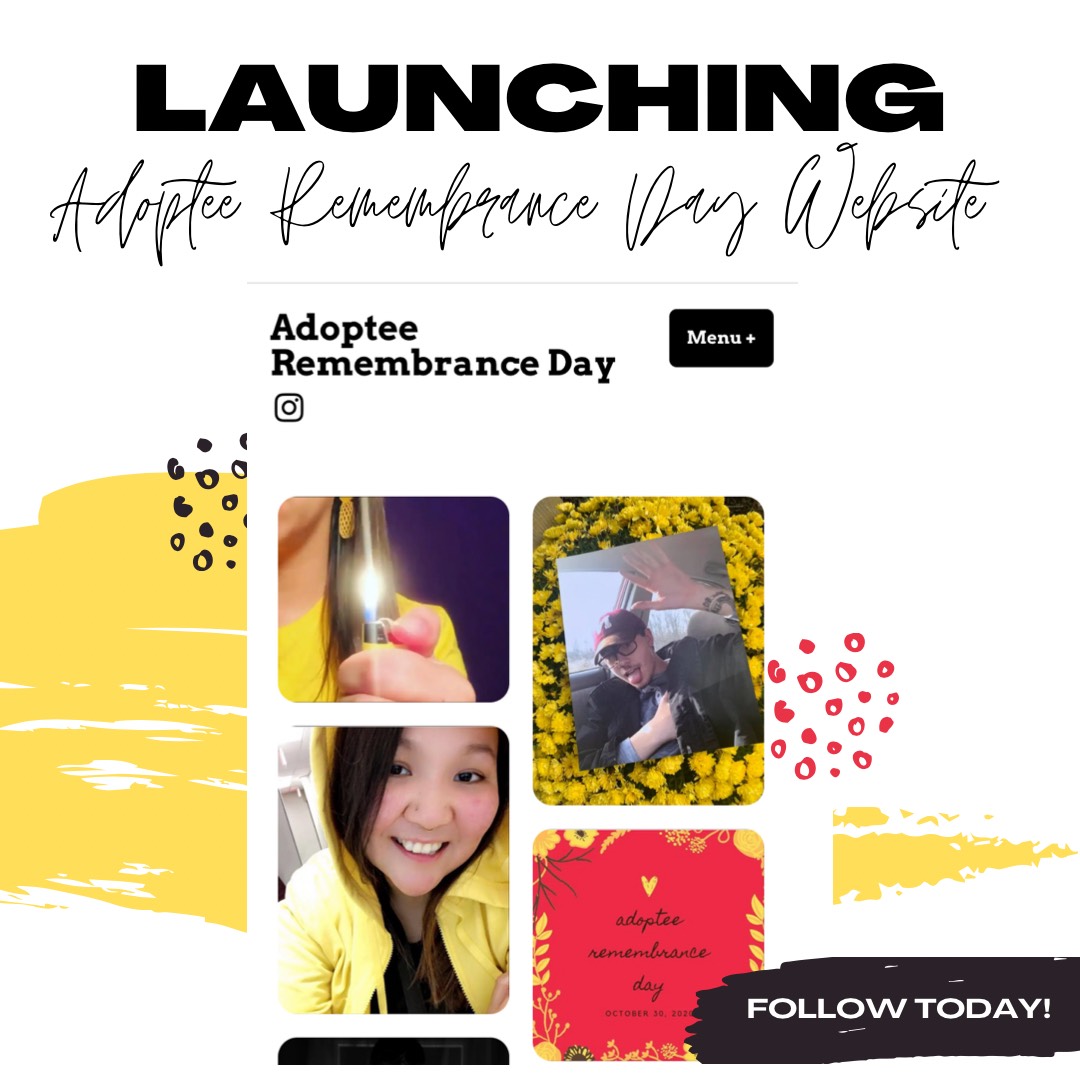

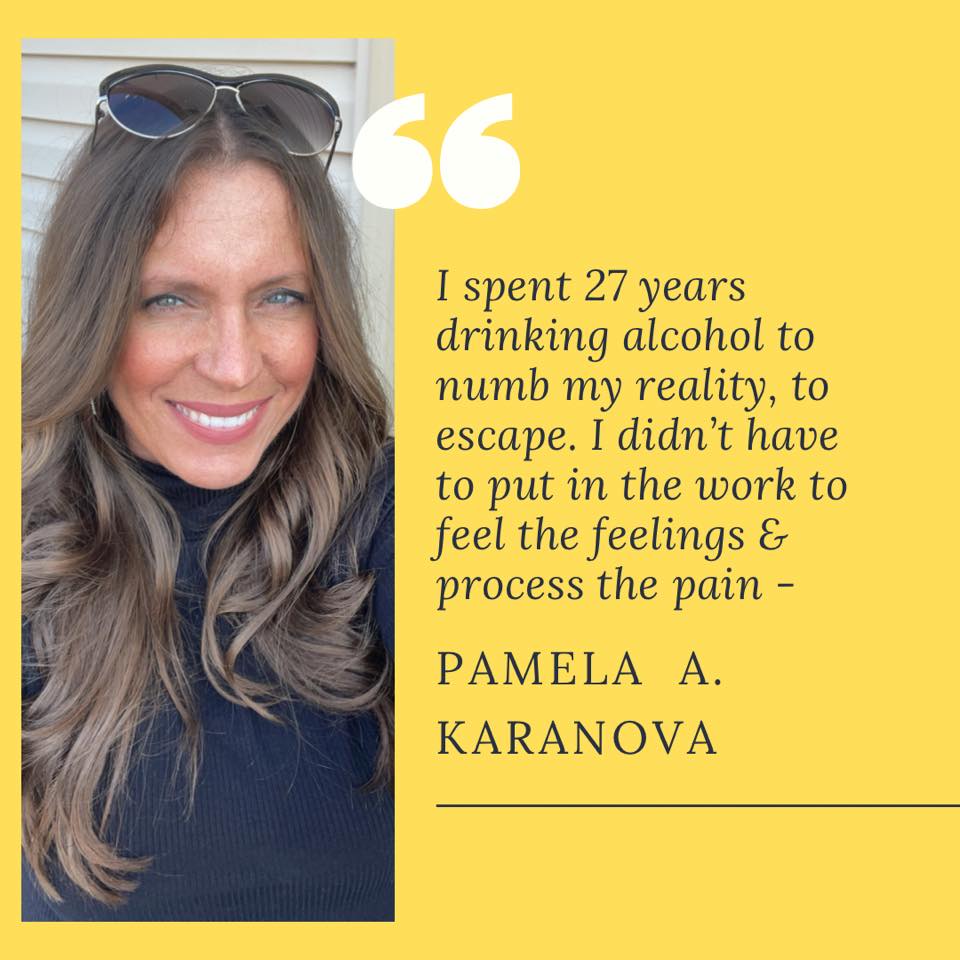




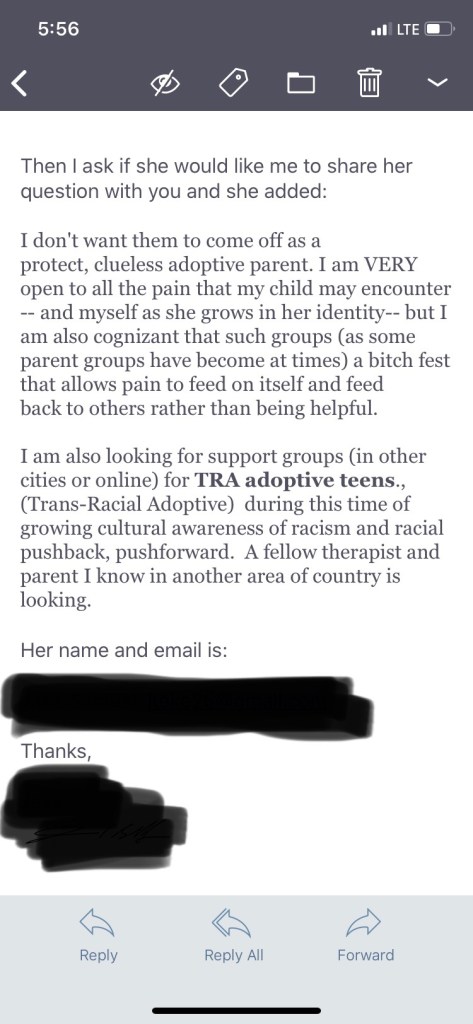



 Pamela A. Karanova