The Real Adoptea Moxie by Pamela A. Karanova is now on SUBSTACK! 

Pamela A. Karanova is an Adult Adoptee, Writer, President of Adoptees Connect, Inc, and the Founder of Adoptee Remembrance Day – October 30th. Pamela has been featured on Adoptees OnReligion News ServiceReckoning with The Primal Wound, and Overcoming Odds.

Bold | Courageous | Fierce | Writer | Unruly Adoptee | Truth Seeker | Uncensored

Adoptea – Dishing out authentic, bonafide adoptee realitea one click, article, comment, and post at a time, adding uncensored and unfiltered rants and raves with an occasional impromptu cup of hot tea & virtual chat time with fellow adoptees & subscribers. 

Moxie – Moxie describes someone with a fighting spirit. If you’ve got moxie, you’ve got confidence, grit, determination, and nerve. If you’ve got moxie, you have a growth mindset, which means you can’t be stopped by an emotional response to a challenging situation and, ultimately, not by anything. Moxie is a word that means: strength of character. It means courage and spunk.
For over a decade, I have been curating adoptee-centric writings with a focus on difficult and challenging topics about adoption on my website www.pamelakaranova.com. As a result, I have exceeded over 200,000 views and hundreds of articles to elevate the adoptee’s voice and lived experiences. In addition, I am the recipient of The Angel in Adoption Award and several awards for the best adoptee website. I have spent countless hours creating adoptee-centric resources for the adoptee community and built lifelong relationships with adoptees and those in the adoption constellation worldwide.

What is The Real Adoptea Moxie?

One newsletter will drop every week & another will drop monthly!

On Substack, I will focus on sharing new and unique pieces of my writings about topics related to the adoptee experience from being in the fog, coming out of the fog, search, reunion, grief, loss, trauma, anger, rage, healing, and all the layers that can come with the adoptee experience. Over the last decade, I have navigated continuous areas in my healing journey. I am enthusiastic about sharing some of the knowledge I have gained with you on the Substack platform. I share one piece of extended writing here for free each month, but I also offer a 5 dollars a month paid subscriber option.

Around the first of each month, all subscribers receive an “Ask Me Anything” newsletter — which will answer one or two adoptee-related questions from paid subscribers. Think: What adoptee healing tools have been the most valuable to you? How have you navigated the grief and loss process? What made you want to search for your biological family? How was your reunion once you searched? Do you regret searching?

Each week paid subscribers get the “The Real Adoptea Moxie Insider TEA” newsletter, which includes sections like:

  • In My Adoptee Opinion — I sound off about adoption topics based on my experience being an adult adoptee. Example: what it’s like growing up adopted, how specific layers of the adoptee experience have impacted me short term and long term about grief, loss, abandonment, rejection, anger, rage, substance use disorder, raising kids, relationships, cutting ties, setting boundaries and much more!
  • Smash that Lie — I share popular myths, secrets, and lies many adoptees are told and set the record straight. I will also link stories/resources from other adoptees who touch on this topic.
  • I Highly Recommend — An overview of recommended resources I have used personally and why I recommend them for adoptees or others in the adoption constellation.
  • Helping Hands & Healing — A advice section that helps a subscriber deal with a current adoptee problem. I suggest adoptee healing tools that have helped me along my journey and share healing tools with fellow adoptees.

The paid plan is $5 per month or a discounted $55 annually.

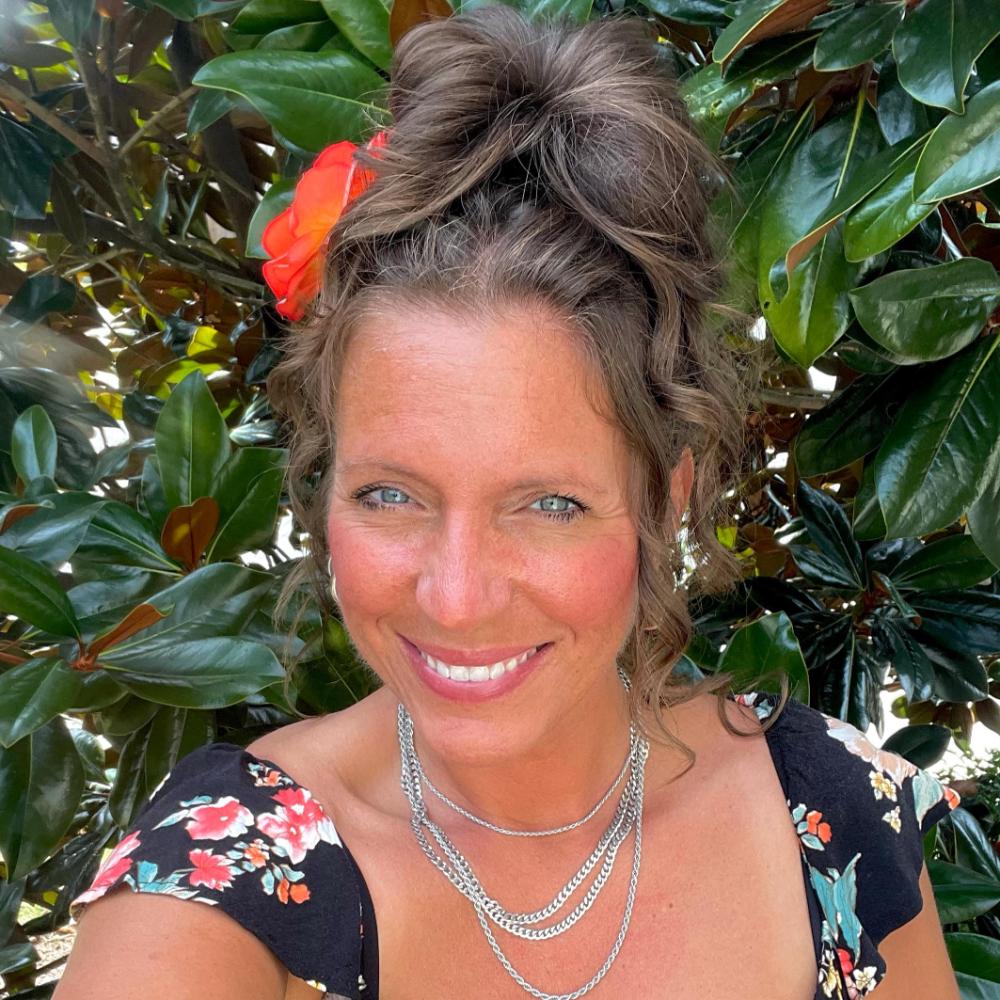
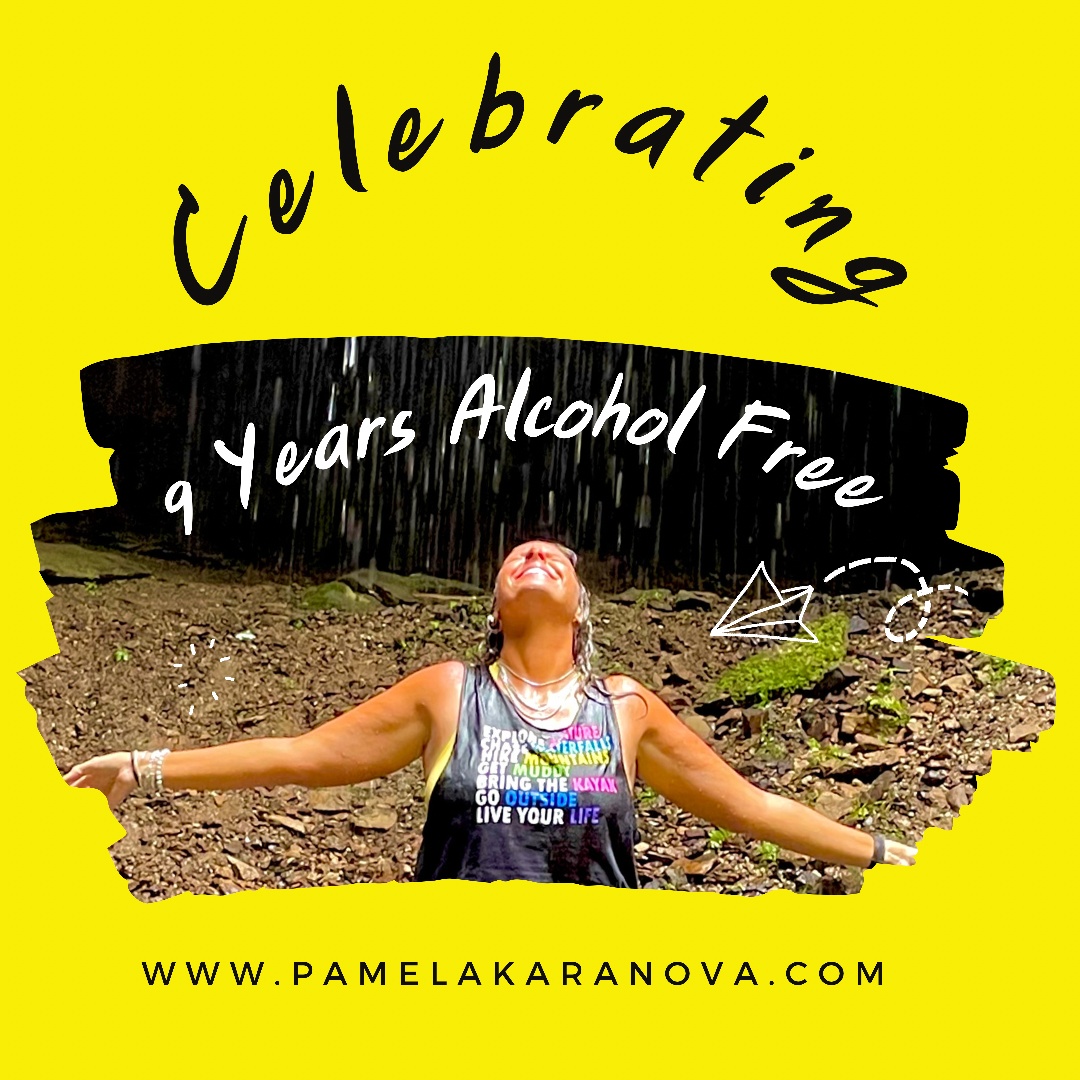
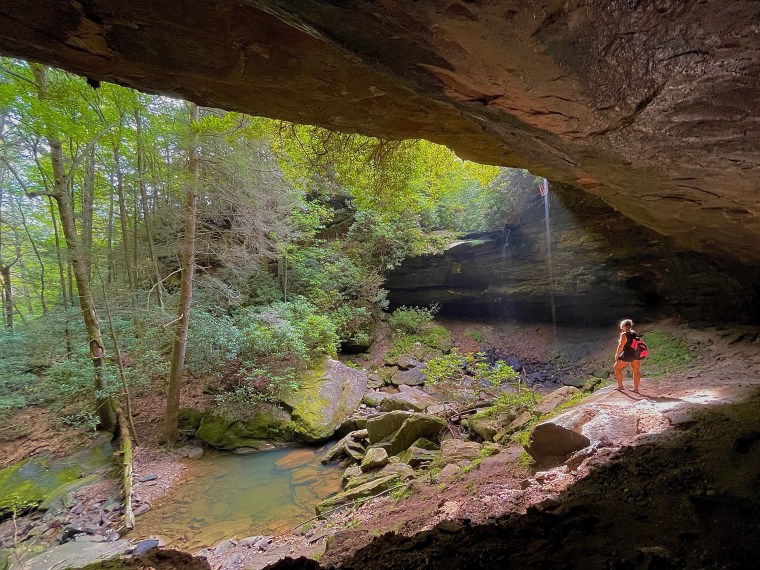
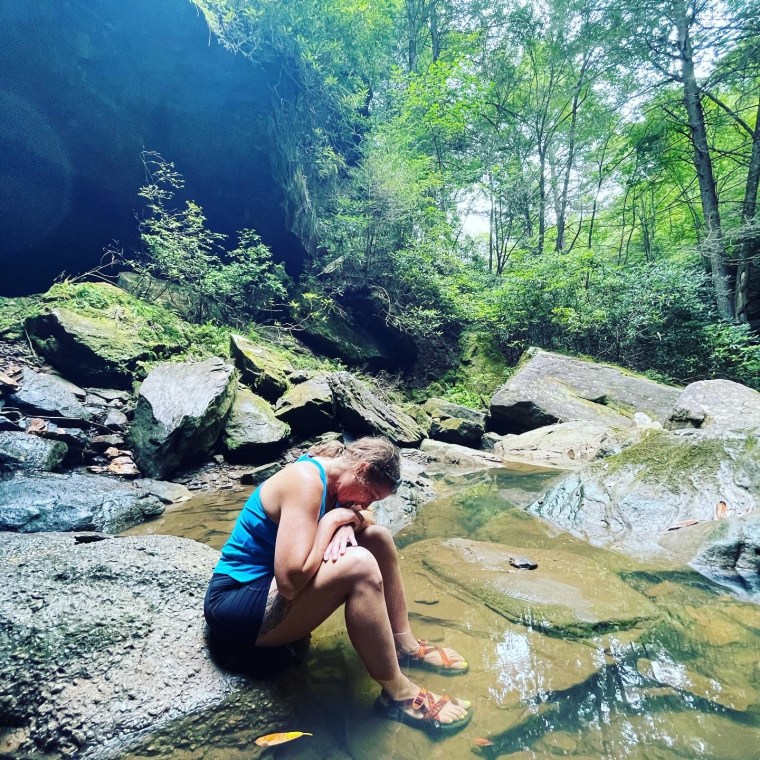
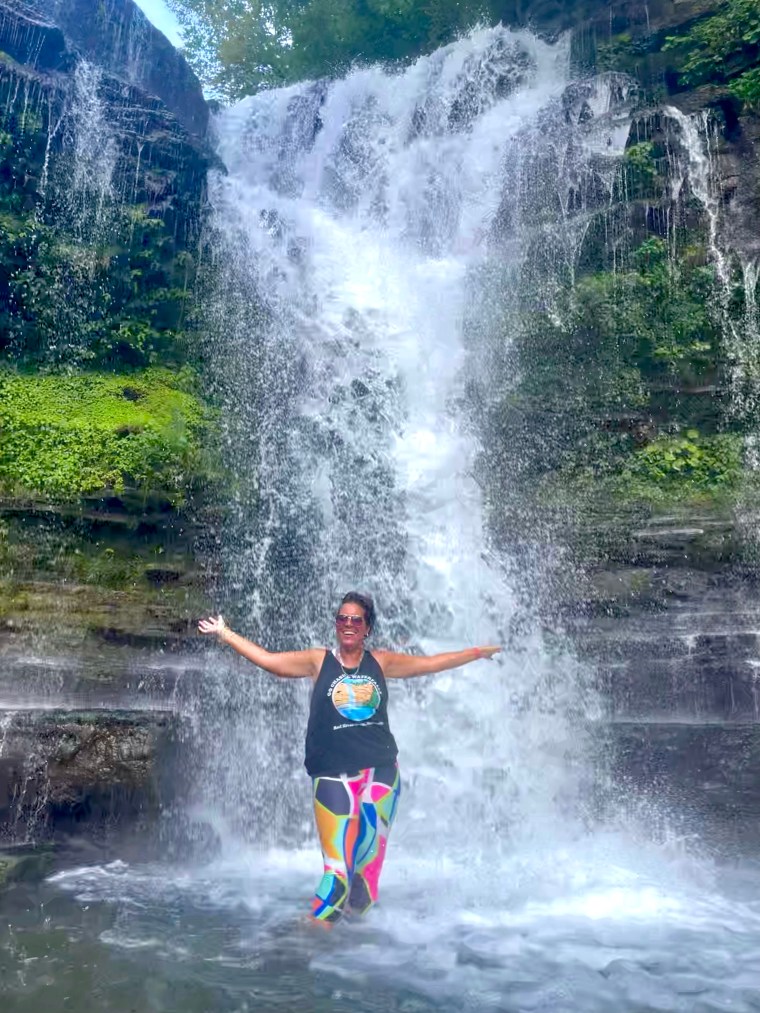
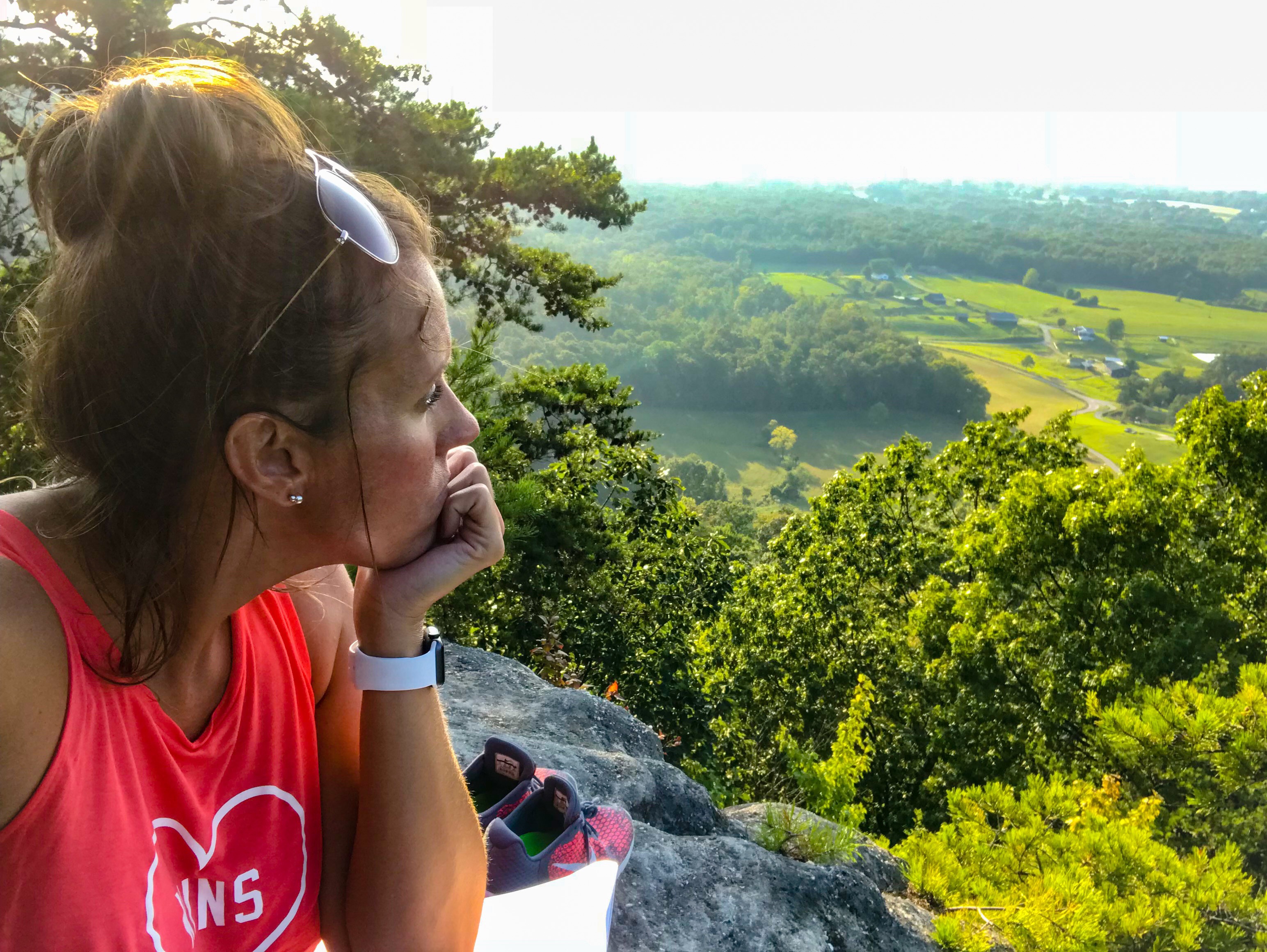
Plus, the occasional waterfall or hiking photo — like this one of me basking in a waterfall!
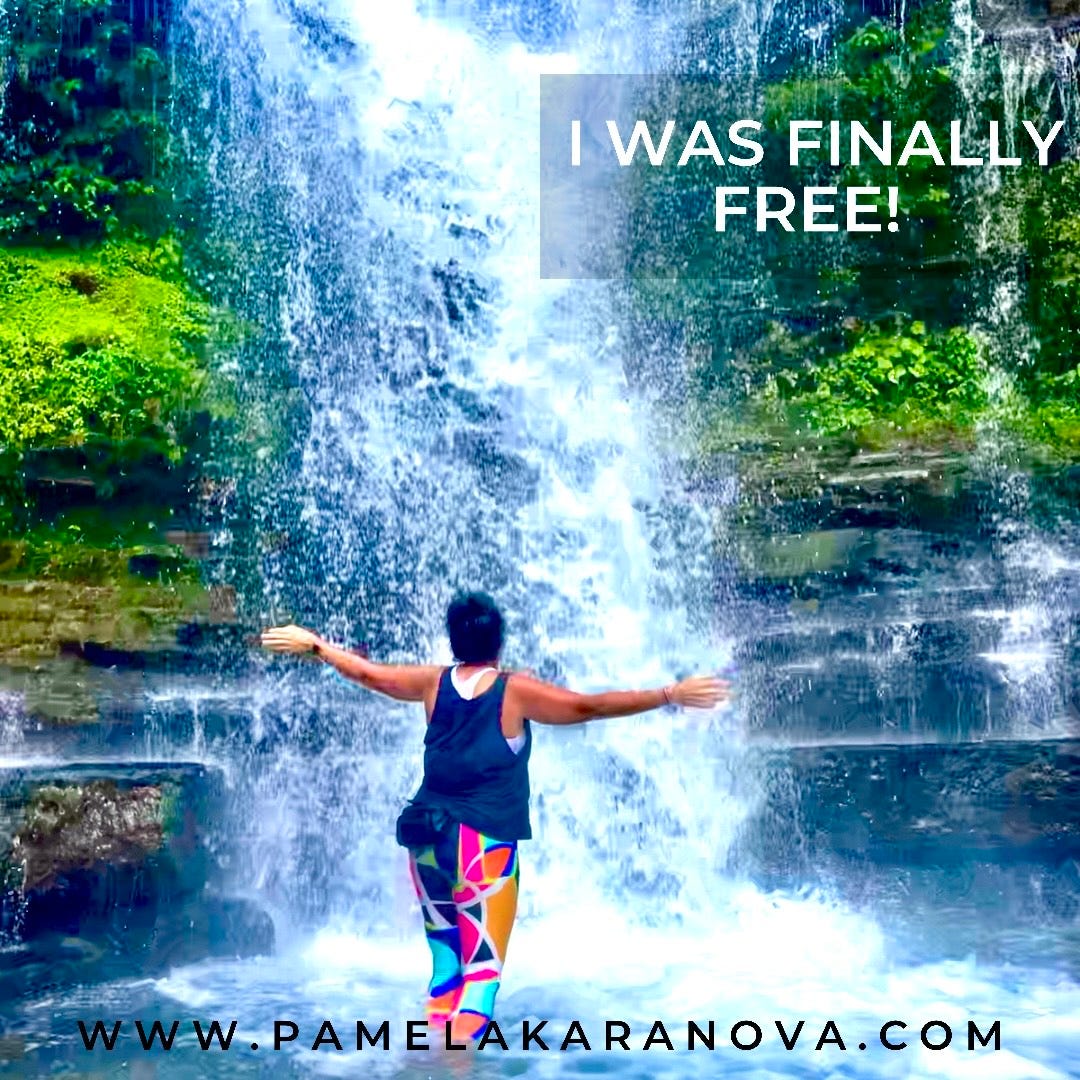
This is Cummins Falls State Resort Park in Cookeville, Tennessee. The hike through the gorge is 2.4 miles in and out and runs into a 75 feet high waterfall you see in this photo.

Who would benefit from The Real Adoptea Moxie?

Anyone who wants to learn more about adoption! I’ll cover various topics, from the basics of living as an adult adoptee to deep heartfelt topics about what it feels like to be adopted and navigate the adoptee journey with the goal of healing. (And you don’t have to be a fellow adoptee to subscribe. Anyone can subscribe!)

Mostly, I’m excited to establish a supportive community for those who are a part of the adoption constellation and non-adopted individuals who have the willingness to learn by offering the 5 dollar a month subscription option.

While most of us have adventures with social media, at times, it’s more challenging to go deeper into our conversations and connections with one another. The Real Adoptea Moxie will be a community built on support for one another’s growth and to gain understanding and validation regarding our adoptee experiences. It’s a place of dishing the adoptTEA in bold honesty, truth-seeking, truth-telling, and uncensored experiences, thoughts, and fierce transparency about adoption from an adoptee’s perspective.

I am committing to spend some time each week in the comment sections of the writings that will be open for subscribers to spark conversations with one another. I will also host an occasional impromptu Adoptea Time by way of a virtual chat space for paid subscribers!

No matter where you are in your adoption/adoptee journey, I’m confident this newsletter will be entertaining, fun, and informative. Whether you’re a free or paid subscriber, I’m excited to have you as part of The Real Adoptea Moxie Community. For my website followers, feel free to follow me over to Substack! I will still be writing on my website, but most publications will be shared at Substack in advance. I would love your support so please consider downloading the Substack app and subscribing today.

Thank you for being so supportive, and I look forward to connecting with you more profoundly through The Real Adoptea Moxie Substack Platform!

The Real Adoptea Moxie is a reader-supported publication. To receive new posts and support my work, consider becoming a free or paid subscriber.

TO SUBSCRIBE TO THE REAL ADOPTEA MOXIE CLICK HERE.

I AM GIFTING 10 LIFETIME SUBSCRIPTIONS TO THE REAL ADOPTEA MOXIE ON SUBSTACK TO MY WEBSITE FOLLOWERS. PLEASE REPLY TO THIS ARTICLE IF YOU ARE INTERESTED.
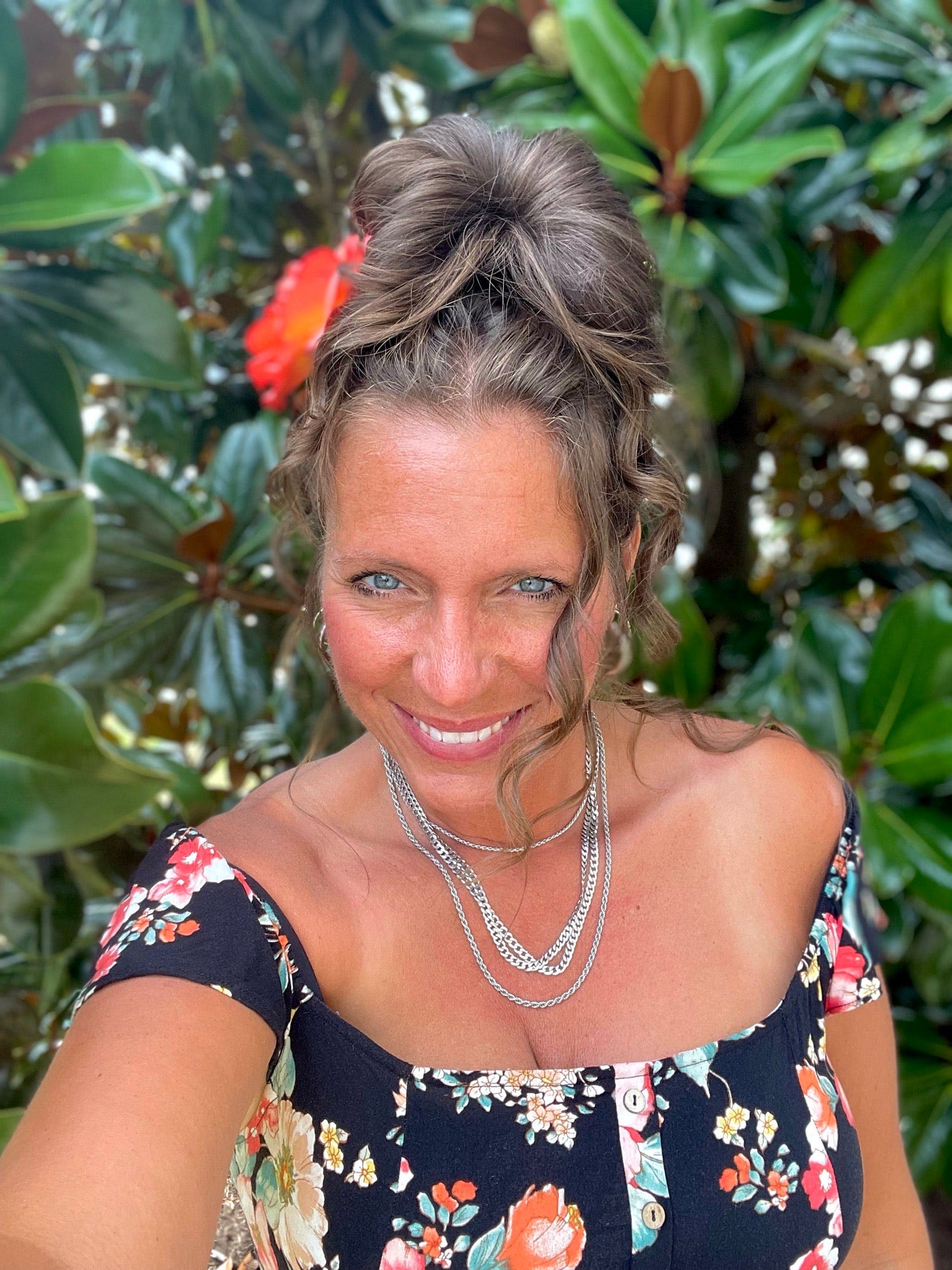
Pamela A. Karanova

Here are some of the writing pieces I’m the proudest of:

The Perplexity of Forced Bonding in Adoption – I share my thoughts on the bonding process in adoption.

100 Heartfelt Transracial Adoptee Quotes that Honor the Truth of Adoption – 100 Transracial Adoptees come together to share feelings on how adoption has impacted them.

Adoptees, Why Are You So Angry? – Adoptees share feelings on why they are angry.

Why Do Adoptees Search? An Adoptee Collaboration – Many adoptees experience why they choose to search for biological families.

100 Heartfelt Adoptee Quotes that Honor the Truth of Adoption – 100 Adoptees come together to share heartfelt feelings on how adoption has made them feel.

My Friend Has an Adopted Child, and They Don’t Have Any Issues with Being Adopted – Shining a light on the comment so many adoptees hear over and over.

Here are some of the articles I have been featured in:

These Adoptees Refuse to Be Christian Pro-Life Poster Kids by Kathryn Post of Religious News Service.

Toward Preventing Adoption- Related Suicide by Mirah Riben.

Before a month celebrating adoption, a day to recognize adoptees’ trauma by Religion News Service.

Bringing Adult Adoptee Issues to Light by Angela Burton of Next Avenue.

“Adoption Loss is the only trauma in the world where the victims are expected by the whole of society to be grateful.” – Rev. Keith C. Griffith.

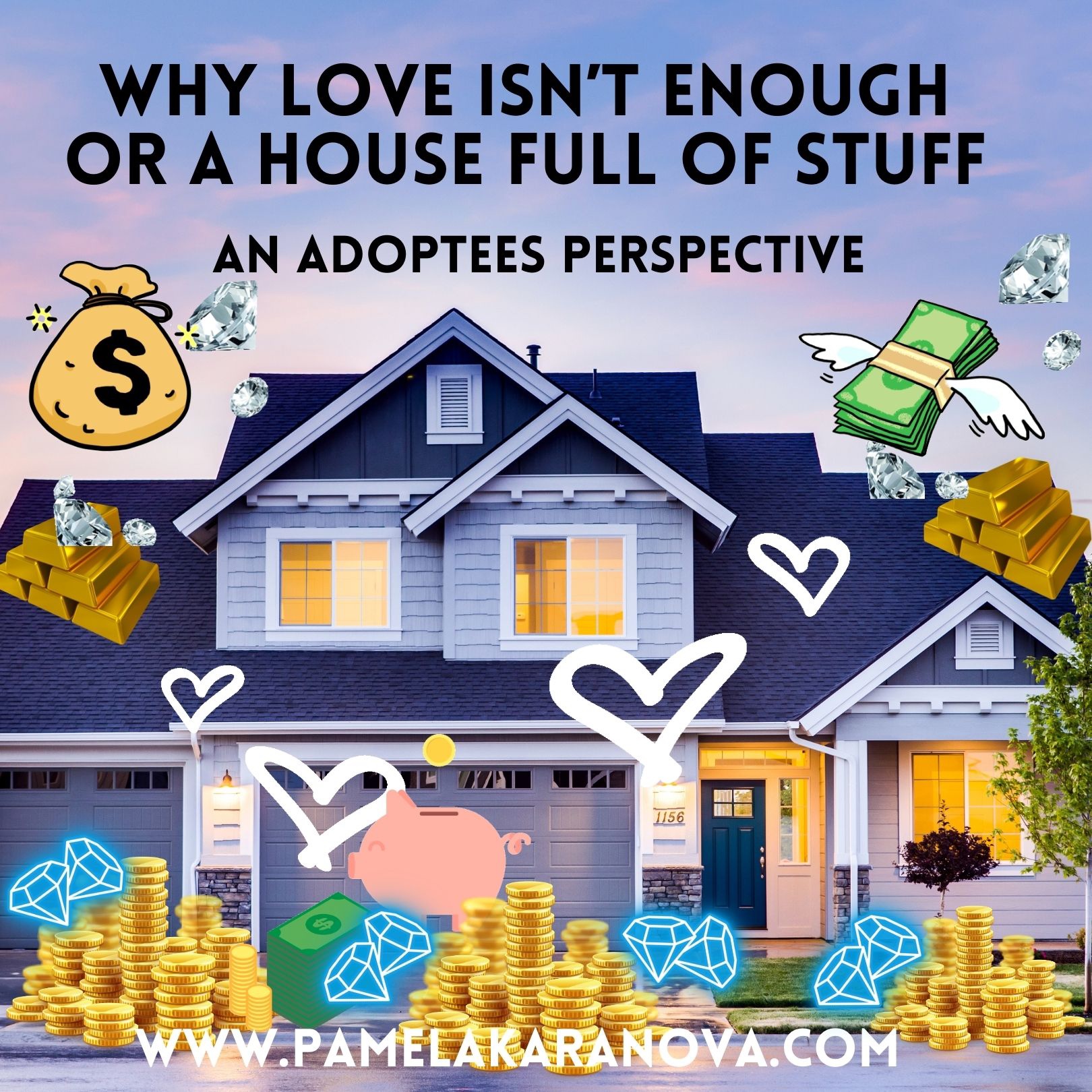
Why Love Isn’t Enough or A House Full of Stuff – An Adoptees Perspective

Why Love Isn’t Enough or A House Full of Stuff – An Adoptees Perspective By Pamela A. Karanova

We’ve heard it for centuries, as early as 1967 when the Beatles released a number-one hit song, “All you need is love.” The lyrics have echoed throughout time, wildly reverberating throughout adoption communities. However, adoptive parents shine bright when it comes to wanting to offer Love to the child they hope to gain through adoption, placing it at the forefront of their motives to adopt. While they might have pure intentions, there are some layers to the adoptee experience they should consider.

What if love isn’t enough or a house full of stuff?

What if the wound from separation trauma is too big to heal?

What if they adopt a child that doesn’t bond with them?

What if the adoption agencies and advocates haven’t been honest and forthcoming about the other side of the narrative that’s almost always ignored, the feelings of an adopted child once they grow up?

What if they have been sold a lie regarding adoption, and they don’t know what they don’t know?

What if they know it, yet they have chosen to ignore it?

I’ve written about this topic in 2015 in an article titled – Love is Not All We Need. Love can’t replace knowing our medical history. Love can’t replace us knowing our ethnicity or our culture. Love can’t allow us to see the invisible ghost faces of our biological parents. Love can’t replace all the memories lost forever. Love can’t make up for a life beginning on a bed of lies. Love can’t cure a lifetime of the grief and loss we feel. Love can’t forge a bond with our adoptive parents. Love can’t fix the broken bond with our biological mothers. Love can’t form my identity that’s split between two worlds. Love can’t heal my broken heart that is shattered from my adoption experience. Love can’t make me trust when those who say they love me most lied to me. All that was lost in the name of LOVE can never be fully fixed or repaired. Love does not compare to a lifetime of pain that an adoptee carries. Love is not enough.

No amount of Love in the world can refurbish the maternal bond that’s been broken when an adoptee loses their biological mother. In writing this article, I hope that this reality is acknowledged and recognized by society because the wound created by the separation from our biological mothers is a wound we carry our entire lives. But unfortunately, the reality for many of us is that the wound is too deep to heal and can impact every area of our lives. It doesn’t stop there. The damage also echoes through generations to our children and their children.

The Secret Life of the UNBORN CHILD by Thomas Verny, M.D. says, “Your unborn baby is sensitive to his parent’s feelings about him, capable of responding to love – We know now that the unborn child thinks, feels, and hears. Smoking, drinking, drugs, food, sounds, and emotions of the mother all affect the health and well-being of the unborn child. The mother and child share experiences, stress, anxiety, peace, harmony, and joy. Her physiological by-products of those experiences are communicated across the placental barrier.”

Suppose we know this to be true while the baby is in utero. In that case, it must be confirmed after the baby is born and relinquished for adoption; separation from our biological mothers forever has lifelong impacts. What does this mean when a mother has decided to give her baby up for adoption?

She likely rejects the growing baby inside her and ultimately rejects being a mother to this baby after it’s born. We would be naive if we didn’t acknowledge this has negative impacts on the unborn baby and the baby after it’s born. Do the research and learn for yourself how critically important the bond between a biological mother and her biological child is. It’s the most important bond the child will have and when it’s broken, repair is a lost cause. It will impact the adoptee deeply.

One minute we have the whole world (our biological mothers), and the next minute she’s gone – forever. Our spirit breaks when we lose our biological mothers.

How can society, evangelicals, churches, and those who support adoption believe that Love and a house full of stuff could replace my entire world that’s gone missing?

I’ve said it before, and I will repeat it, mothers aren’t interchangeable. For me, love couldn’t forge the maternal bond a biological mother has with her child, but it can create an illusion and a counterfeit bond to a woman who desperately wanted a child of her own but couldn’t have any. Being forced to bond with someone, I felt repulsed by was an extraordinarily toxic and damaging expectation forced upon me. It is something I will never “get over.”

I didn’t care what my birth mother was or wasn’t – she was still my whole world. The loss of HER has impacted me significantly my entire life. The original bond that should have been infinite was broken before I was even born while she was pregnant with me.

She drank alcohol the entire pregnancy, rejected me in utero, and after I was born and left the hospital as if I never existed. After I found her, she rejected me again, leaving me brokenhearted, shattered, and unable to grasp or process such a harrowing experience. Especially when I was told, “She loved you so much!” my entire life growing up. How can an adoptee make sense of love when this is our first encounter?

How could she “love me so much” yet reject a relationship with me once I found her? Understanding the complexities behind this reality would take me many years of a healing journey to unravel. It was painful and still is. This is my reality.

My biological mother was in her 30’s when she had me. I was conceived out of an affair with a married man. She wasn’t an unwed young mother who had no choice. My birth father was a close family friend, and he was ten years older than her. Unfortunately, he was married, and my entire existence was kept from him, and I was given up for adoption without his consent.

Knowing this TRUTH has helped me acknowledge, accept, and move forward with healing. However, I want to make a firm statement that no adoptive parents’ love, money, or material possessions in this lifetime could repair the wound of separation from my biological mother or the lifelong journey of fighting the world for my truth. No amount of therapy or religious scriptures could take these wounds away or make them disappear. No God has been able to heal the relinquishment trauma I carry or my life being rooted in secrecy, lies, and deception, and no amount of praying or fasting has made it any better.

No amount of love from my adoptive parents or material possessions will make up for my truth being kept captive for most of my life, which has been the key to my healing. With the truth missing, my grief, loss, anger, rage, identity, and sense of self were enormously affected, impacting every area of my life from the beginning until now. Not just who I am but how I respond to life situations, parent my kids, build relationships, etc.

Somewhere along these lines, society has swept the reality under the rug that when an adoption occurs, the adoptee has to experience the traumatic experience of being separated from their biological mothers FIRST.

Of course, the reason for separation can vary by the story. Still, in the end, no matter the reason for separation, losing our biological mothers hurts us profoundly, and it is a traumatic experience.

Until the world acknowledges this reality, adoptees will continue to die by suicide because they can’t see past their pain. They will continue overflowing prisons, jails, mental health, and treatment facilities. They will continue to struggle, dying on the inside but smiling on the outside.

So, I hope this article lays the realities out in front of the world and that those reading would consider recognizing that in adoption, love isn’t enough or a house full of stuff, and it never will be.

I’ve created a comprehensive list of recommended resources for my fellow adoptees and anyone involved in the adoption constellation. Please use it as you see fit and share it widely.

Much love,

Pamela A. Karanova

Facebook: Pamela A. Karanova

Don’t forget that I’m streaming my articles on several audio platforms for your listening convenience! 👇🏼

📱 iTunes – https://apple.co/3tKzT5f

🌎 Google – https://bit.ly/3JP6NY0

🎧 Spotify – https://spoti.fi/3Ny6h35

📦 Amazon – https://amzn.to/3JScoga

☕️– Buy Me A Coffee https://bit.ly/3uBD8eI
*The views and opinions expressed in this article, memoir, and podcast are that of the author, Pamela A. Karanova. Reproduction of the material contained in this publication may be made only with the written permission of Pamela A. Karanova

100 Heartfelt Transracial Adoptee Quotes that Honor the Truth of Adoption
You have come to the right place if you are looking for the best adoption quotes from the transracial adoptee’s perspective. This article shares 100 Heartfelt Transracial Adoptee Quotes that Honor’s the Truth of Adoption from the transracial adult adoptee perspective.

As we end 2022, I decided to call my fellow adoptees to help collaborate and share quotes from the heart, reflecting the voices almost always overlooked in the adoption constellation. So, 100 transracial adoptees came together to capture some of the feelings and experiences that transracial adoptees go through during their lifetimes.

While you read these quotes, we ask you to remain with an open heart and mind and enter the possibility that we all have a lot to learn from one another. We must recognize that adopted children grow up, reach adulthood, and consume the rollercoaster journey that adoption brings. They are mothers, fathers, sisters, cousins, doctors, nurses, teachers, public speakers, advocates, writers, authors, D.J’s, lawyers, homemakers, students, etc. As transracial adoptees grow up, they host lifelong experiences, and every experience holds value to their lives and stories.

By sharing 100 Transracial Adoptee Quotes with the world, we hope that a new level of awareness will arise that there is so much more to transracial adoption than what society recognizes. Maybe perhaps love isn’t enough or a house full of stuff? Perhaps we should start talking about relinquishment trauma as soon as possible? Maybe adoption hurts more than we would ever know?

Again, we ask for open hearts and open minds.

Thank you to each transracial adoptee who shared their heart here. While you read this article, you will receive validation that you are not alone. We’re in this together, and our voices are valuable and worthy.

We are stronger together.

100 Transracial Adoptee Quotes

  1. “My fundamental outlook on human relationships is: if the person who brought me into this world can abandon me, anyone can. I have inadvertently become an island, trusting no one, grounded by no significant human connections. The word ‘love’ is meaningless to me because it was conflated with abandonment and abuse. I should not know these feelings.”B. Birch
  1. “The way I see it, transracial adoption is human trafficking and the theft of children from the people the world sees as unworthy of raising their own children. I was not adopted, I was stolen.“Elli Mariyama Manneh 
  1. “As a transracial adoptee, your experiences with racism, self-identity, grief, etc., are all unique to yourself, which creates an immense sense of loneliness. Parents of transracial adoptees must know that their child will go through many obstacles they will NOT understand. But it is important to recognize this and always support the best you can!”Miguel Jones 
  1. “I used to pray every night that I’d wake up and be white so I looked like I belonged with the family I was with.”C.C.
  1. “As a TRA, it feels like I culturally appropriate my very own culture whenever I wear or use original clothes, jewelry, accessories, and products from my people. I feel like a total fraud, an imposter that doesn’t belong anywhere.”Jennifer Elise Teer, IG @PiecieLove
  1. “I am a Korean adoptee, brought to Oklahoma in 1982. Becoming a mother changed everything for me. I am convinced, now more than ever, that regardless of the circumstances surrounding my relinquishment, my birth mother still thinks of me from time to time after all these years. There’s no way she does not find herself wondering about the woman I’ve become.”Jennifer H-P
  1. “Dear Adopters, The only reason you were able to adopt me is because society failed my mother and forced her to make a decision she shouldn’t have had to make in the first place. Not yours truly.”Kris 
  1. “Being a transracial adoptee feels like I was set on fire, and everyone around me was ok with the fire because it kept them warm. They all got what they wanted while they watched me burn. The worst part is they expect me to be grateful for burning.”Amanda B.
  1. “I grew up thinking I was white.”Omaira Avila
  1. “Mirrors are a strange companion when no one else reflects you. People and family make it clear, so all you can do is look back at yourself.”Nikolay Arthur 
  1. “Learning in my late 40’s about my Peruvian ancestry, I have referred to myself as a ‘reluctant latina.’  I honestly have no idea what an ‘authentic Latina feels like, nor have I ever experienced the culture of my father’s people.”Lynn Grubb
  1. “Growing up, I wondered who my birth parents were for many reasons. I wanted to know where my physical features came from but also what kind of people they were. I believed if they were good, loving, and smart, that would mean I was. I didn’t believe I could identify who I was until I knew where I came from.” Jen Capeless 
  1. “Love is colorblind, or so they said! Adoption into a colour not your own is beautiful…on the surface for the White Saviour who rescues you. When you find your biology, you truly understand being Black on the outside yet white on the inside. As a transracial adoptee, it’s like straddling two cultures yet fitting wholly in neither.” blacksheep1969 
  1. “It’s illegal to change the identifiable information on your car. Individuals can be fined $10,000  or jailed for up to 5 years for changing the VIN, and nobody bats an eye when the name and date of birth is changed on a birth certificate for an adoptee.”
  • “For every highlighted war hero, there are a thousand more that suffer in silence with the traumas of war. PTSD is the hidden scars of war. Adoption is very similar to the military, where only the positive narratives are highlighted as many more suffer from guilt (being adopted as others are not), suffer from shame (unable to share their abuse), and fear (as they deal with separation anxiety).”
  •   “It’s incomprehensible to me how it’s illegal to sell human organs for profit, but the wholesale of the entire person through adoption is justified by our society.” 
  • “If adoption were a drug, then the evidence of its efficacy would have pulled it off the shelf many decades ago.”
  •   “Adoptions vary like the weather. For every sunny outcome, there is an equal negative, destructive tornado of an outcome that has destroyed either a child, biological mother and/or adoptive family. Therefore, we need to honor all adoption narratives, both positive and bad.”
  • “It’s estimated that nearly 60,000 intercountry adoptees reside in America without citizenship, and roughly 60-70% of domestic adoptions have open records. Adoption laws have made great strides in recent years but so much more needs to be done for every adoptee to have the same rights as a non-adoptee. Of the nearly Seven million adoptions in the United States, it affects almost 1/3 or 100 million Americans face adoption in their immediate family (includes adopting, placing a child for adoption or being adopted.”Jayme K. Hansen
  1. “As a transracial adoptee, I lost my first family, my first culture, my first language—all gone before I even knew I had it. The journey to reclaim them has been long and arduous, and I might never get the answers I want or need. But I will carry on, both for myself and this community.”Patrick Armstrong 
  1. “Having to justify my experiences and realities to the most familiar strangers, fighting to be seen and heard, to two different worlds that I seamlessly exist in, is the most exhausting experience to navigate.”Vanessa Pacheco 
  1. “My parents did an amazing job for the ’80s, and I was always connected with my bio family.  I had a healthy racial identity as black, but you still miss out on some aspects of your culture. However, you learn that no matter how aware your adoptive family is with transracial adoption, they simply can’t grasp living firsthand with racism. At times, they can even use microaggressions without being aware – being an overall positive experience doesn’t negate the challenges. When it comes to transracial adoption, you’re at the mercy of people around you. “Where’d you get them colored kids?” Being “othered” in a space that’s still your own family, it’s a weird complexity. Hair insecurity, trying to find a seat at a table, I’m tolerated but not actually included.”Silver
  1. “I grew up thinking that if I denied my culture and sounded white, people would accept me more.”Marta Aranda 
  1. Being nonwhite, raised by a white family in a white community, has given me a near pervasive feeling of triblessness.  It is communicated in various ways that you are not white but also that you are not of our racial background, especially if you are from a relatively segregated place.  Identity is a constant question.  One of the advantages though is that we get to create our own identities and stories, which is both a privilege and burden that few except us can know.” Andrew Glynn 
  1. “The truth of the matter is that my parents were told that my race was not a factor in how I was to be raised, but race does matter when you are one of the only people of color in your community. Race does matter when you get racially profiled at a store, when someone at work is micro-aggressive, and when kids at school tell you that your skin is ugly and dirty and that you matter less because of it. I struggle to claim my identity as a Latinx person to this day, and I never learned the tools of how to cope with my racially based hate from my family. I used unhealthy coping mechanisms to “stay alive” barely, but luckily, thanks to the online adoptee community, sobriety, and therapy, I am learning how to love myself, brown skin and all.”Joe Toolan 
  1. “Being adopted into a transracial family did not protect me from racism or micro-aggression or being fetishized. I’ve learned that Adoptees might get to experience their birth culture, but they will always experience people’s perceptions of their race and culture.”Cosette Eisenhauer 
  1. “It has taken me years to allow myself to feel angry about my experience as a transracial adoptee raised by a white parent. I want to tell my younger self that my feelings are valid and my circumstances are nuanced. I encourage them (my younger self) to seek those who will provide space to be your full self. You are not too much.”Anica Falcone – Juengert 
  1. “I never feel as invisible as when someone asks me “Do YOU experience racism here?” Hasina Helena, A transracial adoptee who is from India but resides in Sweden. 
  1. “As an International Adoptee, my journey is not exactly the same as that of Transracial Adoptees; however, there are a few intersections. It is from that perspective that I share this feedback. As an Afro-German child growing up in a family that was rife with racial microaggressions was difficult. Clearly, the only way for me to be comfortable in the midst of these conversations was to consistently deny my bio mom’s ethnicity and the European part of my own. There was absolutely no inclusion, exposure, or discussion of German culture.  There were 25 years between the year that I learned I was adopted and the year that I finally met relatives that looked just like me. Having no familial mirror was very difficult for me. I was expected to sink or swim prior to that moment. Upon my reunion with my first family, my adoptive parents admitted that they knew my biological family all along. WTF!?  It changed everything for me and my connection to them. However unconscionable, it was also the defining moment that made me choose to be the one to not spoon-feed generational trauma to my own children.”Jacquelin Taybron 
  1. “In my experience as a TRA, I was often shamed for wanting to know more about my birth family. When I did ask about them, I was told I was selfish, and I was dismissed about wanting to learn more about my culture. I was once told that I can be black but not too black.” IG @thespeckledadoptee 
  1. “Being a transracial adoptee, it’s living with the fear your physical features could condition the way others will treat you.”Maria Daozheng 
  1. “We, as the transracial, as the mixed, as the adopted, exist beyond the outer bounds of language, where your words have no meaning, where we laugh at your categories and borders and contradictions. Beyond the safety of your understanding, beyond the limits of your imagination. What power we must hold, then, as to exist beyond this imagination is to know that a better world beyond this one exists, not only in the future but here and now. And that what we create, becomes.”Yohanyy Torres | Andrew Drinkwater
  1. “Being a transracial adoptee makes us a double minority – both racially and biologically. The world is seen through a lens that is very different than most people. Patience, a sense of empathy, and listening from people who understand we think differently are essential to an adoptee’s ability to thrive. We need this to embrace that we matter; that different is good and that we deserve to be heard, even though we know most cannot and will not ever truly understand from our perspective.”Maria Gatz 
  1. “Adoptees don’t always know exactly what they’re going through. They not only need patience from others but also with themselves. If you are close with an adoptee, be patient with them and learn from them. You never know what is adoption-related trauma and what is part of being human.”Zoe Seymore
  1. “Adoption did give me a very different life for which I am extremely grateful.  In retrospect, there was still a good deal missing. Discovering the transracial element of my pre-adoption life has added immensely to the richness of my life. It’s really unfortunate in so many ways that it had to be kept secret. I just wish I had found out sooner.”Jack Rocco  
  1. “I’ve never felt as a TRA that there was a space for me since I knew my birth parents, but I felt so much of the distance from them that I might as well have not. Maybe there is so much vastness and space and language that is not yet created by us and for us as adoptees to claim for ourselves since so many decisions were made for us. After all, our experiences are our own.”Oumou Cisse 
  1. “My parents say that they just see me as ‘their kid’ while still letting friends of the family and/or relatives say some pretty racist stuff to me when I was growing up. I’m 26 now, and I just realize how not okay that all was.” Grace R. 
  1. “I constantly felt like I was sticking out among family & friends, I forgot how comforting it can be to have friends that look like you. Being a transracial adoptee is such a unique experience, so unique that at times it feels almost isolating.”Julie M. 
  1. “Growing up Asian in predominantly white communities, I didn’t understand the importance of representation until I saw myself being represented. With that comes questions, confusion, and pain surrounding racial and cultural belonging.” Phoebe M. 
  1. “I feel like I don’t fit. Anywhere. Not in my current family…they’re too white. Not in my first family…they’re a world away. I’ve accepted that I’ll never fit. Anywhere.”Sara G.
  1. “Alienation. Wherever I turned, I was constantly reminded that I did not fit the society around me. I am a Latina, but I have no connection to that culture. I grew up white, but I absolutely do not look like it. Alienation wherever I looked.”Carmen C.
  1. “For me, trans-racial adoption feels like a constant journey through an identity crisis- a never-ending cycle of grieving, shedding, discovering, losing, gaining, analyzing, & understanding.” Lauren Castillo
  1. “Being a transracial adoptee means living a life of being misunderstood while also being surrounded by assumptions made by others of your own life. It also means never fitting in anywhere, except for maybe the home you make yourself.” Alexis Bartlett
  1. “My white adoptive mom once told me that she believed in nurture over nature until I started exploring my black identity and “acting culturally black.” I still live with the fact that my mom adopted me with the belief that she could love the black out of me. It continues to break my heart, more than thirty years later.”Dr. Abby Hasberry
  1. “You are stronger than your shadows. Sure there has been major upheaval in our life. I was 26 when I was half told I was even trafficked or adopted. All a bit shady, but I know who I am because I spent my life being me and built myself up one day at a time. Hard days? Yes. Gamut of terrible feelings? Of course, racist attacks, obviously from within my family and not, BUT only if you allow externalities define you does it transform you. Do it yourself, you’ll be happier and less upset. Ciao. Iranian adoptee to an Italian family, raised in Canada.”Flavia Nasrin Testa
  1. “I grew up thinking I was a fraud. Not enough of anything, but always too much. I was told I was no different, so what I was feeling could not be true. There is a hollowness to my sense of self that will always be there.”I Used to Be Sam
  1. “As a transracial adoptee adult, who was raised with the “colorblind” worldview, I was dangerously unprepared for college, city life, and the world. Leaving for college, I vividly remember being convinced racism was not real. As an adult, navigating Blackness, Whiteness, racism, and discrimination for the first time without the “cloak of (white) privilege” life was devastating and demoralizing for me. I felt bamboozled in college, after college, and in many instances in life still to this day.”Molly E. McLaurin
  1. “I felt Swedish, I breathed Swedish, and I lived Swedish – everything I did growing up other white Swedes did as well – but of course, as soon as anything negative happened in school as a kid or teen, it was all blamed on me, and my sister – the psychiatry got involved as is the practice here and only the two adopted kids got labeled, after which we got our rights removed as young adults – the practice is such that whenever an adopted kid/teen is involved in any trouble the psychiatry will label you, we’re sacrificed as scapegoats by the psychiatry and they don’t give a fuck about context, we’re treated like foreigners – not like citizens by them – the statistics tell of adopted kids being four times more common in the psychiatry, and in the suicides for a reason.”Victor Fernando Nygren 
  1. “Growing up, my white adoptive parents forced me to believe they were my only family. Because of this, I’m unable to connect with my Indian culture. To the point where I don’t feel Indian. Sometimes it even feels like an Indian woman didn’t give birth to me.”Winnie 
  1. “I always felt as though I wasn’t “Latina enough” or fitted in anywhere being a Transracial Adoptee. And being torn from my ethnic culture was not my choice as a child. However, reclaiming my roots and my power as an adult on my terms has been my choice, and I am grateful for it because now I realize that HOME has been inside of me all this time.”Sarita Buer, Latina TRA – @saritawellness 
  1.  “Being a TRA has wreaked havoc on my mental and emotional health. Referring to Maslow’s Hierarchy of Needs, my sense of security, belonging, and esteem was neglected when I had no racial mirrors during the formative first 19 years of my life. At the age of 55, I still have no sense of belonging, my self-esteem is in the trash, and I struggle forming lasting intimate relationships.  I wouldn’t wish this internal battle on anyone.”Karen Elliott 
  1. “I think people often think that being adopted is a glamorous experience and a fairytale ending, and I’m here to say that yes, it was an experience I had, but the fairytale ending does not exist.  I have been navigating the intersections of my identity as a transracial international adoptee from South America, growing up in a predominantly white community, along with several other adopted siblings.  These experiences, while unique to my story, are very common, and I have realized how much of my mental health has been impacted by these many layers of my identity.  I hope people understand that being an adoptee is complicated and not as easy or wonderful as some people may think.”Ana Felicia, Colombian Transracial International Adoptee 
  1. “This is what no one told me about being adopted…No one told me that I would find out that I was out of the loop when the most crucial moments in my life were set in motion. No one told me how misplaced I would feel — how I would grow up knowing that I am different, with my origins erased. That I would struggle with buried trauma, racial identity as never-ending grief, because I’ve lost something that I can neither recover nor just “get over.” – Eun Kyung Chee 
  1. “Biological connection means nothing and everything at the same time. You’re told blood doesn’t make a family, and love is a choice. But if love is a choice, then why is it so hard to choose to love yourself? Not knowing your true roots and being reminded of that harsh reality every time you look in the mirror, at your adoptive family’s faces, or at everyone around you who doesn’t resemble you at all makes self-love difficult. And being adopted, being biologically different certainly wasn’t my choice.”Kelly Hrank 
  1. “Growing up, my experiences as a transracial transnational adoptee had been narrated and carefully curated by my white adoptive parents. As a child, the only feelings I was allowed to access were gratitude and happiness, and my own adoption story didn’t even belong to me. Coming out of the Fog freed me to embrace the anger, loss, and grief I had also been feeling my entire life. And to eventually meet a worldwide community of adoptees and witness others who felt exactly or similarly to me was validating and necessary for my adoption trauma healing.”Maze Felix (They/Them)
  1. “Being a multiracial transracial adoptee is a constant search for identity. It is a constant navigation between belonging and not. I feel roots that I don’t know how to access and, at times, explore without feeling like an imposter. It is a constant practice of coming back to myself in acknowledgment that I am enough by just existing.”Tisa A.
  1. “For me, my adoption is the “fairy tale” version, the one people think they’d be getting out of the whole experience. But just because the princess is happy now doesn’t mean her trauma is gone or no longer hurts her. She’s stuck in an endless loop of ‘what if it didn’t happen’ or ‘who was I supposed to be’ and feeling like an imposter at all times because she’s been playing a part she didn’t ask for. Yet, she wouldn’t change a thing because she loves herself for her strength and understanding adoption has given her.”Supposed to be Selena
  1. “My closed transracial adoption was full of lies and deception regarding my ethnicity. This led to a lifetime of confusion, searching for clues to my racial identity. I never fit in and had no “tribe” or culture to claim as my own.”Signed, T. Adams
  1. “Here’s an inside scoop to understanding an Adoptee’s Grief: No matter the explanation for why they were given away, babies do not understand logic and babies do not understand politics, but instead, all they know is that they were abandoned. Babies, instead, should feel safe, secure, wanted, and loved, but that is all lost in the process of relinquishment and adoption. Their baby self has learned the message that they are unwanted and unloved, and so the only way for Adoptees to heal is through self-love.”Haley Hudler, Chinese American Adoptee, adopted in 1997.
  1. “Who I was before the fog was a version of me wearing a mask which was chosen for me. An identity handpicked. Now, here I am after the fog. Maskless. Identity reclaimed anew.” Harley Place, Indian Adoptee 
  1. “I know what it feels like to hold a piece of myself that will never have a true sense of belonging to one culture or family, and that piece of me will always feel lost and stranded. I know what it feels like to grow up being racially isolated and wishing I were white, wishing I looked like my parents. I know what it feels like to be loved by my parents and to have the knowledge that their first preference was to have a biological child.”Amanda Fallon, Korean American Adoptee, Adopted in 1982.
  1. “I may have been adopted from India by white people, but that doesn’t give me white privilege. Ever since 9/11, I receive far more uncomfortable looks from people at the airport.”Nandeeta Ramsey
  1. “Adoption is my roaring broken heart beneath the expectations of love-starved strangers. It is the daring, lonely, and unending pursuit of finding doors and the skeletons they hide. The idea itself of embracing arms, of belonging, is the only home I’ll ever know.”“Amanda” Wild
  1. “Like many transracial adoptees, I’ve always felt like a part of many worlds but more like a visiting tourist. My twist is that my adoptive mom was Mexican, and I’m white, so I grew up around relatives speaking Spanish and eating tamales at holidays, but since my mom didn’t make an effort to raise me as bilingual, I’m unable to access her/our full community. Now I send my little white kids to Spanish immersion school to [re]connect with our Mexican roots (that don’t actually feel rooted to my whole identity), which also gives me cultural appropriation vibes, but it truly was and is a big chunk of my multi-layered culture. So I’m in yet another space where I feel like I don’t belong- transracial adoptee communities that are seemingly all people of color.” Mari Triplett
  1. “My proximity to Whiteness as a result of being raised in a White household didn’t shield me from experiencing racism. It deprived me of learning how to exist as a POC and instead taught me how to erase my sense of identity, culture, and self.”Dong Mee
  1. “As a Chinese transracial adoptee who was raised by my Jewish mother in a predominantly white area, I experienced a lot of confusion surrounding my cultural, ethnic, and racial identity. I spent a lot of time feeling like I wasn’t Asian enough or Jewish enough, no matter how much I tried to fit into those two labels. Since finding the adoptee community, I finally feel like I’ve found a place where I truly belong and can just be my authentic self.”Shelley Rottenberg | IG: @shelleyrottenberg
  1. “I feel impostor syndrome follows me throughout all of the cultures I’ve grown to be a part of, especially my own. I feel an openness to other races that is not reciprocated by anyone I know, as I don’t know any other trans-racially adopted people. I feel proud to be celebrating my culture as I learn it, whereas others who have grown up with this culture may leave it behind or take it for granted.”Soni
  1. “I feel blessed that a family wanted me because upon finding my birth mother, she didn’t want anything to do with me after our first initial meet-up. When I think of transracial adoption. I realize the blessing lies in being able to identify with more than one ethnicity, and this trait allows my future work as a social worker to be impacted positively when it comes to the skill of tuning into the client, intellectually and effectively!”IG @stay_driven05
  1. “I never know which culture I belong to. My Bulgarian Romani or my American that I was adopted into. I feel like I don’t belong in either, and when I do, I feel like an imposter.”Maria
  1. “I never felt like I fit in, I lost my roots and my culture. I remember never knowing what I was ethnically when I was asked and telling my white friends they should be in my family photos instead because they looked more like everyone else.”Chelle Cook
  1. “In grade school, I was one of the only Asian people in my predominantly white community and was heavily bullied for it. I didn’t even understand that I was being bullied at the time, so I never told anyone about the constant racist comments from my classmates. This, combined with having a white adoptive family, ultimately led to a big identity crisis, and it’s taken me a long time to start healing. Surrounding myself with people who accept me and exploring the adoptee community has helped me so much in my healing journey, and I hope other adoptees struggling can find loving communities just as I have!”Kaeli Walker
  1. “The system of adoption has hurt both my adoptive parents and me and simultaneously makes it impossible for us to heal together. It has pitted us against each other, but we are not adversaries. We share collective pain.”Julie Emra
  1. “Anytime I experienced racism or someone questioning my race or ethnicity my adoptive mom would always answer, “but you’re Italian too. Did you tell them that? I found out later I’m not even Italian.”Rhiannon
  1. “Transracial adoption feels like having a house but never a home. Knowing that something/someone is missing, but not knowing how to fill that void. Perpetually isolated even when surrounded by your circle of love.”  – B
  1. “Strangers constantly pointed at me, asking my parents, “Is THAT your daughter?” My parents tried to pass me off as some exotic European, so I learned my true ethnicity by way of a schoolmate’s racial slur. My mom said I looked like a racially derogatory term when I braided my hair. I stood no chance of forming a healthy sense of self and will forever feel alien and disconnected.”L. Calder
  1. “My mental picture of myself was so whitewashed that I couldn’t even recognize my own reflection. How do I reconcile my brownness with a culture that was taken from me?”A. Kumari
  1. “I wasn’t adopted to take a pill. When I act out, I’m heartbroken, not mentally ill.”Tinabtinari  
  1. “My birth mother did not write that my father was Puerto Rican on the birth certificate, fearing I would be adopted by a Spanish family. I spent my whole life thinking I was Irish and English. My adoptive family was in total disbelief that I am half Hispanic.”Terri
  1. “As a transracial adoptee in a white country: “Family-seems to always end up being something I have to prove myself belonging to and worthy of”Hasina
  1. “As a community, we often connect over our trauma and pain. What would it mean to build radical joy, love, and abundance? I have found that joy outside of the adoptee community by connecting with other movements where I can share new perspectives as an adopted person. What would it mean for our adoptee community to join broader movements for social change and add our voices to them?”m. Seol 
  1. “I am a queer, trans, non-binary, neurodivergent, autistic, ADHD, PTSD, Asian-Chinese transracial + transnational (self-estranged) adoptee, survivor, artist, and human. I feel like I was just an object that was purchased and sold overseas as a ‘simple’ solution to a privileged white, cis, het couple’s infertility struggles, to fulfill their dream of having a baby and raising a family, except that each time that I strayed further from their idea of who I should be/who they wanted me to be for them, I got into trouble and made things worse for myself by exploring and expressing who I was. The greatest disservice of my transracial/transnational adoption experience was growing up and being treated like just another white member of the white family I was sold to because there were never conversations about race, I had to figure out on my own how to deal with racism and racist remarks directed towards me or in media, I never developed any early sense of comfortability with being Asian-Chinese, and they never allowed me to go outside of the child they wanted me to be, even when me trying to meet their unrealistic expectations almost killed me and lead me to several mental health struggles and life-long trauma. I AM NOT A SOLUTION, I AM A HUMAN/AN INDIVIDUAL, AND IT IS A DISSERVICE TO TRANSRACIAL ADOPTEES for adoptive parents to NOT embrace the child(ren)’s culture, language, food, history, and everything there is to know for the rest of their lives because THIS IS ABOUT SUPPORTING THE ADOPTEE AND THEIR LIFE; ADOPTION IS TRAUMA.”IG: @ohheyyits_aj (they/them)
  1. “Adoption has brought me the most pain, privilege, loss, and love I could have ever imagined. I want people to know that the act of adoption is traumatic; losing your biological family, heritage, culture, language, and much more is trauma. I want people to know that I don’t think all adoption is bad, but I DO think people who consider adoption should heavily do their research. And lastly, I want people to know that I am enough, I am Asian enough, and I belong in both Asian and American spaces.”  – Lori Scoby
  1. “There has been a great struggle in my life to fit in. Like trying to make a square peg fit a round hole. So, it felt like being forced to whittle pieces of myself away even though I could never truly be like everyone around me. White.”Hanna Lee
  1. “Being a transracial adoptee has always made me feel alone, unworthy and unwanted because I was “different.” “Didn’t have real parents who loved me” and never fit in with the ‘cool kids.’ Recently though, I learned that family is not always blood and true friends never judge you and love you for who you truly are. Being labeled as ‘adopted’ can be challenging to accept, but I’m learning to be proud of my label instead of embarrassed or ashamed. Because I’m adopted, I’ve found a loving and supportive community online and in real life, and I’m extremely grateful for my growth and who I’m becoming.”Allyson Ware
  1. “I have had to fight my entire life to get back a fraction of what was taken from me, my language, my people, my country, my culture, my roots. I have fought so hard only to feel at times like it’s still not enough. I should never have had to fight for something that was my birthright.”Marcella Moslow
  1. “There’s a difference between having a home and feeling at home. As a transracial adoptee, I’ve never experienced the latter, even though I grew up in a supportive, loving home. I currently live in a home and have built a life that’s overflowing with love, support, and empathy. Yet there remains a deep, innate void that permeates my soul, and I believe it will only be fulfilled when I return home to Korea.”Tory Bae
  1. “My parents raised me with the “color blind” mentality that I was no different to anyone in the sea of white people I grew up around while simultaneously using my Asianness as a virtue signal in their saviorist narrative for adopting me. Since I was the first Asian person many people met, I was treated like I was the purveyor of all Asian culture & knowledge even though I was a child. I wish more people become aware of how patronizing it is to live with the belief that white people/the West are deemed better suited to adopt than the people of the same race/ethnicity of the children.”Katie L. 
  1. “Abused, neglected, orphan adopted changes for families and nations to their delight, yet then is 4x more likely to suicide. Thank you for shifting the way you think and act about adoption to change that STAT.”Kristina Lisa 
  1. “As a transcultural adoptee, I struggled for a long time to define my identity and what true belonging means to me—Until I discovered the concept of the third space. Here, I can liberate myself from external expectations and labels and be firm yet fluid in my self-understanding. I am Korean, I am German, and I am everything in between and beyond—I am simply Sun Mee.”SUN MEE MARTIN
  1. “While my feelings about being adopted and being Korean-American are complicated, and they change often, I’m beyond thankful for adoption and the family it’s given me – my family is one of the clearest pictures of God’s goodness in my life. But it’s also really hard – being adopted is hard, and being Korean-American is hard, so having both of those experiences intersect can be confusing and painful at times. For me, having the safe space to process both my grief and gratitude has been so sweet. I’m thankful for the friends and family I have who have shown me Jesus through asking questions, listening to me ramble and reflect, and just being present for me in my pain and doubts this year.”Kim G Instagram/Twitter – @kg_hyunmee
  1. “Quantum Leap Living, where life situations suddenly move me from one continent or situation to another- shedding and acquiring cultures, language, and even my own new/old names, has left me struggling my entire life with realizing I deserve a choice and say in my life. I’ve had to learn this through many emotionally and physically abusive relationships- I simply did not realize I had a choice. I thought “things” and people just happened to me, and I learned to endure.”IG – @lalasunmi
  1. “My recent journey has been to recover/reclaim my Colombian culture and to reconnect it to my identity. All this with the hopes of integrating these aspects of myself that were lost to adoption. It’s also about remembering who we are behind all the social programming of family and society expects of us”Elena Di Giovanna Serrato
  1. “Just because an adoptee is a certain race or was adopted from another country does not mean they have an obligation to learn the language, be interested in the culture, etc., of their birthplace. While there are many who wish for this, there are many who do not. This is part of an adoptee story. It shows the range and depth of our interpretations of personal experiences and should be validated.”Emily IG – @languagetraveladoptee
  1. “Sometimes there’s a small feeling of envy for seeing others and families where the kids look like their parents. It’s not necessarily skin color but specific features. As a transracial adoptee, we sometimes feel more connected to others who are from the country we are born in and, as an extension of the culture. But really, we are culturally never going to be them, and our features will remain uniquely ours in families that brought us here, and that’s one thing not to envy.”Tara S.
  1. “Being an adoptee is like being an elephant in a family of lambs. The environment that the elephant grows up in will affect its mind and heart. Don’t think it won’t, you’d be lying to yourself.”Megha
  1. “Being a Chinese adoptee in America has had its ups and downs. I have struggled with feeling like I don’t always fit in and like I’m not good enough. Growing up, it was a constant battle trying to figure out and accept my identity. But even through the struggles I’ve faced, being a transracial adoptee has made me the strong woman I am today, and now I can proudly say I am a Chinese Adoptee.”Olivia L.
  1. “Though I am a Haitian raised by a non-BIPOC mother, I am not “transracial.” Trans means to erase, transition or transfer. There was nothing left behind, nor did I forget any part of myself. I only had to awaken to this truth: Nothing was left behind, and even my ancestors came with me.”Lanise Antoine Shelley
  1. “Adoption took not only my identity but my existence itself. Rootless, I felt the string that tied me to this world was broken. Faceless. Bodyless. Like if I didn’t exist until I found where I come from and who I am. How could I exist if there was no beginning? Now, I know.” Andrea Maldonado
  1. “Culture that runs through the blood but doesn’t reach past the tongue.”Savannah Quinn
  1. “Parents of transracial adoptees need to step in and advocate for them when they experience racism. It’s hard to self-advocate as a kid when you barely understand you’re a target of racism. The love of family is not a force field for racism-you need to be a vocal activist too.”Sara W. 
  1. “The lines you created were an illusion. I know this because I crossed every one of them. When I didn’t fit into your box, you got scared. I got abandoned.”Shaka Firefly IG – @shakafirefly 
  1. “My biological mother didn’t know or didn’t care to identify my biological father. She went so far as to have the wrong man sign away parental rights to me. I later learned she did know who my true father was and hid a huge part of my identity in the process. I was raised my whole life to believe I was white until I found and reunited with my Puerto Rican biological father.”Luna Ashley IG: @thelunaashley
  1. “I have always known I was adopted and that I was Chinese. My adoptive mom made sure of that. That piece of my identity is why I am here, at the University of Minnesota, studying social work with dreams of working with transracial adoptees like me. I was privileged to grow up being proud of my race and ethnicity. I’m here because I want others to have the experience I did and not live in shame or sadness for not being White.”Ariana Meidan
  1. “Hearing a deep sense of calling from your unconscious ancestral  being within but unable to unlock the secrets or hear its song.”Jade
  1. “I’m so curious how come adoption has yet to solve the historic – current problem of leaving behind young – elder person, place, thing blamed, shamed, scapegoated, trashed that I began seeking and sharing solutions.”River Riika IG: @witchtotake

If you’ve made it this far, thank you for taking the time to read quotes from 100 transracial adoptees. Please share this article in your online communities. Our hope is that we raise a brighter light around adoptee voices and bring the truth to light, one story, quote, and click at a time.

If you are an adoptee, what quotes spoke to you the most? Could you relate to any of your fellow transracial adoptee’s quotes?

Maybe you are an adoptee and missed the call to be included in this 100, we still want to hear from you! If you are an transracial adoptee who has a quote to share, please drop them in the comment section below.

If you are not an adoptee, but you have been impacted by this article in some way, we would love to hear your thoughts as well.

Once again, a special thank you to all 100 transracial adoptees who took the time to share your quote with me, and in return collaborated with one of the most important articles we can share. 100 transracial adoptees coming TOGETHER to share your truth is a powerful initiative.

XOXO P.K.

Don’t forget this article along with all my other articles are available in audio for your convenience, just look up Pamela A. Karanova Podcast on Google PodcastsiTunes , Spotify. and Amazon Music. Interested in treating me with a coffee, to add fuel to my fire? Click here. Many thanks in advance to my supporters!

Concluding Adoptee Remembrance Day – October 30th, 2022 but Adoptee Voices Will Continue to Blaze

by Pamela A. Karanova

Adoptee Remembrance Day: October 30th, 2022, has recently passed, and the collective echoes of adoptee voices can be reflected worldwide. To learn more about this day, click here

It’s no surprise at the outpouring of support the adoption community has received about this special day of remembrance for adopted people worldwide. No doubt about it, it was a difficult day, but every day, being an adopted individual, comes with its own struggles. Yet, we must consider that adoptees have never had the support they need to navigate such a lifelong, complex, and emotional journey. 

One of the core components of Adoptee Remembrance Day is to create one day before National Adoption Awareness Month which is in November and National Adoption Day, November 19th, where adopted individuals can share from the deepest parts of their hearts the reality of how adoption makes them feel. Unfortunately, the Pro-Adoption narrative has always dominated the narrative, but adoptees are dying, and we can’t afford to stay silent. 

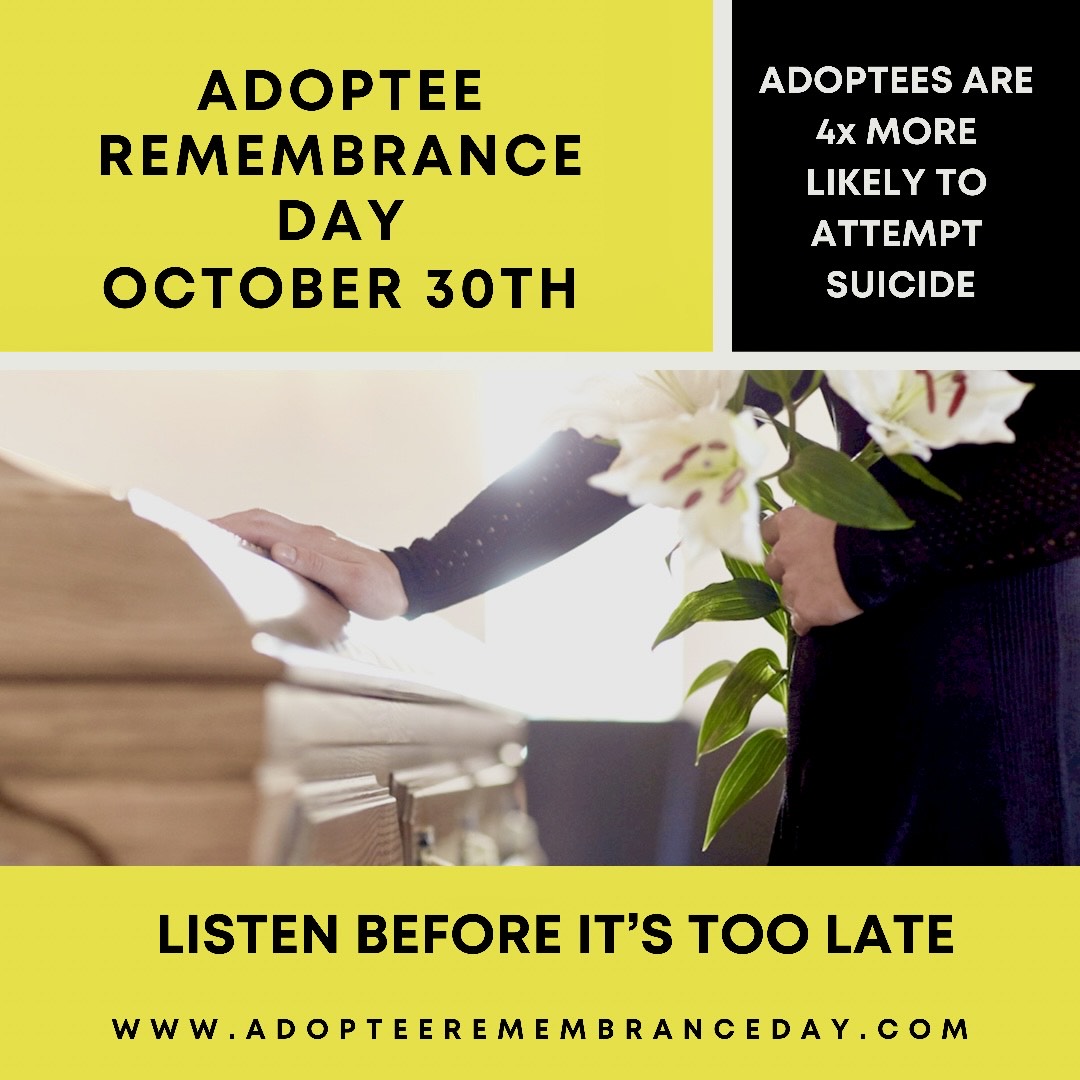
Adoptees are overrepresented in prisons, jails, treatment, and mental health facilities, and we are 4x more likely to attempt suicide. Thankfully, the tides are turning, things are changing for the future generations of adoptees, and adoptee-centric resources are starting to surface more than ever before. But unfortunately, even with some resources surfacing for adult adoptees, our cries for help have been ignored for far too long. This is one of the many reasons Adoptee Remembrance Day – October 30th was created.

With our collective efforts, we’ve picked October 30th annually to share our hearts, and adoptees from all over the world showed up for this day, and they showed out. I couldn’t be more proud to be a part of this community. The adoptee experience is unique to each of us, yet we all share the ultimate loss of our beginnings, which can impact every area of our lives. 

Photo Credit: IG: @nikki_often / Artist / Korean Adoptee

Nikki’s Tribute, “Don’t let the feeling that I’m all alone deceive me. Among the many reasons for this day, Adoptee Remembrance Day is to raise awareness about crimes committed against adoptees by adoptive parents, as well as suicide, and different kinds of loss that are experienced by everyone who is impacted by adoption.”

While the internet is overflowing with tributes from adoptees worldwide, we wanted to share a message of gratitude for everyone who participated, adopted or not. Your voice was loud, and we appreciate everyone who took the time to share something on Adoptee Remembrance Day – October 30th. 

As the Adoptee Movement for Adoptee Remembrance Day continues to expand and grow annually around the world, more non-adoptees will learn that there is so much more to adoption than what they have come to know. Between now and then, Adoptees will continue to do outstanding work in the adoption community by raising their voices and sharing the truth about adoption. I commend each of you and appreciate you!

We are so sorry to all the adoptees who didn’t make it because their pain was too great. We will never stop exposing the hidden side of adoption, and we love you. For the adoptees who are hurting and can’t see past their pain. Don’t give up! You are not alone. To everyone who participated, THANK YOU! WE LOVE YOU! Sending you massive hugs of support and embracing you with love and encouragement to press forward in your cause. 

Below are some online tributes for Adoptee Remembrance Day – October 30th, 2022.

Photo Credit: IG: @chung.woolrim / Artist / Adoptee

Lisa Wool-Rim Sjoblom’s Tribute: “Today, October 30th, is Adoptee Remembrance Day. Today we mourn all the adoptees we’ve lost. Those who were murdered by their adoptive parents and other family members, and those who died due to neglect and abuse. Those we lost to suicide. Today we acknowledge all the adoptees suffering in their adoptive homes and whose please for help no one hears or believes. We recognize all adoptees struggling with depression, addiction, poverty, homelessness, abusive relationships and loneliness. We acknowledge those who have been re-homed – some multiple times, those without citizenship, those who have been deported and those who are incarcerated. We recognize all adoptees searching for their first families, all who are not allowed to reunite and all who are trying to get access to their birth certificates and other documents they’ve been denied for far too long. We recognize all adoptees who will never find their families and will never learn where they came from. We recognize that for many of us, adoption is a wound that will never heal, a grief that will never diminish and a trauma we will carry for the rest of our lives.”

Korean Adoptee Community in Germany‘s Tribute: “We are proud of this collage! It shows cohesion, understanding, love and trust. We are an international community and nobody has to be lone! Special thanks to our friends around the world.”

Photo Credit – IG: @sanjaypulver / Indian Transracial Adoptee / Trans Man ‘ Advocate / Shirt = http://www.adopteemerch.com

Sanjay’s Tribute: ” Thinking of all of us who haven’t been able to grieve the losses to our community because we’re supposed to be grateful/thankful. Or even how close I’ve come to that edge because the pain felt is overwhelming and I couldn’t imagine another way forward. For all adoptees today, I see you, I love you, and your lives matter!”

Photo Credits – IG: @carmencampbell_ / Guatemalan Adoptee / Adoptee Awareness Advocate

Carmen’s Tribute: Adoptee Remembrance Day – October 30th. This day holds a special place in my heart. It’s one in which we reflect upon the hardships that are within being adopted. As well as remembering and honoring those in the adoptee community we have lost too soon. I light a candle to remember how far I have come in this adoption journey of mine. Had you known me as a child, even two years ago I never would have expected me to be speaking at my own candlelight vigil. Sharing with others my adoption journey has led me to a whole new world of healing.”

Photo Credit – IG: @valnaimanauthor / Adoptee / Author / Advocate

Valerie’s Tribute: Adoptee Remembrance Day is October 30th, 2022. Adoptees are four times more likely to commit suicide than non-adopted people. Here is a bowl of yellow flowers from my garden for all my co-adoptees out there. Adoptees Matter, We Matter. So much love to all the lives we lost, those who have attempted, and for those who are still struggling.”

ADOPTEE’S & SUPPORTERS ON TiKTok

Reflections on Adoptee Remembrance Day – October 30th, 2022.

Video Credits – Tik Tok – @wardofthestate1.0
Video Credits – Tik Tok @1adoptee
Video Credit – TikTok – @dariarottenberk
Video Credit – TikTok – @withloveaugust
Video Credit – TikTok – @transmomsbex_kasey
Video Credit – TikTok – @alauraslateagain
Video Credit – TikTok – @theoutspokenadoptee

Video Credits – TikTok – @truthspeakssp
Video Credits – TikTok – @wardofthestate1.0

Video Credits – TikTok – @june_in_april

To our fellow adoptees, keep sharing and keep shining. We need you; you matter, and your voice is critical to the community that has been marginalized for a lifetime. Please take care of yourself and practice a healthy balance between self-care and pouring into the adoptee community.

Please visit the next Adoptee Remembrance Day – October 30th, 2023 Event Page on Facebook at CLICK ATTENDING! Invite all your friends and family.

Much Love and Gratitude,

Pamela A. Karanova / President Adoptees Connect, Inc. | Founder, Adoptee Remembrance Day – October 30th.

Here’s a comprehensive list of some wonderful articles for everyone in the adoption constellation.

100 Heartfelt Adoptee Quotes that Honor the Truth of Adoption by Pamela A. Karanova & 100 Adoptees Worldwide

Before A Month Celebrating Adoption, A Day to Recognize Adoptee’s Trauma by Kathryn Post of Religion News Service.

Adoptee Recommended Resources by Adoptees Connect, Inc.

Recommended Resources by Adoptees On

Understanding Why Adoptees Are At A Higher Risk for Suicide by Maureen McCauley | Light of Day Stories

Suicide Amongst Adoptees by Hilbrand Westra

Adoptee Centric Therapist Directory – Grow Beyond Words

Adoptee Remembrance Day: Today by Light of Day Stories

Toward Preventing Adoption- Related Suicide by Mirah Riben

Adoptee Books- Visit adopteereading.com where you will find a comprehensive list of adoptee books recommended by adult adoptees.

Adoption and Suicide Prevention: Adult Adoptees Speak Out by United Survivors

Still Grieving Adoptee Losses, What My Adoptive Parents Could Have Done Differently by Pamela A. Karanova

Adoptee Remembrance Day by InterCountry Adoptee Voices (ICAV)

Adoptee Remembrance Day by Adoptees On

Adoptee Remembrance Day Presentation by Brenna Kyeong McHugh

Adoption, DNA and the impact on a concealed life Tedx by Ruth Monning

Adoptee Remembrance Day – October 30th by Bastard Nation

It’s Hard to Smile Today – My Tribute to Adoptee Remembrance Day – October 30th by Pamela A. Karanova

Adoptee Suicide by Layla Schaeffer

Adoption BE-AWARENESS and Remembrance By Mirah Riben

Adoptee REMEMBRANCE Day by Janet Nordine, Experience Courage

Considering Adoption? What Adoptees Want You To Know by Pamela A. Karanova

Facing the Primal Wound of Transracial Adoption by Naomi Sumner

Adoptee Remembrance Day – October 30th YouTube Poetry Hosted By Liz Debetta

Listeners Acknowledge Adoptee Remembrance Day by Adoptees On

Adoptee and Identity by Just Jae

Adoption and Addiction by Paul Sunderlund

The Trauma of Relinquishment- Adoption, Addiction, and Beyond by The OLLIE Foundation

Adoptee Suicide in the Media by Jeanette-ically Speaking

An Adoptees Nightmare by Cryptic Omega

6 Things You Should Know About Adoptees and Suicide by Jennifer Galan

InterCountry Adoptee Memorial by ICAV

I’m Adopted: You Can’t Fix Me or Take My Pain Away. Please Stop Trying by Pamela A. Karanova

Transracial Adoptee Voices of of Love and Trauma by Mikayla Zobeck

What is Gaslighting and How Does it Impact Adopted Persons by Dr. Chaitra Wirta- Leiker

Creating Space To Find Who I Am – Pamela Karanova – Who Am I Really Podcast? Damon Davis

The Secret Identity of An Adopted Child: Catharine Robertson at TEDxBaltimore

Article on Light of Day Stories about Adoptees Connect, Inc.

Bringing Adult Adoptee Issues to Light by Angela Burton of Next Avenue

These Adoptees Refuse to Be Christian Pro-Life Poster Kids by Kathryn Post of Religious News Service

Adoption Decision Making Among Women Seeking Abortion

Mental Health and Psychological Adjustment in Adults Who Were Adopted in Their Childhood: A Systematic Review

Substance Use Disorders and Adoption: Findings from a National Sample

Dealing with Adoptee Suicide by Lynelle Long

Adoptees, Why Are You So Angry? Over 100 Adoptees Share Heartfelt Feelings by Pamela A. Karanova & Adoptees Worldwide

We Should Be Fighting for a World Without Adoption by Michelle Merritt

When Your Biggest Blessing Invalidates My Greatest Trauma by Pamela A. Karanova

    Where darkness resides: suicide and being adopted – is there a connection of elevated risk?

   Adoption as a Risk Factor for Attempted Suicide During Adolescence

What it Costs to be Adopted by Michele Merritt

The Mental Health of US Adolescence Adopted in Infancy by Margaret A Keyes, PhD.

Relationship Between Adoption and Suicide Attempts: A Meta Analysis

     Risk of Suicide Attempt in Adopted and Nonadopted Offspring

     Behavioral Problems in Adoptees

Risk of Eating Disorders in International Adoptees: A Corhort Study Using Swedish National Population Registers

Cancelling My Adoption by Netra Sommer

Risks of Suicide Attempt in Adopted and Nonadopted Offspring

Rediscovering Latent Trauma: An Adopted Adults Perspective by Michele Merritt

     Adopted Children Have Twice the Risk of Abusing Drugs if Biological Parents Also Did

     Can Adoption Create Addicts?

On Anniversary of Roe v. Wade, Adoptees Don’t want to Be A “Pawn” in Abortion Debates

Adoptees 4 Times More Likely to Attempt Suicide by Jenny Laidman

Infant Adoption is a Big Business in America by Darlene Gerow

Adoption and Trauma: Risks, Recovery and the Lived Experience of Adoption

Give Me Back My Name by Michele Merritt

Stop Weaponizing Adopted People for Your Anti-Choice Agenda by Michele Merritt

Adopted Children at Greater Risk for Mental Health Disorders by Madison Park

     Understanding Why Adoptees Are at Higher Risk For Suicide

Video Credits – Korean Adoptee Community in Germany – @koreanische_adopteierte_ev

For All The People in The Back, It’s Time to Acknowledge Adoptee Remembrance Day – October 30th

What do I mean by “For all the people in the back?” It’s saying “SAY IT LOUDER FOR THE PEOPLE IN THE BACK” aka for the people on the sidelines, in the shadows and/or for the people who refuse to acknowledge the sentiments in this article. It’s been used over the years to put an emphasis on an important topic, but specifically to those who turn a blind eye, or refuse to listen or acknowledge something. In other words, I don’t need to say it louder for some as they are actively involved for the cause, but I’m saying it LOUDER for the people in the back who continue to turn a blind eye. This is my meaning behind it.

Soon we will be honoring our 3rd annual Adoptee Remembrance Day – on October 30th around the globe. This is a day to reflect on the side of adoption that’s almost always ignored. I would love to ask for the support of all who care to take the time to listen and learn that there is more to the adoptee and adoption experience than what society portrays.

If you have an open heart and an open mind, please proceed with the willingness to listen and learn from a well-versed adult adoptee with some essential things to share that could be life-saving for adoptees worldwide. Thank you in advance.

First things first, before any adoption takes place, every adopted person experiences a life-altering loss first. This loss is so profound that it can and does impact every area of our lives. If you can evoke empathy for another human being, I am asking you to briefly place yourself in the shoes of an adopted person so I can take you on a journey of what our experiences can be like. Let’s put the “adoption” piece on the shelf and rewind how our lives unfold before we’re ever adopted.

No matter why adopted people are separated from their biological mothers, families, cultures, and beginnings, we all have a [His]-Story and a [Her]-Story. Yet, a lot of the time, our beginnings are swept under the rug as if our beginnings don’t exist. The reality of this being a traumatic experience is ignored by all, and adoption is viewed as a win, win for all in the adoption constellation.

The agony that many adoptees face, not knowing who we are or where we come from, is an agony that some adoptees can’t survive. Sometimes our pain is too great. As an adoptee suicide attempt survivor, I take this cause to heart in a very significant way.

Not only did I try to end my life when I was a teenager, but I have also struggled with suicidal ideation throughout my life. I almost ended my life again in 2017 due to many adoptee-related situations and issues happening all around the same time that almost took me out. However, I found enough strength to turn things around and take a lifetime of pain, and I found purpose in it. Not all adoptees can find this strength. They are the reason I share my story and voice.

We must acknowledge and understand that separation trauma is separate from us being adopted, and with that, we can learn to understand each dynamic more profoundly. Please read The Vital Contrast Between Relinquishment Trauma, Separation Trauma, and Adoption Trauma and Why We Should Know The Difference to learn more.

The separation from our biological mothers is a preverbal trauma tucked away in our subconscious memory that, for many of us, has a way of visiting us throughout our lives. Some adoptees struggle significantly in life, and some don’t struggle as much. I am sharing my voice for those who struggle because my heart can feel their pain because I am one of those adoptees.

Building relationships with adoptees worldwide for over a decade, dedicating countless hours to hearing their stories, I can say that every single adoptee I have had contact with has struggled with being adopted, EVERY SINGLE ONE. Even the ones with the “picture perfect” adoption story still have had difficulties with it to some degree. To ignore this reality would be a travesty to adoptees everywhere. When they hurt, I hurt. When they cry, I cry. I feel their pain because I have carried the same pain.

When separation trauma is swept under the rug and never acknowledged by the adults in our lives, it hurts the adoptee. Adoptees can’t find the language to articulate how they feel in our childhoods, and we can’t heal from secrecy, lies, and half-truths. However, when the adults in our lives acknowledge this reality, it helps us heal when we have the adults in our lives facilitate helping us find the language to process our complex emotions. It also helps at great lengths when they help us find our truths and support us along the way.

The sooner we can start this process, the better and I recommend an adoptee-competent therapist on deck to help facilitate this process at age-appropriate times. This is a lot of work; however, when anyone wants to adopt a child or newborn, they should automatically take this into account because the complexities from relinquishment trauma compacted by adoption trauma run deep.

When we are adopted and our separation trauma is ignored, it can set the adoptee up for a lifetime of abandonment, rejection, grief, loss, anger, rage, and addictions. The list could go on forever. When we know that separation trauma is different than adoption trauma or the adoption experience, we can acknowledge the different feelings each adoptee might have about their own lived experience.

It’s totally okay that we feel different feelings, and we all seem to have different degrees of struggles. No two adoptee story is the same. We can have fantastic and loving adoptive parents and also feel deep grief, loss, sadness, and sorrow for all that was lost before the adoption took place. Adoptee Remembrance Day is a day we would love others to acknowledge the loss that every adoptee experiences before they are adopted.

Adoptee Remembrance Day is a day to step outside our level of understanding and into the lens of adopted people worldwide, with the willingness to listen and learn from their experiences. It’s a day to acknowledge that separation trauma and adoption trauma come with unique layers that need understanding.

We are urging everyone to get involved because the reality is that adoptees are DYING, and we can’t afford to stay silent or turn a blind eye. You don’t have to be adopted to participate. Maybe you know and love an adoptee or had a wonderful adoption experience, but you know many of your fellow adoptees did not. Whatever your role is inside or outside the adoption constellation, you have a much-needed voice within Adoptee Remembrance Day – October 30th.

How can you get involved?

Listen to adoptees! Visit the Adoptee Remembrance Day Info tab and learn more about how to put your hand on this critically important day in the adoptee community. Below are valuable articles and videos about Adoptee Remembrance Day and the adoption experience. I encourage you to tap into each resource, share them on October 30th and add your thoughts based on what you have learned.

You will find acknowledgments and thoughts from individuals and organizations worldwide who have something to say about Adoptee Remembrance Day. Please read and share these resources on your social media platforms. A little willingness goes a long way, and you could be saving an adoptee’s life!

Thank you to all the adoptees, relinquishees, non-adoptees, organizations, and supporters near and far. A collaboration of our voices coming together for this critical cause is a powerful message to send to the world! People are finally starting to listen! Thank you for your time reading; your support means everything to me and adopted people worldwide!

Love, Love

Pamela A. Karanova

President, Adoptees Connect, Inc.

Founder, Adoptee Remembrance Day – October 30th

Pamela A. Karanova

100 Heartfelt Adoptee Quotes that Honor the Truth of Adoption by Pamela A. Karanova & 100 Adoptees Worldwide

Adoptee Recommended Resources by Adoptees Connect, Inc.

Recommended Resources by Adoptees On

Understanding Why Adoptees Are At A Higher Risk for Suicide by Maureen McCauley | Light of Day Stories

Suicide Amongst Adoptees by Hilbrand Westra

Adoptee Centric Therapist Directory – Grow Beyond Words

Adoptee Remembrance Day: Today by Light of Day Stories

Toward Preventing Adoption- Related Suicide by Mirah Riben

Adoptee Books- Visit adopteereading.com where you will find a comprehensive list of adoptee books recommended by adult adoptees.

Adoption and Suicide Prevention: Adult Adoptees Speak Out by United Survivors

Still Grieving Adoptee Losses, What My Adoptive Parents Could Have Done Differently by Pamela A. Karanova

Adoptee Remembrance Day by InterCountry Adoptee Voices (ICAV)

Adoptee Remembrance Day by Adoptees On

Adoptee Remembrance Day Presentation by Brenna Kyeong McHugh

Adoption, DNA and the impact on a concealed life Tedx by Ruth Monning

Adoptee Remembrance Day – October 30th by Bastard Nation

It’s Hard to Smile Today – My Tribute to Adoptee Remembrance Day – October 30th by Pamela A. Karanova

Adoptee Suicide by Layla Schaeffer

Adoption BE-AWARENESS and Remembrance By Mirah Riben

Adoptee REMEMBRANCE Day by Janet Nordine, Experience Courage

Considering Adoption? What Adoptees Want You To Know by Pamela A. Karanova

Facing the Primal Wound of Transracial Adoption by Naomi Sumner

Adoptee Remembrance Day – October 30th YouTube Poetry Hosted By Liz Debetta

Listeners Acknowledge Adoptee Remembrance Day by Adoptees On

Adoptee and Identity by Just Jae

Adoption and Addiction by Paul Sunderlund

The Trauma of Relinquishment- Adoption, Addiction, and Beyond by The OLLIE Foundation

Adoptee Suicide in the Media by Jeanette-ically Speaking

An Adoptees Nightmare by Cryptic Omega

6 Things You Should Know About Adoptees and Suicide by Jennifer Galan

InterCountry Adoptee Memorial by ICAV

I’m Adopted: You Can’t Fix Me or Take My Pain Away. Please Stop Trying by Pamela A. Karanova

Transracial Adoptee Voices of of Love and Trauma by Mikayla Zobeck

What is Gaslighting and How Does it Impact Adopted Persons by Dr. Chaitra Wirta- Leiker

Creating Space To Find Who I Am – Pamela Karanova – Who Am I Really Podcast? Damon Davis

The Secret Identity of An Adopted Child: Catharine Robertson at TEDxBaltimore

Article on Light of Day Stories about Adoptees Connect, Inc.

Bringing Adult Adoptee Issues to Light by Angela Burton of Next Avenue

These Adoptees Refuse to Be Christian Pro-Life Poster Kids by Kathryn Post of Religious News Service

Adoption Decision Making Among Women Seeking Abortion

Mental Health and Psychological Adjustment in Adults Who Were Adopted in Their Childhood: A Systematic Review

Substance Use Disorders and Adoption: Findings from a National Sample

Dealing with Adoptee Suicide by Lynelle Long

Adoptees, Why Are You So Angry? Over 100 Adoptees Share Heartfelt Feelings by Pamela A. Karanova & Adoptees Worldwide

We Should Be Fighting for a World Without Adoption by Michelle Merritt

When Your Biggest Blessing Invalidates My Greatest Trauma by Pamela A. Karanova

    Where darkness resides: suicide and being adopted – is there a connection of elevated risk?

   Adoption as a Risk Factor for Attempted Suicide During Adolescence

What it Costs to be Adopted by Michele Merritt

The Mental Health of US Adolescence Adopted in Infancy by Margaret A Keyes, PhD.

Relationship Between Adoption and Suicide Attempts: A Meta Analysis

     Risk of Suicide Attempt in Adopted and Nonadopted Offspring

     Behavioral Problems in Adoptees

Risk of Eating Disorders in International Adoptees: A Corhort Study Using Swedish National Population Registers

Cancelling My Adoption by Netra Sommer

Risks of Suicide Attempt in Adopted and Nonadopted Offspring

Rediscovering Latent Trauma: An Adopted Adults Perspective by Michele Merritt

     Adopted Children Have Twice the Risk of Abusing Drugs if Biological Parents Also Did

     Can Adoption Create Addicts?

On Anniversary of Roe v. Wade, Adoptees Don’t want to Be A “Pawn” in Abortion Debates

Adoptees 4 Times More Likely to Attempt Suicide by Jenny Laidman

Infant Adoption is a Big Business in America by Darlene Gerow

Adoption and Trauma: Risks, Recovery and the Lived Experience of Adoption

Give Me Back My Name by Michele Merritt

Stop Weaponizing Adopted People for Your Anti-Choice Agenda by Michele Merritt

Adopted Children at Greater Risk for Mental Health Disorders by Madison Park

     Understanding Why Adoptees Are at Higher Risk For Suicide

My Friend Has an Adopted Child, and They Don’t Have Any Issues With Being Adopted

“Well, Joan is a close friend of mine from church, and she adopted two daughters from overseas in the 1980s, and they don’t seem to have any of the issues you are speaking about. On the contrary, they seem pretty thankful and happy that they are adopted.”

I can’t even express how many times I’ve heard this in my life from people who likely mean well. But, unfortunately, it’s usually when I share something that is not in alignment with the popular narrative of how adoption is viewed, and/or I share some of the heartache and pain many adoptees (including myself) experience in their journey.

Before every adoption takes place, the separation from one’s biological mother is a traumatic experience, and it goes unrecognized most of the time. But, unfortunately, this is sometimes the most significant trauma of the adopted person’s life, and it can and does impact us for our entire lifetimes. So, how can an adoptee heal when our trauma is celebrated worldwide?

 Once adopted, those layers only add to the layer of trauma from maternal separation from our biological mothers. I feel confident in sharing that I genuinely think most people have no idea about the impacts of maternal separation and how the complexities can echo in the adopted individual’s life for years to come. It not only impacts the adoptee’s life for years to come, but it impacts future generations as well. But once you know the truth, you can’t unknow the truth. Of course, you can choose to ignore it, but that has long-term consequences for the adopted individuals in your life.

When someone knows of a “well-rounded” adoptee, they feel the need to speak up and share that they know ONE adoptee who doesn’t have any issues with being adopted. I look at this type of comment as a silencer statement. In other words, when someone says this to an adoptee or about an adoptee, they know I feel their knowledge sharing is meant to trump whatever painful piece to the adoptee experience I am sharing.

I will be candid. I can’t speak for all adoptees, but I can say that by building relationships with hundreds, if not thousands of adoptees worldwide for 10+ years, I have yet to meet an adopted adult who has ZERO issues with being adopted. They are why I keep writing and why I keep sharing, it’s for them.

Most of the time, when I communicate with adoptees, they share that they have never let their adoptive parents or family know how they truly feel because the risk is too consequential. However, we also have to consider that if the adopted person is a child or someone who’s not “out of the fog,” the information shared on their behalf isn’t necessarily accurate. Children can’t tap into sharing feelings about separation trauma, and they don’t know how to articulate feelings they are having that are so complex. They need the adults in their life to help them, but that is an impossible feat as long as all the adults in their life are convinced “Little Johnny and Jane are fine, just fine with being adopted.”

Adults in contact with the adopted child are responsible for researching separation trauma and coming to a space of acceptance that it exists. This is the ONLY way the adopted child will express feelings of grief, loss, and sadness. I have said for many years that every adoptive parent should become a specialist in how to help children process grief, and I recommend the grief recovery method. Why? Because the sooner we start to process the grief from all of the loss of our biological connections and history, the sooner we begin to heal. The only way this will happen is if every adoptive parent chooses to step out of denial that maybe “Johnny and Jane aren’t fine, just fine.” I completely recognize how difficult this might be as a parent; however, if you want to save your adopted child’s life, you will start to learn more about helping them grieve before it’s too late. Trust me when I tell you, I know so many adoptees who have spent their lives just wanting to DIE because they don’t have a way to process the pain; the world won’t listen. They think dying would be easier than living with the neverending doom of sadness that separation trauma, compacted by adoption trauma, brings.

One of the first things I recommend is that all parties do extensive research on how important the bond is between a biological mother and her child. Then, read, read and read more. Look up attachment disruption and learn as much as you can. This has helped me understand what I lost and what has always been missing from my life.

Without this knowledge, I would have never known. One of the books that helped me understand how impactful the bond between a mother and a baby is Babies Remember Birth by David Chamberlain.

Searching the internet, you can find many articles about attachment disruption and the consequences that follow that have lifelong implications. For example, read The Primal Wound by Nancy Verrier.

But, let me also share, you cannot guarantee that a child will attach and bond with the adoptive mother. I know hundreds of adoptees who have never bonded with their adoptive mothers, and the mother wound x2 causes immeasurable damage to the adopted person and lasts a lifetime.

We must recognize that the separation trauma exists, whether the adopted person “seems like they are fine, just fine” or not. Unfortunately, one of the most horrendous things that the adoption agencies and adoption officials have done is normalize maternal separation as if the trauma of this life-altering event doesn’t even exist. Not only are they ignoring it exists, but they aren’t providing the adoptive parents with resources on how to navigate the waters. It’s honestly offensive and monstrous because these agencies and adoption officials are often familiar with these dynamics. Still, they choose to turn a blind eye because they profit from separating mothers and babies.

For all those who continue to share the narrative that “My Friend Has an Adopted Child, and They Don’t Have Any Issues With Being Adopted,” I ask you to please get to know more adult adoptees. (not adopted children)

Please attempt to sit down with them and listen to their stories. Consider that your friend’s adopted child likely wouldn’t tell their adoptive parents how they feel. Ponder that a child can’t usually find the complex language that aligns with the multi-faceted layers of the adoptee experience. Think about the very nature of them being adopted and how it is celebrated worldwide. How could they tap into real feelings when they have been conditioned to be grateful they were adopted?

And how many adoptees do you know that seem to have no issues with it? One or two, you say? Well, I suggest you try to hear the stories from anywhere from five to ten adoptees, and then let’s see if you have the same opinions. As I already shared, I’ve gotten to know adoptees personally all over the world, and not one of them has said they are “fine, just fine” with being adopted.

It’s not even as much about the one adoptee who’s “fine just fine” with being adopted as society at large does not know how to acknowledge and accept the fact that they have been sold an award-winning LIE when it comes to adoption. That’s where people get uncomfortable.  

Well, let me make a declaration for 2022 and share that we’re tired of hearing you say, “your friend adopted a child, and they are fine, just fine.” It minimizes the real adoptee experience, and let’s be completely honest. You have no idea what that adoptee feels, so please stop saying these things to adoptees you meet in life. It’s harmful, and it’s hurtful. If you insist on speaking for adoptees, at least consider putting in the work and sitting down and having a real heart to heart and hearing the absolute truth from an adult adoptee and not just one or two. Talk to many. Learn to be comfortable with difficult conversations. Then and maybe then will you have a truthful opinion that might be valid to share?

Thank you for reading.

Don’t forget this article along with all my other articles are available in audio for your convenience, just look up Pamela A. Karanova Podcast on Google Podcasts, iTunes , Spotify. and Amazon Music. Interested in treating me with a coffee, to add fuel to my fire? Click here. Many thanks in advance to my supporters!

*The views and opinions expressed in this article are that of the author, Pamela A. Karanova. Reproduction of the material contained in this publication may be made only with the written permission of Pamela A. Karanova

Adoptees Deserve Far More Than What They Get

*Disclosure Statement: I do NOT claim to speak for all adoptees in this article, nor do I claim ALL adoptive parents are abusive or fit the narrative of the topics brought to light in this article. CHILL #apfragility

And for the record, Jesus, his love, our adoptive parents love or a house full of stuff isn’t enough. 

I keep seeing individuals use Jesus as a reason to invalidate the reality and truth of the adoptee experience. 

This has to stop. 

Adoptees are DYING. 

PLEASE STOP! 

Listen to Adoptees before it’s too late. 

First things first, if we’re transparent, adoption is messy AF. Everything about it. It’s complicating, emotional, taxing, and exhausting. There is no one size fits all, and all stories are unique in their own way. 

I’ve not only navigated my adoptee journey and spent most of my life in agony over it, but I’ve listened to the stories of hundreds of my fellow adoptees. We all have in common that we experience painful pieces of our journeys that can impact many areas of our lives, if not every area. 

“So what’s the big deal? Everyone deals with pain in life!” 

The big deal is that we live in a world that promotes and celebrates adoption (just like religion)  but do they realize they promote relinquishment trauma on every child separated from their biological mother?  While they pray for another person’s child, they ignore entirely that every adoption is rooted in loss and trauma FIRST.

They are praying for TRAUMA TO HAPPEN!

 If you have ever prayed for a child to adopt, YOU ARE GUILTY! 

Thousands of adoptees have walked before me and navigated these muddy and messy waters of trying to navigate a life that’s rooted in relinquishment trauma. Thousands of adoptees are walking behind me that haven’t yet made the connection, and some are slowly emerging out of the adoptee fog, figuring out just how damaging relinquishment trauma is on every person separated from their biological mothers at the beginning of life. 

For some of us, we don’t make this connection until later in life. We become all too familiar with waking up every day trying to make sense of it all, trying to heal, and finding happiness when our very beginnings were severed from the woman who should love and want us the most, our biological mothers. 

Society has this conditioned belief that adoption can be an excellent and painless alternative to many scenarios in life. For example, maybe someone can’t have children of their own, or they want to save unwanted children, so they sign an adoption registry and start the process to adopt a child. Whatever the reason is, we need to get to the root of the problems, and there are many! 

Adoption is a supply and demand multi-billion-dollar unregulated industry. Check out The Child Catchers: Rescue, Trafficking, and the New Gospel of Adoption by Kathryn Joyce or The Stork Market: America’s Multi-Billion Dollar Unregulated Industry by Mirah Riben if you need to research for yourself.  

If adoption agencies would genuinely care for the child’s best interest, they wouldn’t be in the business of separating them from their biological mothers. Whether some women choose to parent or not, if we have more adoption agencies, we have more accessibility to provide services for a mother to pass her baby over to strangers. Just like the more adoptive parents who want to adopt, keep these businesses in the business.  

Unfortunately, these agencies are FOR-PROFIT.  Of course, that’s why an adoption costs so much, yet we fail to realize that adoption today is rooted in legalized human trafficking. If you haven’t figured this out by now, I encourage you to do some soul searching and researching. The adoption industry is selling babies and making a living off of doing it. When a price tag is being put on a human being’s head for any cost, it’s human trafficking. It shouldn’t matter that adoption is legalized, it doesn’t mean its right.

When many adopted children are adopted, they are legally assigned a new identity, and their history is essentially erased. However, even when our beginnings are painful or abusive, we are still connected to our past via DNA and our history. We all have a history, even when the system of adoption is set up to destroy, erase and abolish its existence. Even when it’s painful, we deserve to know our truth and all of it. 

Why are so many secrets kept in adoption? 

When someone signs up to adopt a child, they sign up to co-sign for secrecy, lies, and half-truths regarding the adoptive child. Do you know what secrecy, lies, and half-truths do to a human being? 

They destroy them and stall their healing. 

When biological mothers refuse to share the truth about the conception, birth, and biological father of the adoptee, they add many levels of shame and secrecy the adoptee later has to uncover. It’s AGONIZING to not know who you are or where you come from!

Why should adoptees have to experience deception at every turn? 

We deserve more than that. 

HONESTY

TRUTH

TRANSPARENCY

It’s no secret that we can’t heal from half-truths because we don’t know what we are healing from. So if you ever wondered why your adopted child or adopted adult in your life is angry, sad, depressed, addicted to substances or struggling, I would like to look no further. Relinquishment trauma compacted by adoption trauma is the culprit. I’m not saying other things might exacerbate these issues. However, the ROOT cause is abandonment, rejection, relinquishment trauma, and adoption trauma. 

For those unfamiliar with the statistics, adoptees are 4x more likely to attempt suicide, and we’re overrepresented in jails, prisons, treatment, and mental health facilities. Why? Because adoption is rooted in secrecy and lies, anything embedded in secrecy and lies is bound to have significant repercussions. It’s also rooted in relinquishment trauma.

If you support adoption, you are a co-signer. 

Why should we have to spend our whole lives trying to fix what adoption has broken? 

Why should we have to fight the world for our truth? 

Why should we have to experience relinquishment trauma, to begin with? 

Why is our history, ethnicity, siblings, DNA connections, medical history, original birth certificates, and biological connections and relationships be kept from us? 

Why does the world rob us from acknowledging our grief, loss, and trauma?

Why have our adoptive parents co-signed for this pain? 

Why did our biological mothers give us away? 

Why should we have to look at doctors our whole lives and say, “I don’t know my medical history; I’m adopted?” 

Were they genuinely ignorant? Or did they choose to ignore these realities for the sake of their wants and needs? 

ADOPTEES DESERVE MORE! 

It’s no secret that there have never been resources for adoptees until recently. We didn’t sign any paperwork, yet we are sentenced to life for a crime we didn’t commit. 

For most of us, learning our TRUTH is the beginning KEY to accept that truth, acknowledge it, and make a choice to move towards healing. 

NO TRUTH = NO HEALING 

If our truth is kept secret from us, it will always have ways of impacting our lives and circling back around. It will keep surfacing. We often depend on substances to take our pain away because it’s so great we can’t process the feelings or address the trauma. 

Don’t read this and think for a minute that open adoption is any better. The secrecy part is usually not there; however, did you ever wonder what it’s like to be traumatized over and over again by being removed from your biological mother over and over again? You see her one day, and then you are ripped from her arms the next? How can anyone inflict this type of pain on a child they supposedly love? Open adoptions aren’t legally binding, and many times adoptive parents have no problems closing the adoptions. DOOR SLAM IN YOUR FACE, and there is nothing you can do about it. NOTHING!

Adoptees are met with adoptive parents who believe that Jesus, Love, and a nice home are enough to stand in the gap for what the adoptee has lost. This is manipulative and gaslighting behavior.  Let me be completely honest; you are fooling yourself if you think that any amount of love can replace the woman that gave us life! Jesus has never healed my adoptee wounds, and even if I believed he was real ( I did at one point in my life), I can and will never think he’s in the business of separating mothers and babies! If you believe this, you are delusional! That sick and twisted mentality is one of the many reasons I am no longer a believer.

A fancy house, a two-parent home, and all the material belongings in the world will never replace the loss an adoptee experiences. Adoptive parents get divorced, abuse their adoptive kids every day. Adoptees are sexually abused in their adoptive homes all the time. Many times adoptive kids are used as pawns to fill a void in the lives of their adoptive parents. Many of us are adopted solely to take care of our adoptive parents in their old age and even replace the relationship with a biological child that went south. Yet, time and time again, we’re expected to meet the expectations of our adopters, and no matter how hard we try, we always fall short. 

We are not their DNA, and we will never be. Yet, we notice being treated differently. We know when we are treated like the adopted child and adult in the family. We know when we don’t fit in or belong. Trust me; we feel it every day of our lives. As adoptees how it feels to be left out of the will, just because you are the adopted one in the family. Ask adoptees what it feels like to sit at the funeral of a biological mother or father, yet not be listed in the obituary as if they don’t even exist.

ADOPTEES DESERVE FAR MORE THAN WHAT THEY GET

The moral of the story is, get on the right side of wrong.

LISTEN TO ADOPTEES BEFORE IT’S TOO LATE. 

 Understand that many of us aren’t grateful at all for all of this pain and trauma being inflicted on us at no fault of our own, nor should we be expected to be. Understand that many of us would have rather been aborted, and if you are withholding the truth from an adoptee, you need to share the truth NOW. Even when the truth hurts, we want it because it’s ours! If you see your adopted child or the child you adopted who is now an adult hurting, help them process pain, grief and loss. Try HARDER to understand your adoptees’ pain, and never diminish it or tell them they should be grateful or get over it and move on. NEVER use Jesus as a tool that intercedes in them processing pain. Research spiritual bypassing and don’t do it! Understand there is no time frame on grief and processing all that is lost and research and become great at helping an adoptee process grief and loss. Know that there is NOTHING you can do to fix us or take our pain away, and we would like to ask you politely to please stop trying.

The world might feel like we have a replacement family for our biological mothers and families, but we haven’t. That’s a fantasy, and the sooner everyone realizes this, the better. No one can sweep our DNA under the rug, but they keep trying. I can promise you that the truth always comes out, especially now more than ever, with the increasing ability to do DNA testing. 

There is no amount of money, fancy car, house or vacations that can make up for what was lost because of adoption. Nothing on this earth can replace the memories and relationships lost. NOTHING.

For my fellow adoptees, never give up hope in finding your truth. If anyone has told you your biological parents are deceased, DO NOT BELIEVE IT. I repeat, DO NOT BELIEVE IT unless you are standing over their grave AFTER you have done DNA testing to confirm you share DNA with them. I can’t tell you how many times I have learned that adoptees are told their biological parents are deceased, only for them to be very much alive. I am one of these adoptees who was told my birth father was deceased, and I refused to believe it and later found out he was very much alive!  

Please know you didn’t deserve the cards you were dealt. You deserved far more!  You are strong, and even in the dark moments, realize you aren’t alone. You are a survivor, surviving daily. Know that you don’t owe anyone anything outside of yourself. I challenge you to take back what was taken from you because you are the only person who can do it. Look deep within yourself, and you will find precisely what you need. 

Don’t forget this article along with all my other articles are available in audio for your convenience, just look up Pamela A. Karanova Podcast on Google Podcasts, iTunes , Spotify. and Amazon Music. Interested in treating me with a coffee, to add fuel to my fire? Click here. Many thanks in advance to my supporters!

Love, Love

*The views and opinions expressed in this article are that of the author, Pamela A. Karanova. Reproduction of the material contained in this publication may be made only with the written permission of Pamela A. Karanova

Twenty Seven Years of Wishful Drinking Died Nine Years Ago, So Did I

AUGUST 13, 2012 – MY WHOLE LIFE CHANGED!

“NEW BEGINNINGS ARE OFTEN DESCRIBED AS PAINFUL ENDINGS” – LAO TZU

August 13th – This was not only my earthly birthday, but it’s my re-birthday.

What’s my re-birthday? It’s the day I decided to live alcohol-free.

I have double reason to celebrate, so I shall.

I can hardly believe I’ve made it to this milestone of nine years alcohol-free. I remember nine years ago on that day, I was utterly lost, frightened, and all alone and had no idea what the next 24 hours had in store, let alone the next nine years. While I continue to walk forward towards a new season, it’s clear parts of the old me are dead and gone.

A little back story, I started drinking at twelve years old. I grew up in a small town in Iowa and was introduced to alcohol very young. Twenty-seven years after that introduction, on August 13, 2012, I was finally at a place where I decided alcohol was no longer for me.

Twenty-seven years is a long time.

I would be confronted with many life-altering situations; however, the need to keep alcohol close by was constant. I remember the days where I didn’t think I could survive without alcohol. And in my mind, I couldn’t, so I didn’t. It was my best friend and my confidant. It was always there for me and created a bridge I happily crossed every time I consumed alcohol. My reality was too much and too hard to process.

Alcohol created many fun memories and vibes, and it also made a lot of traumatic ones. The traumatic ones caused lifelong altercations on how I view the world and also myself. 

When I walked away from alcohol

August 13, 2012 – I had no idea it would cost me damn near all my friends, but it did. I walked anyway. I went from an extensive group of people I hung out with to literally less than five. 

What was I going to do with my time now? 

What person would I become? 

What hobbies did I have that didn’t involve alcohol? 

WHO WAS I? 

The truth is, I had no effing clue. Alcohol was the center of my life for my entire life. I stepped into a new space and a scary one. They say when you drop addictions, you have to replace them with other healthy things. I started going to church regularly, and the next thing you know, church friends, church activities, and church serving took up all the space I used to use partying. Then, Although I have different views on the church now, it did step in and create a bridge I needed to get to where I am today, and because of that, I am thankful. 

When you remove the center of your world, the walls come crashing in and you have to pick yourself back up and rebuild yourself and your life. It was like I died that day when I stopped drinking alcohol, and every day for the last 9 years I’ve been rediscovering who I am without alcohol, slowly coming back to life again. It’s like a brand new baby being born but for me I was re-born. Not the giving my life to Christ reborn, as that ship has already sailed and sank. I’m talking about every fiber of my being being transformed into a new me, not what other people told me to be or what my environment influenced me to be. Between beliefs, conditioning, and experiences I had to break out of the old and step into the new.

“You don’t know this new me; I put back my pieces, differently.” – unknown

This quote fits perfectly.

Over the last nine years, my life has progressed to great lengths and many times I’ve had to look myself in the mirror and I’m finally at peace with what’s looking back at me but not without a lot of blood. sweat and tears FIRST. I’ve had to get alone with myself to find myself. I’ve been single the majority of the last nine years, and even when I have been in brief relationships or been in the dating world, I continue to find myself learning more about the new person I have become. Hardships help us grow, and so do those we have around us inside our inner circles. Even with heartbreak, I’ve learned lessons that are of great value to me. 

“For a seed to achieve its greatest expression, it must come completely undone. The shell cracks, its insides come out and everything changes. To someone who doesn’t understand growth, it would look like complete destruction.” – Cynthia Occelli

I’ve loved, and I’ve lost, and I’ve been betrayed and hurt. The kicker is that now I’ve learned that processing difficult emotions and feelings isn’t something I need to run from. Drinking alcohol every day for 27 years, I was clearly running from processing pain. I couldn’t sit with my sober self and alcohol was the great escape. This is one of the most significant dynamics of my career with drinking alcohol. I didn’t know how or want to feel those feelings of abandonment from my birth parents and the trauma I experienced in my adoptive homes. When I stopped drinking, all my adoptee problems showed up at my front door, and I was forced to sit with them, and I’ve been sitting with them for nine years now. It’s been painful but humbling at the same time. Crying and showing emotions is like the dried up well is living again. Finally, I can look at myself in the mirror and know I am not going to die like my birth parents, and I have done the work on myself to turn the page to live a happier and healthier life. 

Not just for myself, but my kids and future grandkids and my legacy. 

I have always had a tough time with my birthday, but this year was different.  Things seemed lighter and happier. I decided I wouldn’t wait for anyone to celebrate me because I had enough reasons to celebrate me. Waiting on others leads to disappointment. I have learned that I need to put my happiness into my own hands. I had a brief moment of sadness, which I feel was part of my processing the realities of the day I was born. My birth mother left me at the hospital, and I lost everything that day. Being adopted is always a hard pill to swallow. I had challenged myself in recent years to allow space for those feelings and process them and save room to enjoy my day because even when my biological mother abandoned me that day, one badass woman was born. 

Here’s an article on How Adoptees Feel About Birthdays if anyone is interested. It’s not just me; it’s many adoptees who struggle with our birthdays. 

I’ve been stuck in the dark sadness long enough. I’ve paid the price and done the time. I’ve put in the work to overcome the damage adoption has caused and lived a sober life doing it. THIS IS A MIRACLE! I will be working towards healing for the rest of my life; however, it’s critically important that we equally carve out space to enjoy our lives. We must find the balance not to let our adoption journeys dominate our lives. I’m guilty of doing this for the last 11 years, but today is a new day. 

This year, my gift to myself is to step away from almost all things adoption-related and step into a new life that I should have been living many years ago before the adoption trauma and alcohol tornado took over and consumed every fiber of my being. I think as adopted people; we owe that to ourselves. When we remove something unhealthy from our lives, we have to replace it with something healthy. My career with alcohol was unhealthy for me, not to mention what 27 years of consuming alcohol has done to my body. Adoptionland hasn’t been a healthy place for me either, for the majority of my time being present in the adoptee community. I stepped away from most of it long ago, however I still have areas I’m stepping away from in attempts to make my load lighter and my life happier.

This year, I had my birthday month all planned out for myself to bypass the familiar disappointment I get from outside sources. I also had a sweet friend tell me that I needed to celebrate my birthday month, not just the day. So while I didn’t exactly celebrate the whole month, I did celebrate a few weeks. 

The weekend before my birthday, I met with one of my forever friends, Christi. I took her on an adventure to Pine Island Double Falls, located in London, KY. We had a blast and enjoyed spending the day running wild, as we youngins love to do. 

The following week before my birthday, my youngest daughter accompanied me on a mini-photo shoot at one of my favorite parks in Lexington, not far from my house. The purpose was to celebrate my 9-year milestone of living alcohol-free with my MOTHER, AKA Mother Nature. I had a nine balloon, and my daughter took some lovely photos to capture this celebration beautifully.  

August 13, my actual birthday and re-birthday, I decided to take a mini road trip with my kids to Joe’s Crabshack to get some Dungeness Crab BBQ, one of my favorites! All I wanted was a little time in the presence of those I adore the most and who mean the most to me. My kids! It was a surreal experience because as I walked into Joe’s Crabshack with my kids, I realized the last time we had been there together was nine years earlier, TO THE DAY. The last day I drank alcohol on August 13, 2012. I wanted my birthday dinner to be at Joe’s Crabshack in Louisville. While this fact dawned on me, I couldn’t help but reminisce about where I was nine years ago and where I am today. WOW, at the difference nine years makes. We ate a lovely meal, went outside to take some pictures of the sunset of the river, and had a precious time together. Then, we drove back to Lexington to have cake together, my favorite pistachio from Martine’s Bakery here in Lexington. It was a perfect day to remember, with those who make my world go around. 

The following day, I decided to run off into the wild on a self-care solo trip to Tennessee to Cummins Falls State Park. This was an adventure to remember, and I must do it again and stay a weekend to explore the area more. There were two waterfalls I made it to, Cummins Falls and Waterloo Falls. Being able to be solo and hike this gorge was an excellent experience. But, sometimes, we have to take off and go live life. 

The following week on August 20, I flew to Salt Lake City to visit my best friend. It was the first time seeing her in almost three years. You can learn more about that visit by reading my article “Learning to Live and Hike with Supraventricular Tachycardia (SVT)”  We had a super time together, and it was fantastic to have my first hot springs visit with her, despite the SVT. It was also exciting catching up with another friend, seeing my best friends cute little family, and spending time with them. 

Here are some photos I would love to share with you! 

The changes I’ve made in the last few months have resulted in a lighter feeling with life in general, and I’m optimistic about the future and the path I have set for myself. 

Little by little, letting go of the unnecessary things makes room for the things that matter. I don’t want to waste more time on things that set me back and keep me stuck. I will write about that more soon. 

Special thank you to everyone who made my birthday special and to those who donated to my birthday fundraiser, sent me texts, called me, mailed gifts, and made my day one to remember. Special shout out to my close friends, family, and supporters near and far. I appreciate you all! Thank you! I love you!

Don’t forget this article along with all my other articles are available in audio for your convenience, just look up Pamela A. Karanova Podcast on Google Podcasts, iTunes , Spotify. and Amazon Music. Interested in treating me with a coffee, to add fuel to my fire? Click here. Many thanks in advance to my supporters!

Love, Love

Taking My Adoptees Connect Hat Off

Photo: by Joshua Coleman / Unsplash

For now, but not forever.

Disclosure: This article does not mean I’m quitting Adoptees Connect, Inc. It means I’m taking the Adoptees Connect hat off when I share certain things about my journey, as well as when I write here in my blog.

One of my biggest struggles over the last few years of my life is the Adoptees Connect hat I wear. It seems the role I have taken on with Adoptees Connect is such a significant role, sometimes I’m wearing that hat more than my own personal hat. This is one of the reasons I’ve been working hard at setting some very consistent boundaries for myself.

When Adoptees Connect launched in January 2018, I truly had no idea what a commitment I was taking on, or how this would impact me personally or professionally. All I knew was that adoptees were dying, and they needed an in-person space to call their own. The internet was great for some things, but when an adoptee is at ends rope, ready to leave the world it’s unrealistic to expect them to have enough energy to get online and ask for help.

I set out on creating in person communities of others who understand their pain. I didn’t want this for ONLY my community, I wanted it for every adoptee community. I knew it was life or death for adoptees everywhere. Whatever I was taking on I knew it was worth it, because I finally found purpose in all the pain I had experienced in my life. It brought glimmer hope and healing to myself, as well as my fellow adoptees.

That doesn’t mean it’s been easy.

I’ve learned that even setting personal boundaries, and having an in person adoptee community that sadness can still set in, as well as complex adoptee issues. One of the many hard parts for me is having to wear the “Adoptees Connect” hat and represent Adoptees Connect, Inc. which has sometimes shadowed over my own thoughts and feelings. I’ve had to put Adoptees Connect first along with the vision and mission. In many situations that has caused discord with people for the simple fact I’ve felt like I’ve had to protect my vision, especially when I feel it’s been threatened. I absolutely hate this part of my role in Adoptees Connect. It’s been the worst part for me because I don’t like or enjoy discord. I do realize it’s a part of life but I will never like it.

I’ve learned that different people love what Adoptees Connect is about, and they want to be a part, and make commitments but when it comes down to doing the work they aren’t committed. I’ve learned that different people love what Adoptees Connect is about, but they have their own agenda which doesn’t necessarily align with the vision and mission of Adoptees Connect, Inc. They attempt to apply their vision to the Adoptees Connect vision and when it’s not in alignment, it creates discord, disconnect, and hurt feelings. It’s been very draining to say the least.

At the end of the day I’ve felt more times than I can count how many times I’ve had to confront people that due to our visions not being in alignment, and the outcome is it’s best we disconnect from partnership. This isn’t an easy thing for anyone to do, but to keep the commitment to the AC vision, it’s had to be done.

In my own personal life, this load has taken a toll emotionally, mentally, and even physically. Never once have I wanted to throw in the towel on Adoptees Connect, but sometimes I want to take the Adoptees Connect hat off when I share my feelings. Especially here on my own website when I share my feelings on my own personal journey.

I’ve always felt like my dedication and Adoptees Connect “Hat” has taken the forefront, even before my own personal life. I’ve kept a lot quiet because of fear of how others will respond to my struggles, and the role I play within Adoptees Connect, Inc. I can no longer do this for my mental health. One of my fears is, “What will others think of me?” “How will they respond that I’m feeling the way I am?”

This article is sharing that moving forward, at least on my website I’m having to take the Adoptees Connect “Hat” off so I can share my own personal struggles and experiences. I have promised myself I would be true to me, and in that I want to be able to help other adoptees with different struggles they might be having as things are so significantly changing for so many of us in our lives.

I hope my articles moving forward will help someone, and I hope others will give me grace in understanding that I’m human too like the rest of you. We’re all experiencing things differently than we ever have and allowing space for the different hats and changes we all wear is important. We should never have to hide pieces of ourselves to make others comfortable or out of fear. Thank you for understanding that making these changes for myself is a part of my self-care and personal boundaries.

Thank you for reading and I hope you are making changes in your life to accommodate your emotional and mental wellness at this current stage of your life.

Be easy on yourself.

You aren’t alone.

R.I.P. RECOVERY

img_0181Never in a million years would I think I would be at a place where I would be writing about this topic, let alone feel like it is a piece of fabric intertwined into my journey.

So much has changed in my life in the last 6 months, like it has for most of us. For me, the good seems to outweigh the bad but that does not mean there was not a lot of pain to get here. I think if we are all honest Covid-19 has rocked our worlds to the core, followed by the racial injustices and racism we continue to see that is dominated the news and our worlds in the recent weeks. Let us be honest, it has always been there, we are just now seeing it at this magnitude.

I have been thinking recently about everything I have learned along my recovery journey all the way back to my childhood being in treatment at 15 years old. I have heard many times that once you consider yourself in recovery, you will always be in recovery. Like the saying, once an alcoholic always an alcoholic. I have heard that one too. I remember that one of the significant steps towards recovery was accepting that my recovery journey was a way of life, forever.

Ball and chain, ride or die recovery for life! 

One of the most wonderful things about growth is the ability to see ourselves differently from the person we used to be. For me, everything has changed in the last 8 years. On August 13, 2020 I will celebrate 8 years sobriety and let me tell you – It is a day I celebrate. It also happens to be my birthday. The day I came into this world and the same day I was separated form my birth mother forever, is the same day I celebrate my sobriety birthday. It might not be for the reasons you think, so let me share a little bit.

The last day I drank alcohol was the day I truly started living. That is when the shit got real, and adoptee issues smacked me straight in the face. They had always been with me, but alcohol numbed the pain at least temporarily. The last drink I ever had, was the end of the old me and I was welcomed by being an Adoptee in Recovery. It was a rebirth, a new life, and it has taken me 8 years of blood, sweat and tears to get to the space of arrival to where I am today. I could write for days at all the work I have put in to get here, but I don’t have time to write it and I’m sure you don’t have time to read it.

The reason I am celebrating that day is not because I was born that day. That is a very painful piece of my story, as it is for most adoptees. I gifted my kids a new mom that day, and I gifted myself a new life. That is why I celebrate that day. I also celebrate it as a reminder of all the heartache I had to go through to get to the place of sobriety for 8 years. I think I will always celebrate this day, and it means something different to me than almost everyone else. It is accomplishment, freedom, joy, and pain. I cried years of tears and sat with a lifetime of adoptee pain to finally get to a place where I can finally say “I’m Okay.”

That does not mean I do not have bad days or bad hours. It just means that I have accepted I am adopted and there is not anything I can do about it. I have accepted both my birth parents rejected me and my adoptive family was abusive and there is nothing I can do about it. I have walked through good days and bad days, and still process this pain daily. I have accepted that the pain is here to stay, and although it might get easier on occasion, I know it will always come back around because I will always be adopted. The layers of pain are just too great to disappear, so I have learned to welcome it and learn to sit with the pain.

Let me be clear, I will ALWAYS be recovering from the damage adoption has done! I will always share that damage, and my journey so other adoptees are inspired, and so they don’t feel alone. 

I’M NOT GOING ANYWHERE.  

I think recovery is something we move through. Some of us attach it to us for the rest of our lives, and some of us can move through it and let go of the label when and if the time is right. Whatever works for each of us individually is all that matters. It’s not a life sentence and I refuse to accept it is any longer.

img_0183

I no longer have a desire to drink, and quitting the alcohol was the easiest part for me. I have been asking myself lately why I must attach the label “RECOVERY” to my life forever? Because they said so? Those in the recovery realm have told me that is what I need to do to stay in sobriety? Yes, that is part of it. I have learned for years that the minute I no longer consider myself in recovery, is a pathway to relapse to my old life. This has truly been embedded into my mind and I have always been ride or die recovery because of it. The THOUGHT of removing that label has never entered my mind until now.

I learned in the recovery world, that working the 12 steps was an ongoing process. I remember working them back to back for years. One day it was like a light switch went off and I realized years had passed me by and I was on this merry-go-round ride going around and around on the recovery wagon nonstop. Countless time invested that I can never get back, however I would not change a thing. These experiences have brought me great understanding and wisdom not only about myself, but the world we live in.  In this flip I switched, I made more changes in my life. I withdrew from Celebrate Recovery to “find myself” outside of the rules and regulations of this ministry and recovery program.

Most of you reading understand my love for nature but I will be clear, I did not reconnect with this love until after I left the church and the recovery ministry all together. They were two things that sucked my time bone dry, and I did not have time to do anything else. Fast forward to now and it is 2020 and all I want to do in my spare time is escape to nature and I have found it to be the greatest aspect to my healing journey yet to date.

What if I have worked so hard and so long at recovery, that I really feel okay with my life now? What if I have pulled out all my root issues and worked on them for years and I have moved forward with my life? What if I am no longer stuck? What if I have decided I want to write my own pages of my story and I have finally decided I no longer want to refer to myself as being in recovery? What if I am comfortable with this?

What if the recovery world does not support me or if they judge me or tell me I am making a bad choice? What about Adoptees in Recovery? How will I identify myself moving forward? What will people think? Can I still share my recovery journey with others? Can I still celebrate my sobriety?

The moral of the story is, I genuinely do not care what anyone thinks. These fears have been on my mind off an on over the last few months, and I am finally ready to let them go while I make a public declaration that I am saying RIP to RECOVERY. Being an outsider looking in, although this is a piece of my story, I have noticed this label has hindered me in many areas of life.

I am determined to not let this change the fact that I am always growing and moving forward. I am always striving for greatness and continuing to improve my life in all areas, mind, body, and spirit. I truly feel all I am doing is dropping the label because I have put in all the work and effort that if I want to drop it, I can. I don’t like how this can be a life sentence. It’s up to us to write the pages of our story, not one is going to do it for us. No one has the right to try to confine us to commit to any label for the rest of our lives.

I want to just live my life.

I want to be happy and free from all the rules and regulations that go along with recovery and what that even looks like depending on what recovery program I am a part of. Yes, things still hurt sometimes, and they always will but I’m no longer interested in continuing with the ride or die, ball and chain link to the recovery world that I’ve invested so much time in for the last 8 years. Recovery has been such a huge part of my life for so long, it is going to take me some time to stop using the terminology but if I am being honest that is all it really was. Nothing is going to change aside from removing the lifelong life sentence of the label. I hate labels, all labels. They can and do cause a lot of damage, so one by one I am removing them.

Can’t I just be someone who doesn’t drink alcohol?

Sure I can!

I don’t have to cling tight to a label for the rest of my life to do this. 

I am writing my own story, and today I am Pam and I am happy internally. I’m healing daily, I am moving forward and growing. Instead of saying “I’m Pam and I am in recovery from LIFE FOR THE REST OF MY LIFE” I am going to start sharing that “I’m Pam and  I have finally found a LOVE FOR LIFE!”

With this, I must go live it!

img_0182

Until I did the 8 years of time recovering, this would not be possible. I do not regret a thing. I just want to enjoy life; do the things I love and spend time with those I am close too. That is, it.

RIP RECOVERY

TODAY I’M FREE

Don’t forget this article along with all my other articles are available in audio for your convenience, just look up Pamela A. Karanova Podcast on Google Podcasts, iTunes , Spotify. and Amazon Music. Interested in treating me with a coffee, to add fuel to my fire? Click here. Many thanks in advance to my supporters!

d5a71516-b8fb-4335-9634-67a7c487301e

Is Open Adoption The Answer?

img_8289

Time to seek input from those of us who have the most expertise in the adoption constellation- The Adult Adoptees!⚡️

The topic of OPEN ADOPTION keeps being brought up as a solution to closed adoption, and I’m seeking wisdom from the adoptees here to share your input on open adoption vs closed adoption. Of course none of us have been able to live both, but we do feel adoptees still have the best advice based on living adopted. They certainly have more experience than the adoption agencies, adoption attorneys and adoptive parents. As well as the birth mothers who make this choice thinking it’s the better option.

To the adoptees here, Is one better than the other? Why or why not? Do you recommend open adoption? When someone asks you if it’s better than closed adoption, how do you respond? Share as little or as much as you like!

Comments will not be censored! Here are responses from 22 adoptees who had enough courage to chime in on this topic. Thank you to each of you!

img_8290

  • In some ways, yeah. But on the other, growing up, I just wanted to be “normal”, and “normal” wasn’t having 2 families. I still struggle with that idea and feel like I need to be “rid of” one of them. At the end of the day, I don’t think adoption is an answer at all because there’s no win situation for the adoptee. – Alexis
  • Phuck adoption. Adoption needs to be killed. Legal Guardianship. That’s the answer – Danny
  •  I don’t believe it is the answer. It is a band aid over a bigger situation. The only thing with open adoption is that the child has the opportunity to know where he/she comes from. But in the end there is still trauma for child. Confusion. And again it is not in the best interest of the child. – Elva
  • Guardianship is the answer. Whereby contact to parents is open where its safe to do so, where the child keeps his or her birth certificate & identity intact and where the child isn’t Gas Lighted into believing adopters are the birth parents. The Guardianship concept isn’t likely to happen anytime soon so where open adoption isn’t the answer , its better than nothing . But legislation needs to put in place so that adopters cannot close an open adoption. Legislation allowing the child to return to his or her mother and or father should be put in place to remove the permanency of closed or open adoption. And with open adoption, I believe it is in the child’s best interest to not only see their mother often & with regularity, but that mothers should be encouraged & welcomed into the child’s home environment too. Not keen on the idea of an adoptees mother being shut out of the child’s home. It must feel odd & strange that a mother or father is kept locked firmly out of the child’s home. If it is safe for the child to have contact to their mother then it is safe for the mother to be welcomed into the adopter home so to create a stronger working relationship between mothers & adopters which in turn would make a child feel much more at ease & therefore happier. – Gordie
  • No, it most definitely is not. Legal guardianship is. – Janice
  • I cannot imagine how heart wrenching it must be to see your mother periodically and then watch her go back to her life and family without you over and over again!
    I was in a closed adoption so cannot speak from experience, but, in my view it would be unsettling to say the least. Let’s just reform adoption to be a last hope Guardianship only when a child has been proven unable to live with any of their own family. And if possible should lead to help for parents and eventual return to family. Let’s make adoption work for adoptees instead of hopeful family builders. – Kimberly
  • I wish there was no adoption at all. I can understand that there will always be those who are unable or unwilling to parent their child and I would rather see the child with a family than an institution. What I have a HUGE problem with is stripping away a child’s identity. Furthermore, forcing a child to pretend that they are from the adopted family. Because of this, if there have to be adoptions at all, (and why cant there be legal guardianship instead of adoption?), I would rather see open than closed. I feel closed adoptions should be eradicated completely. I wish more than anything I would have been able to grow up knowing my siblings. That hurts me to my core. I am grateful to know them now, but I will never have that shared history with them, and it is very emotional and hard to see them interacting with each other and with my parents in a way that I can’t. Children deserve to know where they come from and who they come from. They are entitled to see what their parents look like and know how to get ahold of them. Adoptive parents should never be able to close an adoption or stop contact with the bio family. My two cents worth. – Denise
  • I’ve never understood how open adoption is the right choice for the child. Wouldn’t that cause more confusion and anger for the child? – Krystyna
  • No. Just no. No adoption until a child is old enough to choose. – Sammy
  • My adoption 60 years ago was Gray Market. Not totally legal baby selling ring people who made arrangements to traffic babies between Maryland, NY and NJ. I grew up in NY. The baby sellers often falsified much of the information (names, ethnicity, etc.) Found out in an argument when I was 15 that I had been adopted. They gave me the information, yet took away a great deal of trust + given the shock of the news shared in anger. Not to say these ring folks placed babies in bad homes, however, they got in serious trouble for their extensive role in the practice. Met the Lady that gave birth to me. Nice, open, vulnerable, kind, lost, and not ‘mother’ material, therefore open might not have mattered, plus my parents might have felt insecure given all of the dynamics. – Roxan
  • I don’t feel that open adoption is a solution to closed adoption. Adoption, in its entirety needs to be overhauled. Adoption should not be an “option” to “build a family”. Buying a womb wet infant is baby selling, plain and simple. Guardianship and kinship placements should be considered first if in fact there is a pregnant woman who really and truly cannot, shouldn’t or won’t parent. I believe in most instances, mothers do want to parent, but may be in a temporary situation that makes it impossible or impractical to parent. Help with the temporary hardship should be the goal of every social worker out there. A birth certificate should never be changed, parents should never be replaced with lies. An OBC and a court order if guardianship should be enough documentation to register for school, get a license, passport, SS card, etc. Why is a falsified piece of paper proof of your identity? Closed adoption is horrific because there are so many questions, so much missing information, that it can be hard for a child to feel “real”. Open adoptions are potentially more problematic in that the child is repeatedly ripped from their natural family and may wonder why they aren’t good enough to stay with them or a myriad of other feelings of otherness. There is no win-win for children in these scenarios. – Daphne
  • I can’t imagine how an open adoption would feel as a kid growing up. I was in a closed adoption so can only recount that experience and hazzard a guess about open adoption. Whilst I wondered and made up stories of my birth mother it wasn’t something that affected every waking hour. It wasn’t every moment I looked on a mirror or got told off for being naughty. Indeed it really was as I grew older into adulthood that I started to explore how I felt more deeply. I’m fortunate to have reunited with my birth mother so the circle was closed with no gaps. She was adorable. I never thought after meeting her that I’d wished she’d kept me for my life would not be what it is now if things had been different. I sat on an adoption panel for many years and to place some of the children in an open adoption would have been harmful to them. I like the idea of letterbox contact which we do in the uk. Exchanges of letters and pics maybe twice a year via the adoption agency. Both sets parents remain anonymous but the kids get to keep in touch with their history. I think open adoption would work too if both parties are open and caring enough not to let their egos fight over the child. I used to explain to my own kids that their are so many sorts of families and parents and that each had reasons for being as they are and that is how the world works. I am happy with both open and closed adoption as long as it’s the adoptees interests that are at the forefront of any decision. – JoJo
  • All adoption is abuse of a child’s human rights. There is never a need for adoption for a child who is genuinely in need of (frequently temporary) care. Kinship care (never adoption) should be sought in the child’s father and mother’s family/extended family so that a child can grow up within their own family, having mirroring and feeling grounded. Knowing who they are, their family, place and culture. Failing this, a Legal Guardianship is kindest to the child; puts the child’s welfare first and has regular checks. Adoption has become a multi billion dollar industry by supplying babies who belong to one family to infertile people who feel entitled to a child when they can’t have their own children naturally, or to saviour attention seeking types. That a person could even think like that, ie, that they are entitled to someone else’s child, is beyond me. Adoption involves child trafficking and skullduggery of every kind and lies and deceit. Infertile people go to great lengths, fundraising on facebook, having bake and garage sales to buy a baby. How disgusting. There is never ever a thought for what the baby would want, only what they want. Adoption: First, it severs a child from the mother the child already knows and is waiting to meet. A baby knows their own mother by scent. Second, it cuts a child off from all that is rightfully theirs by birth. Their name, their birth certificate (is replaced with a fake birth certificate naming strangers as their parents), their family, their neighbours, their place, their history and heritage, their culture and country. Third, it forces a child to live a pretend life. Pretend these strangers are your parents. Pretend you are their son or daughter. It forces a child to try to be what the owners/adopters want, as adoption promised them the child would be “just like them,” and they truly believe, delusionally, that if they cajole, manipulate and bully the child enough, it will be moulded into what they want. The child tries to cooperate because he or she fears further rejection from the owners. This child usually develops Stockholm Syndrome and is loyal to his or her captors and parrots all they tell her. “Adoption is beautiful”, oh yes, adoption is beautiful! For this child to look at the truth of what was done to them is too painful. When a child is just him or herself, this is unacceptable to the owners/adopters as it reminds them they are really NOT the child’s parents. The child is being true to his or her own inherited traits and it really upsets them and they feel they were conned and didn’t get value for their money. This child is the black sheep, the receptacle for the narcissists vile projections. So many adopted people tell of their lives being destroyed by adoption and by narcissistic adopters. Recent studies have shown that most female adopters are narcissists. The amount of adopted children worldwide who are being abused in every way but especially sexually, who are being beaten, starved, imprisoned and murdered by their loving adopters should be enough to get this barbaric practice stopped, but its not. Too much money is being made off the backs of innocent children and mothers. Adoption has no follow on checks so adopters can do what they like to the innocent children they got their hands on. The idea that someone else’s child can be legally owned by infertile or other types of people who ‘want children’ is beyond appalling and reprehensible. The child loses their mother/father and family and the life they should have had all because some strangers want a child? More regard is given to puppies and kittens than to human children. Its outrageous and it needs to be seen for the child abuse it is and outlawed. Legalized child abuse. Taking someone else’s child is NOT a cure for infertility. Acceptance is the cure for infertility. Surrogacy is another breach of children’s human rights and we are seeing many of those purposely created children now with broken hearts just like adopted people have…. longing for their fathers and mothers. The same people who shouted about children being separated from their parents at the border have no problem coveting and taking someone else’s child themselves. They disgust me. – Geraldine
  • I think it’s the best way to go. I wish mine had been! – Courtney
  • Open Adoption Well for a start in N.Z there is no such Legal Law. Its only on the word of the Adopting Parents which they can break at any given time. Then on the other hand the Birth Mother can also walk away, perhaps she has a new partner, so that new family is her main concern, or new partner says NO to contact with her first child. Its a very mixed bag. Its like everything some work most don’t. Again the Adopted child pays the price. – Josie
  • I don’t recommend any adoption but open is better than closed. I grew up with no real information about my parents. The non-identifying information did not answer any of my questions and only prompted more questions. I didn’t even have a photograph of my parents. I had nothing and that was horrible. I would have appreciated having access to my parents, siblings and grandparents. But since my APs were abusive what I really needed was to return to my real family. Adoption of any kind can really mess with your head but having access to information would have been better for me. – Lorene
  • No – Julia
  • I have already read and heard many stories about the so-called “open adoption”. Often the mother is persuaded to agree to an “open adoption”. She is presented with a fantasy. However, in 99% it is turned within 1 year so that a closed adoption is approved by the judge because the adoptive parents convince the judge “that the contact is very confusing and slaughter for THEIR child. !!! The mother has no right to speak, so all adoption is bad for mother and child. – Barbara
  • No adoption is the answer be accountable for your actions. – Elizabeth
  • ONLY if the CHILD wants to be. Why can’t you can’t adopt without changing their names? Without stripping them of their identity? Without taking away their relationships with their families? – Britney
  •  I think abortion is the answer. If a woman doesn’t want, or isn’t able to keep a child, she shouldn’t have it. – Kris
  • Open adoptions aren’t any better IMHO. Can you imagine being ripped away from your biological mother over and over again? Every single time that happens a trauma occurs. All relinquishment, open or closed is rooted and grounded in trauma. We have to stop co-signing for trauma. The only way to eliminate such trauma is abolish adoption as we know it. Only in abusive situations we need to focus on keeping the child in the family first, (kinship) and if all options have been exhausted in that area then guardianship should happen. In guardianship, no names are changed, histories aren’t sealed and our lives aren’t based on secrecy and lies. Our truth AND ALL OF IT must stay in tact! This idea of “protecting us” from the truth needs to be stopped because it’s killing adoptees! We can’t heal from secrecy, lies and half truths no matter if its closed or open adoption. I can never support adoption or open adoption until 100% of our truth is disclosed. We also need to be 100% for family preservation NOT adoption separation. Open adoption is not better than closed adoption. Abolish it, and stop keeping secrets. The truth needs to be mandated and the truth means nothing hidden. – Pamela

Are you an adoptee and have thoughts on this?

Please share below, we want to hear from you!

Please consider sharing this article the next time someone asks if open adoption is the solution to closed adoption.

Don’t forget this article along with all my other articles are available in audio for your convenience, just look up Pamela A. Karanova Podcast on Google Podcasts, iTunes , Spotify. and Amazon Music. Interested in treating me with a coffee, to add fuel to my fire? Click here. Many thanks in advance to my supporters!

d5a71516-b8fb-4335-9634-67a7c487301e

I Don’t Know My Mom

cc09eb88-57a6-4fc7-81c1-357e86283337-1
The Voice of An Adoptee in Recovery from Relinquishment Trauma & The Mother Wound

I don’t know my mom, but I wish I did. I’ve dreamed of her everyday ever since I was a little kid.

Spending a lifetime of searching, I finally found her name but uncovering the truth has been a heartbreaking game. 

Adoptions don’t have beautiful beginnings, instead they’re grounded in loss but the world says we’re winning. 

How am I winning when I didn’t know her name? The woman that brought me into the world, our fingers, toes and DNA are the same?

I don’t know my mom, but I wish I did. I’ve dreamed of her everyday ever since I was a little kid.

I waited for her to come back, but she never showed up. Did she have a clue how her actions would keep me stuck? 

Wading knee deep in my grief, loss & sorrow, many times wanting to end my life. Struggling to find hope or find happiness in tomorrow. 

Do they even think about how an adoptee will feel?

What if our wounds are too deep to heal? 

Did they consult with the adult adoptees before they made this life sentencing deal?  

What if love isn’t enough, or a house full of stuff? 

Did they care about the memories gone, or our grief or our loss? 

Did they know we would forever have a hole in our hearts, and what’s left is shattered in a million parts? 

Did they care that we would spend our lifetime picking up all the pieces?  

Using all our strength to find a glimmer of what deep down peace is? 

I don’t know my mom, but I wish I did. I’ve dreamed of her everyday ever since I was a little kid.

The beautiful bond, broken too soon. Did she know the sorrow she would feel after she walked out of the delivery room? 

How can the world celebrate such a deep rooted trauma? 

Oh, that’s right they have no clue what it’s like to never know or lay eyes on your momma.

Her smell, her smile, her laugh, her touch. No matter who or where she was, I loved her very much. 

I don’t know my mom, but I wish I did. I’ve dreamed of her everyday ever since I was a little kid.

Living life as my [ her ] – story unknown, created constant intense inner conflict and torment.

Parents unknown has been my greatest source of pain, case closed. 

I’m no adoption fairy,  I’m not into serving adoption feel good juice. I’m focused on dishing out 100% adoption truth. 

I don’t know my mom, but I wish I did. I’ve dreamed of her everyday ever since I was a little kid.

p.s. I’ll never get over it, so stop spinning that b.s. 💯

#healingthroughwriting

Don’t forget this article along with all my other articles are available in audio for your convenience, just look up Pamela A. Karanova Podcast on Google Podcasts, iTunes , Spotify. and Amazon Music. Interested in treating me with a coffee, to add fuel to my fire? Click here. Many thanks in advance to my supporters!

d5a71516-b8fb-4335-9634-67a7c487301e

Still Grieving Adoptee Losses, What My Adoptive Parents Could Have Done Differently

img_4065

I was born in Iowa in August of 1974. At that moment when I found out I was adopted back in 1979, I wish my adoptive mom would have sat down with me and opened the conversations about what adoption REALLY meant. I was around 5 years old.

Instead, I got something like this.

Me: Mommy, I grew in your tummy like the baby in the lady’s belly on television?

Adoptive Mom: No, you grew in another lady’s belly. She loved you so much, she gave you to me to raise because she wanted you to have a better life. It was a dream come true for me to become a mommy. I couldn’t have children of my own. I will always love her for that because she’s given me the greatest gift of my life.

Me: Who is she?

Adoptive Mom: I don’t know who she is. You were adopted. If you want to know who she is, we will have to wait until we get enough money for an attorney to get the sealed records opened. Right now, we don’t have enough money. I just know she loved you so much and wanted you to have a better life.

Me: Where is she?

Adoptive Mom: I don’t know where she is.

Me 1980: Who is She?

Me 1981: Where is She?

Me 1982: Who Is She?

Me 1983: Where is She?

Me 1984: Who is She?

Me 1985-1994: Every Single Year – Who is she? Where is She?

Every Single Year

Adoptive Mom: I don’t know who she is or where she is. You were adopted. If you want to know who she is, we will have to wait until we get enough money for an attorney to get the sealed records opened. Right now, we don’t have enough money.

At 21 Years Old in 1995 I said to my adoptive mom, “WHO IS MY BIRTH MOTHER? WHERE IS SHE?’ It was like a broken record. 

Adoptive Mom: Well, there’s something I want to tell you. When your dad and I signed the paperwork for you to be adopted, the doctors accidentally gave us the wrong paperwork. We saw your birth mothers name, and the street she lived on. If you call your dad, he might remember the information.

I remember this exact moment, because I immediately became enraged and the anger that took over, is something that’s hard for me to process. I’m just telling you THE TRUTH because once I found out she lied to me my entire life, I have never looked at her like a mother again. EVER! Yes, for the record I have forgiven her, but we had an estranged relationship until she died and I don’t regret it for a minute. I can’t have people in my life who lie to me, for any reason at all. Hopefully this will help adoptive parents understand, lying and deception under any circumstances is never okay.

What kind of mother lies to their child repeatedly? I have had to unpack this, and there are many layers and dynamics to it but this layer (along with all the layers of adoption) of the onion has impacted me greatly my entire life.

I was adopted in 1974 and things were different then. I’m certain my adoptive parents were told to not talk about it, to sweep it under the rug and act as if me being adopted didn’t exist. So many adoptive parents weren’t given the correct tools to use so they knew how to navigate these complex dynamics of the adoptee experience.

Looking back, how I wish things were handled? 

Today I believe in my heart of hearts, my adoptive parents didn’t have a CLUE of what they were doing. I don’t think adoption agencies or adoption attorneys are preparing adoptive parents for the TRUTH, and how to navigate it as making money trumps everything in that arena.

I think the deception regarding lying to me my whole life is a way my adoptive mom was able to stall me from finding my truth. But let me just tell you, there were consequences for that. I never trusted her again, and I’ve always felt like she adopted me for her needs, not mine. This has impacted every area of my life, still to this day!  I was a pawn to fulfill her void because she couldn’t have children of her own. I would like to encourage anyone dealing with infertility issues, please seek help on your own. Don’t make your adopted child fill your void. 

I wish more conversations were opened at that moment I found out I was adopted in 1979 and moving forward.

I wish our conversation would have went like this. 

Me: Mommy, Did I come out of your belly like the lady on the television?

Adoptive Mom: No honey, you came out of another lady’s belly. She was unable to take care of you, so she decided to have someone else parent you and that someone else was your dad and me. No, she loved you and gave you away. No, you were my biggest gift because I couldn’t parent or have kids of my own!

Me: Who is she? Where is she?

Adoptive Mom: Because you were adopted, when you are old enough, we will do everything in our power to help you try to find her. Helping your adopted child search and find their biological parents means everything! Support us!

Me: I want to find her now.

Adoptive Mom: We can’t find her until you are 18, but it’s okay to be sad you lost her. It’s okay to love her and want to find her. You lost the most important woman of your life, and it’s okay to feel sad for losing her. Would you like to talk about it? How are you feeling about this? Open these conversations and never stop!

Repeat, Repeat, Repeat

No one has ever asked me how it feels to be adopted!

Me: Weeping, my grieving starts at 5 years old because I have every reason to be sad for losing the woman who carried me in her belly for 9 months and who brought me into the world. Regardless of whose dreams she made come true to be parents. Regardless of how much LOVE she thought I was going to have in this “BETTER LIFE” I was promised. Regardless of how happy my adoptive parents were to be parents, and their dreams coming true, I still deserved the right to grieve my losses as soon as I discovered them.

The catch is, I was 5 years old. I didn’t know how to do this. I needed my adoptive parents to step in and open the dialog and put ME AND MY LOSSES FIRST. I needed them to set their dream come true to be parents on the shelf and BE REAL WITH ME!

Yes, this is possible at 5 years old. At age appropriate times it is possible to share the TRUTH with adopted children. If you can’t do this, you have no business being an adoptive parent. Period!

I would give anything if someone in my life would have sat me down and said “It’s okay to be sad. It’s okay to be mad. it’s okay to feel hurt, and broken, and lost. If I was you, I would feel that way too after losing so much!

But that never happened so at 45 years old, I have been going through the grieving process for 7 years now, all alone.

What did I lose?

My Birth Mother.

My Birth Father.

Connection.

My maternal and paternal grandparents.

My siblings on both sides.

Memories from all the above.

My ancestry.

Genetic Mirroring

My identity

My medical history.

Maternal Bonding

My peace of mind, taken by always searching for clues to my family.

My childhood, taken because I was searching my entire life.

I lost how to regulate emotions, because these are the biggest emotions I’ve ever had, and I had to keep them secret so my adoptive parents wouldn’t get hurt. This was a HUGE internal war within me. It almost killed me. Not to mention, as a child I can’t articulate how I’m feeling, and I don’t have the words to describe it.

I needed help, and I didn’t get it although I’ve been in therapy my entire life since I was 5 years old, and the THERAPIST COULDN’T EVEN HELP ME! Adoption was never talked about, and it was the ROOT issue!

Abuse of substances for 27 years took away my pain, but only temporarily. A lot happened in 27 years.

Today, I’m doing for myself what my adoptive parents and Adoption Culture didn’t do for me. I’m allowing myself the space to grieve my adoptee losses, whatever that looks like for me. Usually I run off in nature, and I cry there because Mother Nature doesn’t have an ulterior motive behind her role in my life. She want’s nothing from me. I write here on my website. I share my feelings in my Adoptees Connect group. I have ways to process, but I’ve had to figure this out alone, after a lifetime of pain.

So, I seek Mother Nature the most, as no one in this world seems to understand that adoptee grief is something I will process for the rest of my life. It never goes away. Just like grief from someone loses their mom in childbirth, or someone losing both their parents in a car wreck.

The difference is, those people are given the gift and privilege of being able to grieve their losses as soon as they happen and usually throughout the duration of their lives, it’s normal to coach them through the grief process.

Not for adoptees.

We are stripped of that privledge but that doesn’ t mean we aren’t grieving on the inside. 

We must grieve in silence, and for many of us, it kills us. I’ve attempted suicide multiple times as a adopted teen, and have contemplated suicide many times as an adult due to my adoption trauma. Mix grief, loss, abandonment, rejection, C-PTSD and the internal confliction I experience daily, it’s a miracle I’m alive and I feel the same for all adoptees who make it out alive. We also live in an Adoption Culture society that celebrates our losses and tries to talk down upon us for feeling anything less than “thankful” or “happy” about our experiences.

I’m just telling you; adoptees are dying out here and there is something adoptive parents and Adoption Culture can do about it. If you know all of this, you can’t unknow it and you can’t say someone out there didn’t share it. If you have adopted a child, please understand that this child can and will have lifelong difficulties that will need ongoing care. Please know that we never outgrow being adopted. Yes, adoption is complicated and it’s messy. No one story fits all. We know this.

But please understand that being adopted is with us FOREVER. The sooner we can start grieving our losses, the sooner we start to heal. Please understand that NO AMOUNT OF LOVE IN THIS WORLD CAN REPLACE THE LOSS I have always felt by losing my biological parents, and all the losses that come with that. Please understand no ivy league college, a brand-new car at 16 years old, or a huge house on a hill can take away these losses. We should be allowed to grieve as early as possible, at age appropriate times and this is life or death for us.

If any adoptive parents might be reading, please allow these conversations to be opened at age appropriately times. Please seek therapy on how to do this. Please don’t ignore this. Please understand no matter how much of a blessing you feel adoption is, it doesn’t change the fact that we experienced a trauma the moment we lost our birth mothers, and that trauma is compacted by pretending it’s not there by adoption being celebrated. I’m sharing here what I wish was done differently based on my experience.

I will be grieving these losses for the rest of my life, but I can’t help but wonder how my life might have been different if I would have started grieving at the moment I found out I was adopted. Please don’t let Adoption Culture deceive you, because I’m here to tell you if you ignore the grief and loss process for your adopted child, you will be sorry you did.

Please don’t mistaken this article as I’m sitting in sadness, depressed, angry or mad at the world. I was in that space for most of my life, because I couldn’t grieve my losses. But today, becaue I’ve allowed myself the space to do this, I’m healing daily and I have actually been able to find love in my life. Love for myself, love for life itself, love for others, love for all things around me. It’s almost impossible to get to the space I am, without grieving my losses. Today I enjoy life. Today I welcome my sadness when it comes, I embrace it and I invite it to stay awhile. I sit with it, I talk with it, and I process it. Then I let it go, until it circles back around again. Procesing adoptee grief is a lifelong journey. The sooner we embrace it and stop running from it, the sooner we start to heal.

 If you’ve made it this far, I commend you.

Adopted Adults are the KEY to learning what should have been done, or what could be done differently. If you’re an adoptive parent, and you have any questions for the adult adoptee community, visit How Does It Feel To Be Adopted? on Facebook. This platform was designed for you in mind.

Adoptees, What are some ways you have been able to grieve your losses? What age did you start this process? Did anyone ever encourage you to do this growing up? Have you been alone in this process?

Adoptive Parents, where are you at with this topic? Did the agencies or attorneys give you information on how to proceed with this topic? Have you been able to open these conversations? If yes, what has that looked like for you? If no, what are you waiting for?

Don’t forget this article along with all my other articles are available in audio for your convenience, just look up Pamela A. Karanova Podcast on Google Podcasts, iTunes , Spotify. and Amazon Music. Interested in treating me with a coffee, to add fuel to my fire? Click here. Many thanks in advance to my supporters!

Love, Love

d5a71516-b8fb-4335-9634-67a7c487301e

Adoptee Pain

img_4644

The views and opinions expressed in this blog are purely and entirely my own.  I do not claim to, nor make an effort to speak for all adoptees. – p.k. 


“I want you to be healed in Jesus Name!”

“Will the pain every go away?”

“Will the pain get easier?”

“You have to let go, and let God!”

“Oh she just had a bad adoption experience!”

“Adoption is a gift from God, sorry you had a bad experience!”

“Aren’t you thankful you weren’t aborted? You got life!”

The list could go on and on of things I’ve heard people say, and even things I’ve said myself. Over the last 8 years of coming out of the fog, I have learned so much and God has shown me so much about my personal experience and journey. I felt I needed to share some of it with my followers.

ADOPTEE PAIN

2010 I started the healing process. Healing from what? A lifetime of brokenness, heartbreak, grief, loss and trauma some of which is from my adoption experience, some is from other things that have happened in my life. Back in 2010 I was still drinking to numb my pain. I was a functional drinker, I went to work everyday and loved my career. I raised 3 kids, paid my bills, had fun and enjoyed my life to the best of my abilities.

I quickly learned that alcohol and the healing process didn’t work well together, and actually it was pretty catastrophic if I’m being honest. Mixing alcohol with trauma?  I learned that alcohol had actually stalled my healing, it made me not process my pain. It was my great escape. I was a runner, alcohol was my magic carpet and for 27 years I rode it ducking and dodging anything remotely painful. One thing I wasn’t doing was FEELING ADOPTION GRIEF, LOSS & TRAUMA.

When August 13, 2012 came rolling around I had enough of myself. At this point I spent 27 years running from the pain from my past and my adoption experience. August 13, 2012 was also my birthday. The day I came into this world, and the day my birth mother abandoned me and left me. It doesn’t matter who else was around to substitute HER. No one ever has, nor will they ever replace HER. They tried, but didn’t succeed!

I soon started a recovery ministry called Celebrate Recovery and spent the next 4 years working the 12 steps, mentoring other women, leading a women’s chemical dependency group and processing my pain! You read that right. Processing my pain. How do I do this? I never learned how to process my pain. Adoptee pain is ignored and denied to us by the entire WORLD!

Adoption is wonderful!

Adoption saved you!

Adoption gave you LIFE!

If I left it up to this world to help me, I would be dead right now. This world has never had any help for broken, hurting adult adoptees. We don’t fit the narrative of how adoption is perceived by society. Not only do many of us not fit in with our adoptive families, but many of us don’t fit in with our birth families. We don’t fit in with the world which leaves us more isolated and alone than you could ever imagine.

One by one, I started working on my adoptee issues. Triggers, memories, grief, loss, trauma, C-PTSD, abandonment, rejection, mother wound, father wound, sadness, depression, anxiety, aloneness, isolation, and the list could go on. ADOPTION IMPACTS EVERY AREA OF OUR LIVES. As my drinking came to a screeching halt my adoptee reality came rolling in like a ton of bricks. Smacked me straight in the face. Knocked me dead in my tracks.

The fog began to lift, and things got real and fast. Celebrate Recovery was somewhat of a safe space for me, but no one understood me. They didn’t get what I was saying, and they too had the idea that adoption was all wonderful so I was some ungrateful little brat for not appreciating the fact I wasn’t aborted. I had a small handful of close friends who were always there to listen and support me, but they didn’t understand it because they aren’t adopted. I was still isolated and alone in many ways and because Celebrate Recovery was a ministry the goal was to BE HEALED IN JESUS NAME!

Well, I showed up and I did the work. Day after day, week after week and year after year I kept going back and guess what? I still have the pain I did when I walked through the doors. I still am broken. I still have a broken heart, and I still have MAJOR ADOPTEE ISSUES. I remember feeling like I was doing something wrong and like I had to hide like I really felt because this healing everyone was talking about just wasn’t working for me!

“You are choosing to hang onto the pain!”

“You aren’t praying enough!”

“I think you need to fast!”

“Stop thinking of the negative and think of the positive!”

All of these things only made me feel worse about my situation and myself. It made me feel like I was the exception. I was the one that was never going to get the healing. I was the one God was punishing because I’m one ungrateful little b**ch and I’m not thankful I’m adopted. I hate being adopted. I heard people say, “There are reasons people don’t get there healing!”

What in the actual F*CK does that even mean?

*pardon the curse words, but I’ve come to the realization from some close friends that cursing can be therapeutic and it’s not all that bad. It feels really good to say a curse word every now and then and as part of my unconditioning out of the church, I’m allowing myself to say a curse word when I want. 🙂 

Do the people who say these things know how damaging this can be to people? I found myself running a rat race trying to BE HEALED in Jesus name and it never worked! What did work is the moment I left out of the church and began to process my REAL PAIN away from all the HOOPLA that the church pushed on me, I became much more free than I had ever been! I found healing in that freedom more than I ever did inside the doors of the church or inside Celebrate Recovery.

Now that I’m an outsider looking in I’ve learned so much in gaining a better understanding in my truth, the truth and God’s truth. Let’s dissect that for a moment. What does that even look like?

The more I share my truth, the more uncomfortable it is for non-adoptees to hear, read and learn about the damage adoption causes an adoptee. They want me to be healed so I shut up. They want me to “get over it” so they stop hearing about it. They want me to move on with my life, because they are done hearing the truth. Reality is adoption is damage and some of the damage can never be undone.

I’ve learned many times the truth hurts, and it’s hard to swallow. Of all the adoptee activism I’ve done in my 8 years of coming out of the fog, I’ve heard HUNDREDS of adoptee stories! If not thousands. I have put in the time, energy and work to learn from so many adoptees from all over the world and guess what. The MAJORITY of them have heartbreaking stories where adoption has negatively impacted every area of their lives, for an entire lifetime. I wouldn’t make this stuff up! I can’t unknow what I know.

If God is the way, the truth and the life, then GOD IS TRUTH. Let’s be truthful for a moment. What about the broken, hurting and lost adoptees? Who is looking out for them? Who is speaking for them when they don’t feel strong enough to speak for themselves? Where are the resources for them?

Because being a broken, hurting and lost adoptee myself I have only found that for myself in creating it for not only myself, but other adoptees in Adoptees Connect.

Do you think my fire and passion for this Adoptee “thing” came from nothing? No, it came from a very dark and painful place where I have had no choice but to reside for most of my life because of no resources for adoptees.

What if I become “Healed in Jesus Name”?

What does that look like?

Will my spark die?

Will my purpose dissolve?

Will my fire die for Adoptee City?

Will I walk off into the sunset as a “Healed Adoptee” feeling WHOLE and leaving all the broken adoptees behind to figure it all out on their own? Will I finally be happy inside and outside and the dark cloud be gone? Will I forget all about being adopted and how much it’s impacted every area of my life? Will my triggers be dissolved into none at all? Will my mother wound go away? Will my trauma disappear? Will my grief and loss be non-existent? Will my heart finally be WHOLE? Will my truth disappear?

If I answer all these questions, and if I’m REAL about it and if I share the TRUTH, if I let all these things go, what will I have? What will my purpose be?

If God heals, and he wants us to be whole, what about those of us who try that, and we don’t get our healing? How do you know it’s not for a good purpose or a God purpose instead of a punishment? please be careful what you say to people!

What if I’m alive here today so I can share the pain of what it’s like growing up in an emotionally and mentally abusive adoptive home, so that hopefully other adoptees who have experience this won’t feel alone? What if I’m here to bring light (truth) to the reality of the damage that happens anytime a mother and a child is separated? How do we know that my story, my pain hasn’t gone away because God wants the world to know that adoption TODAY isn’t what he intended for it to be? How do we know if all the secrecy and lies in adoption that impacted me in negative ways, is something God wants brought to light because HE IS THE WAY, THE TRUTH AND THE LIFE?

Why is this so hard for some people to accept about ADOPTION? Adoption is rooted and grounded in grief, loss and division! Secrecy and lies follow suit. What if I’m not “Healed in Jesus Name” so I can share my truth that is the same TRUTH thousands and thousands of adoptees have all over the world?

What if my pain is here to stay because I have work to do?

Should I trade my pain for complicity?

Nope.

Not me.

I will continue to hold it, keep it tight so I can continue to share the truth about the jacked up adoption industry and how negatively adoption has and will continue to impact adoptees in a negative way all around the world.

What a hefty price to pay, to carry this burden that has been placed upon my shoulders. At least in the process I’m being true to me, who I am and my experience. I’m being true to my fellow adoptees who are all over the place hurting, some on the edge of suicide, isolated and all alone. At least I’m doing something positive with this pain. At least it won’t go in vein. At least I’m sharing my truth as I see it. I’m not drinking to numb my pain any longer. This is the reality of being an adult adoptee. This is my reality.

Another reason I’ve hung onto this pain so tight is because it’s all I have of my birth mother. That’s extremely hard to comprehend to some people but for me, meeting her once, and her slamming the door shut left me with a lifetime of questions, pain, hurt and more severe abandonment and rejection issues than anyone on this earth can imagine or comprehend.  I wrote about the pain associated with my birth mother one time, and you can read that here; Mother May I but even after this writing it’s been impossible for me to let go of the pain associated with HER, my birth mother.

I’ve come to the conclusion that it’s because it’s all I have of her. I don’t have the memories, I don’t have the lessons learned, I don’t have the relationship other people have or had with their mother. I have nothing of her, but the pain. The balloon at the top of this photo is a symbol for me that if I let go of the pain I will be sitting in an empty chair. I’ll disappear into a world of nothingness, more alone than before.

How do I let the pain (her) go?

For me, this has been one of the hardest things to do, that’s easier said than done. Mother’s Day I’m reminded of her, everyday I look in the mirror I’m reminded of her.  I’m her daughter weather she wanted me or not. I have her fingers, her feet, her skin tone, her alcohol issues, her stubborn spirit. I am her. If I let her go, I let myself go.

Does this make sense to anyone?

Anyway, as the poem “Mother May I” says, “But if I let it go, what will I have? There are no memories to remember, no future, and no forever. I thought of saving a piece, folding it up and putting it away. Then I can take it out on a rainy day. Because then you will know I never forgot you. I never want you to think I forgot about you”

Who would have ever thought that out of the fog, into recovery being an adoptee this MOTHER WOUND would be so deep and a wound that is such a mixture of emotions filled with grief, loss and pain. Even if I try to let the pain go, and let her go the wound is still there.

MOTHER LESS is what I’ll always be.

That impacts every day of my life in it’s own way.

For me acceptance has been key, and that is acceptance of the pain as well. If I get on the bandwagon of “Being Healed” that will go against my acceptance of the pain and this journey and it will only hurt me more. Have I healed in some regards? Absolutely. I’ve grown and healed a lot over the years and I believe I will grow and heal some more. It’s taking out the expectation that one day I will be totally be healed is something that’s been extremely important in my journey. There is too much pain from all different angles to ever believe I will wake up healed one day. For me, learning how to navigate the triggers when they come and sharing my pain in my writings has been healing for me. Knowing I’m not alone by networking with my fellow adoptees has also been a important part of my journey.  Validation has been critical to my acceptance and healing as well.

Because I have adoptee pain, it doesn’t mean I haven’t been able to find some beauty in my life. I have a million things I’m thankful for, and there are things I love about my life. There are things that bring me great joy, and comfort. Please don’t mistake my blog post as I’m someone sitting around mad, angry and mean all the time. That’s farthest from the truth. This happens to be part of my therapy, and part of my healing space. This is where I share my adoptee pain. #healingthroughwriting

Sharing my views on Adoptee Pain from my experience is something I’ve wanted to write about for some time now. For the adoptees reading, how have you handled your pain? How have you processed it? What has worked for you and what has that process been like for you?

Many Blessings,

img_4447

Pamela Karanova | Adult Adoptee

The Girl in the Grocery Store

I wasn’t 100% sure I was going to write about this but it’s been on my mind pretty heavy dd3b937b1788b74f542f5891f1128b73--drawings-of-eyes-crying-sad-face-drawing-sketchesso I decided to get it off my chest. I’m also curious if any of my fellow adoptees have experienced anything similar?

Let me share, I’m a 43 year old adult adoptee. I’ve been single for many years, I’ve raised my kids as a single mom. I’ve had a lot of alone time and I’ve embraced it and I actually love to be alone because it seems to be the safest space for me. After many years I recently ventured out into the dating world and I’m currently seeing someone. As we’ve gotten to know one another over the last few months, I have shared a little of my adoption experience with Him. He’s listened and taken in what I have shared, but he doesn’t seem to have much to say in response which seems to be the norm for most non-adoptees. I can dig it because what is there to say? Usually one has to be able to relate to an extent so a conversation dialog is created and there the conversation goes.

In all honesty I haven’t shared all the dynamics of what it’s like to date an adopted person, me specifically. I have only shared with him a few details and some of the things on my list of “Special Needs”. O_O

One of the main things is COMMUNICATION. I made sure in the beginning I let him know how important communication is to me because areas of UNKNOWN are a area of FEAR for me. Maybe I didn’t say “Communicate with me at all times because if you don’t I start to freak out inside and my mind goes haywire and I need you to communicate with me!”… But chances are I said similar, but in a nicer way that said “Hey, communication is important to me so please communicate with me as much as possible”.

Do you have any idea how daunting it is to explain to someone all your adoptee issues? The great thing about this handsome man is I haven’t even had to tell Him all of these issues and one by one they seem to play themselves out. I want to be honest with him, yet what is too much especially in the beginning of a dating relationship? Again, FEAR of sharing too much is always at the forefront and wondering if he will leave like everyone else has, is on my mind so not saying much at all until the situation arises seems safer?

I think in time things reveal themselves so the need for me to vomit all my adoptee issues all over his lap is not necessary. I must say I’m rather sad and somewhat depressed I can’t seem to just forget all about this adoptee crap and get on with my life. As soon as I feel like I’m on top of the world, boom I crash and fall. If you read my blog years back you will see I have done the work! I have tried EVERYTHING! The highs and lows from this adoption thing seem to follow me all over and chances are they will follow me for the rest of my life.

It’s sad and depressing to me.

When I get to this “Space” all I want to do is sleep. I lose my MOJO and go into what I call a “FUNK”.

I never know when the sadness is going to rear it’s ugly head. All I know is when it comes I have to embrace it and KNOW that my response to current situations that might happen are based on the little girl that was abandoned as a baby and child. A non-adoptee reading might have no clue what I’m taking about and might just think I need to check myself into a mental ward, which might not be a bad idea. BUT I promise you if you do the research like I have, and understand that many of our responses to current situations are based on unprocessed stored memories from the beginning of conception and on, you will see that my responses as well as many adoptees aren’t all that “OFF” for the situation at hand.

I know this is A LOT.

Being adopted is A LOT

I hate being adopted.

“Well why are you so negative and why can’t you find the good in being adopted?”

I will save that answer for a totally different blog post because I’m not trying to go off today.  Stay tuned.

Back to the girl in the grocery store…

I turned into a little girl in the grocery store!

Laugh while you can!

It was humiliating!

I went with my guy to the grocery and I had to use the rest room. He was just getting a few things and we walked to the back of the store and found the rest room. I said “I’ll be right back” and walked on in. A few minutes later I came back out and I didn’t see Him. Where did he go? I just knew he had to be right around the corner. I walked a few steps and didn’t see him. I walked a few more steps and didn’t see him.

WHERE WAS HE AND WHY DID HE LEAVE ME HERE?

I TOLD HIM I WOULD BE RIGHT BACK.

My heart starts to do some flips because now I know he’s gone. I didn’t see Him anywhere. My mind starts racing and I started to walk up and down the isles and as I passed each isle, my panic button was being triggered more and more. Every step I took where I couldn’t see Him my fear increased. I felt like I was split in two. The real me KNEW he had to be there somewhere, but the little girl in me knew I was lost. The FEAR from the little girl was much MUCH stronger than the reality of Him being there somewhere.  I was in a full blown panic episode at 43 years old in the damn grocery store!

I walked to the front of the store, and even looked out the front window and thought, “Maybe he went to the car and he’s waiting on me?” or “Maybe he’s hiding around one of these corners trying to play a trick on me?”.

Up and down the isles, faster and faster, searching… I was so upset that he left me. I got tears in my eyes, and I kept looking for Him. In my mind he left me. I continued to search, but I hated the way I was feeling. As I walked all the way to the opposite side of the store I got tears in my eyes. I kept searching. I was frantic.

After many minutes and a dissecting the store in search of HIM I finally laid eyes on Him. A sigh of relief came over me.

He’s here after all and he didn’t leave me…

By this time my mind was mentally and emotionally exhausted. I’m pretty sure I was pouting as I got closer to Him and my eyes were tearful. I’m pretty sure if I said what I was feeling he would have been totally taken back by my reality and considerably shook at my revelations.

I remember saying, “Why did you leave me?” He said, “I told you I was going to find the milk and chicken”. Obviously I didn’t hear that part.  I’m pretty sure he could tell I was visibly upset. I told him I didn’t hear him.  I’ve been beating myself up ever sense then and I am still upset about it because I feel like as far as I am on my healing journey I should have been able to flip the switch on that one.

He said, “Do you really think I would leave you?”. I just looked at Him. I couldn’t even say anything after that because me feeling what I felt at that moment I felt LEFT & LOST. Knowing he would never leave me in the grocery was at a parallel ends of the spectrum of how I was feeling at that moment.   I  had the feeling like I had been abandoned in the grocery at 43 years old by my BOO! WTF! At that time, I either wanted 1 of 2 things to happen. I wanted Him to hug me tight and tell me he’s never gonna abandon me or leave me in the grocery store or ever for that matter, OR I wanted to go crawl in my bed and pull the covers up and never come out again.

I couldn’t do either. I had to just pretend that this episode didn’t happen and I didn’t share with him my feelings about it because I thought it would be just too much for anyone to take in. I do love to communicate and I would like to share it with Him. This is one of the many “Special Needs” that many adoptees might face that our significant others need to know about so they know how to help us and handle us better.

REALITY= I was at the grocery store in the town where I live. I knew where I was. I wasn’t lost but that isn’t how I felt.  I felt abandoned and lost, like the little girl I always was searching for her birth mother.

My thing is who the hell wants to deal with this crap? Seriously? It’s something so small to so many but to me it was a huge deal. I’m disappointed and I’m sad in myself for responding this way, although I feel had no control over it. It was a much deeper psychological episode than I felt I could control. I’ve been working on triggers and how to respond when I have them which is ALL THE TIME but this one swooped up on me and I felt helpless in my response. It was almost like the feeling of coming down on a drug, terrible terrible feeling.

I would rather DIE than feel this way!

I’m not freaking kidding either!


THE DREAM

 I was about 5 years old around the time I found out I was adopted.

After this I had a reoccurring dream as a little girl and through much of my life. I was in a hospital around 5 years old wearing a hospital gown. I remember the long hallways going on forever and ever and I was running up and down the hallways looking for my birth mother. I could very vividly remember being frantic, running and pulling the curtains back on each hospital room searching for HER. It went on forever, and I never did find her in the dream. Again, I had this dream over and over through out my life.

This searching FEAR is the exact same way I felt in the grocery when I felt like I was LEFT & LOST.

I’ve always been triggered by feeling lost, and I definitely associate this to adoption. If I can’t find my car parked coming out of the grocery store and I have to walk all over looking for it, I feel lost and I start to panic inside and get tears in my eyes. Worst feeling ever.

The feeling of your mother abandoning you and never coming back, ever. A deep homesick feeling and nothing or no one can help it.

That’s how it feels.

Let’s turn the coin and talk about living real life searching for my biological mother everywhere I went my entire life. Most adoptees can relate 100%. This isn’t a dream. This is real life. I mean today, September 7, 2017 I know where my birth mother is.

She’s dead.

I no longer search for her  but these episodes sparked by FEAR of being abandoned and rejected, LEFT & LOST take me back to the unresolved emotional wounds that are under the surface from being an adoptee.

It’s scary!

It’s complicated.

Adoption is complicated.

All adoptees are different.

Not all adoptees can sympathize with this type of issue, yet some can.

It seriously messed me up and I still haven’t gotten myself back right yet.

I want to tell my guy, but I don’t want to burden him or anyone else with my issues so I have shared it here instead. Maybe one day I’ll get up enough courage to share this blog post with him, until then I will keep it to myself for fear of……

To me, this is one example of so many I could share how adoptees are tormented by emotional and psychological issues we carry regarding being adopted. It might seem small to some, but this type of thing happens daily for many adoptees, and sometimes hourly and more. It’s a constant mental struggle and it’s exhausting just to be alive most days.

Adoption is a permanent solution to what is most of the time a temporary problem and adoptees are the ones doing the life sentence. We pay the price for life, while the rest of the world glorifies how they think we should feel, gratefulness.

I’m sick of adoption. Because of all the real true dynamics, I know and feel and live regarding all the pain, grief, loss and trauma that happens when a child is adopted is why I am deeply saddened anytime a child is adopted and separated from their first families. I am me alone, yet I see and hear the pain and heartache from hundreds of adoptees all over the world that I’m acquainted with. Please believe I am not singing this tune all alone. We create our own army and support one another and validate one another.

If you are an adoptive parent and you have made it this far I commend you for reading. I appreciate it. It takes courage to make the choice to try to learn from adult adoptees. Please look up my tab that says “Adoptee Blogs” and save it as a favorite and you will have never ending knowledge based on real TRUE experience from those who know adoption the most- The Adoptee.

Adoptees, can you relate?

Have you ever had anything like this happen?

How did you diffuse out of it?

Thanks for reading,

img_9360
Pamela A Karanova

145b6685af5cb74ee058a1befdada4b6--dope-quotes-confidence-quotes